Performing Under Pressure: Mental Skills from Olympics
Discover 5 mental skills that transform pressure into performance. Research-backed strategies from performance psychology applied to your high-stakes moments.
Dr Dev Roychowdhury is a researcher and consultant in performance psychology and mental health, with extensive background in academia, industry, and military.
Picture this: You’re standing at the edge of the ice. Four years of preparation compressed into the next four minutes. Billions watching. One misstep, one under-rotated jump, one mistimed landing can end your dream, and even career.
Your heart hammers at 165 beats per minute. Your hands tremble slightly inside your gloves. The arena lights feel hotter than usual. The music is seconds away from starting. Every eye in the rink fixed on you.
Now imagine stepping into a boardroom where your quarterly presentation will determine your promotion. Or walking into a thesis defence where years of research face expert scrutiny. Or preparing for a high-stakes operation where lives depend on your decisions.
Different contexts. Identical psychological demands.
The Winter Olympics happening right now in Milano Cortina showcase this reality every single day. Athletes who've trained their entire lives face pressure that would paralyse most of us. Some deliver flawless performances. Others crumble despite equivalent physical preparation.
Research in performance psychology reveals something crucial: The difference isn't talent. It's not genetics. It's systematic mental skills training.
Studies tracking thousands of athletes across decades show that 70% report performance anxiety affecting their competitive results. Yet a distinct minority consistently perform their best when stakes are highest. They've developed specific psychological competencies that allow pressure to sharpen focus rather than degrade it.
These mental skills aren't mysterious. They're teachable. And they transfer far beyond sport.
💡
Key Insight: Pressure doesn't determine performance. Your psychological response to pressure does. Mental skills training changes that response from debilitating to enhancing.
In this article, I break down five foundational mental skills that I’ve used to help elite athletes develop systematically, and show you exactly how to apply them to your own performance arena – whether that’s business, academia, military service, the performing arts, or competitive sport.
What Pressure Performance Actually Is
Before we dive into techniques, we need clarity on what pressure actually means. The terms get muddied.
Pressure is the subjective perception that a situation has high stakes and your performance matters significantly. It's the feeling that outcomes depend on how you execute in this moment, combined with awareness that you're being evaluated or that failure carries meaningful consequences.
A job interview is pressure. A championship final is pressure. A surgical procedure is pressure. A thesis defence is pressure. A combat operation is pressure.
Stress is your body's physiological response to demands placed on it. Increased cortisol. Elevated heart rate. Muscle tension. Stress is biological – pressure is psychological.
Anxiety is worry about future outcomes you cannot fully control. It's the mental rehearsal of potential failures, the rumination on worst-case scenarios, the "what if" thinking that spirals.
These three overlap, but they're distinct. Understanding the difference matters because interventions differ.
Here's what makes pressure unique: Pressure is fundamentally about stakes and scrutiny. When both are present – when outcomes matter AND someone is watching or evaluating – pressure peaks. Remove either element and the pressure diminishes.
Think about practising a presentation alone in your office versus delivering it to the executive team. Same content. Same skills required. Vastly different psychological experience. The difference? Stakes and scrutiny.
Pressure also has a paradoxical quality. At moderate levels, it enhances performance for most people – the slight edge of nervousness that sharpens focus and mobilises energy. This is why athletes often say "I perform better in competition than in training" or why some professionals say "I do my best work under deadline pressure".
But there's a tipping point. When pressure exceeds your capacity to manage it psychologically, performance degrades rapidly. Decision-making slows. Motor skills deteriorate. Working memory narrows. Attention fragments.
Performance psychology consultants call this "choking" – the failure to perform up to your skill level when pressure peaks. It's not lack of ability. It's psychological breakdown under pressure that prevents you from accessing abilities you demonstrably possess in lower-pressure contexts.
The crucial insight: Pressure is neutral. It's an amplifier. If you bring strong mental skills to the situation, pressure amplifies your performance positively. If you bring anxiety, self-doubt, and poor attentional control, pressure amplifies those negatively.
This is why two people with identical technical skills perform so differently under pressure. Their skill level is the same. Their mental skills differ dramatically.
Research tracking elite performers across domains – surgery, aviation, military operations, emergency response, performing arts, and sport – consistently shows that the highest performers in high-pressure contexts have developed systematic psychological competencies. They're not naturally calm under pressure. They've trained themselves to be.
And that training follows identifiable patterns. It involves specific mental skills that you can develop deliberately.
Let's explore what science reveals about how pressure affects us, then we'll break down the five foundational skills Olympic athletes use to perform when it matters most.
The Science in Simple Terms
Why do some people thrive under pressure whilst others crumble? Why does pressure enhance performance for certain individuals but degrade it for others?
Decades of research in sport psychology, cognitive psychology, neuroscience, and performance psychology reveal several crucial mechanisms at work. Understanding these helps you grasp why mental skills training works and what you're actually training when you develop these competencies.
The Arousal-Performance Relationship
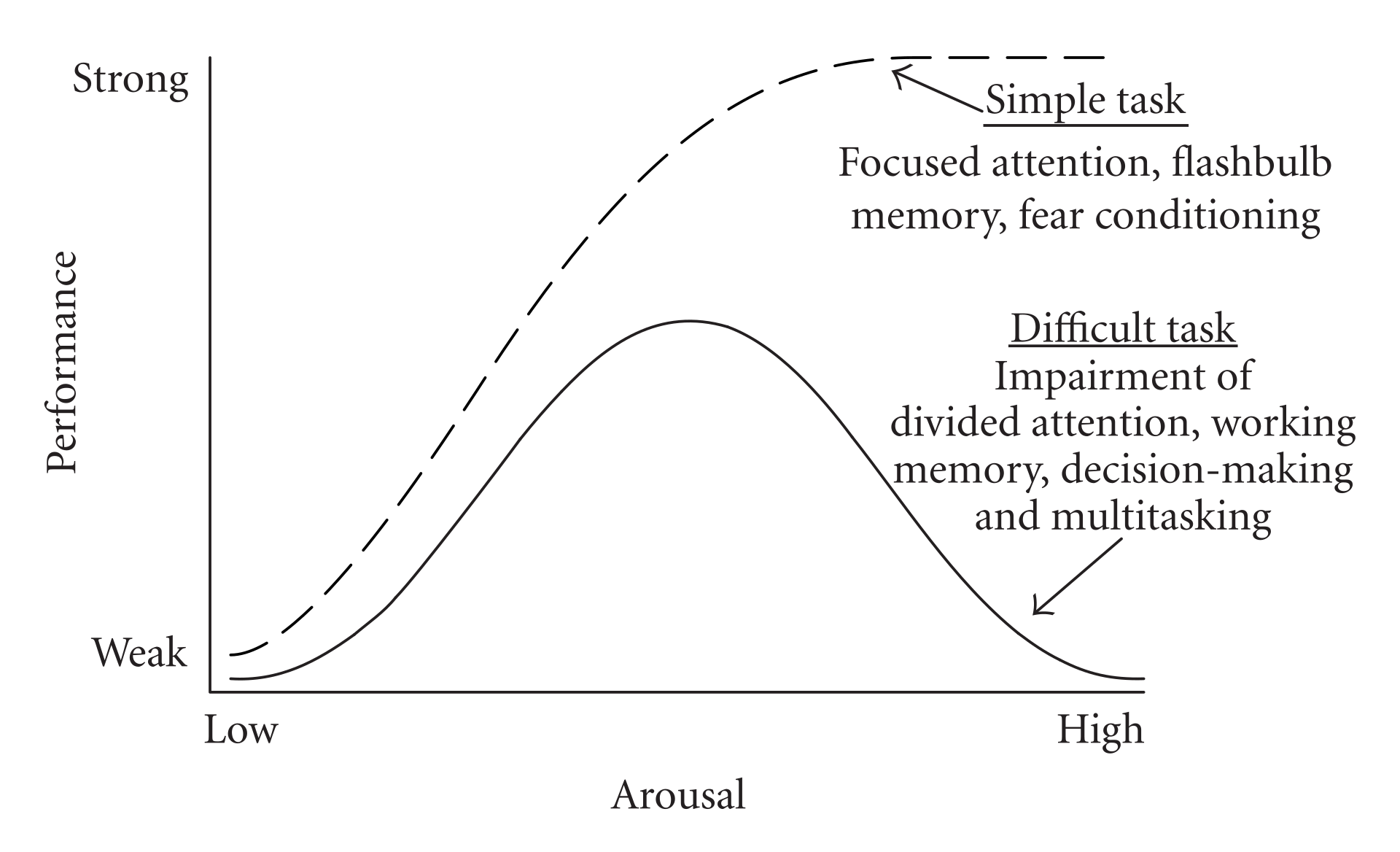
Your nervous system has an arousal dial. At one extreme: deep sleep (zero arousal). At the other extreme: panic (maximum arousal). Performance happens somewhere between these extremes.
Back in 1908, Robert Yerkes and John Dodson discovered something fundamental: The relationship between arousal and performance isn't linear. It's an inverted U-shape.
At low arousal: You're sluggish. Unfocused. Lethargic. Your brain isn't mobilising sufficient resources. Think of trying to compete or present when you're bored or under-stimulated. Performance suffers.
At moderate arousal: You're alert. Focused. Energised but controlled. Your brain allocates attention effectively. Physical systems are primed without being overwhelmed. This is the optimal zone – often called "the zone" or "flow state" in sport psychology literature.
At excessive arousal: You're panicked. Attention fragments. Physical systems flood with stress hormones. Fine motor control degrades. Working memory narrows. This is where "choking" happens.
By Yerkes and Dodson 1908 - Diamond DM, et al. (2007). "The Temporal Dynamics Model of Emotional Memory Processing: A Synthesis on the Neurobiological Basis of Stress-Induced Amnesia, Flashbulb and Traumatic Memories, and the Yerkes-Dodson Law". Neural Plasticity: 33. doi:10.1155/2007/60803. PMID 17641736., CC0, https://commons.wikimedia.org/w/index.php?curid=34030384
Here's what pressure does: Pressure pushes arousal upward. When stakes and scrutiny increase, your sympathetic nervous system activates. Heart rate climbs. Breathing quickens. Muscle tension increases. Cortisol floods your system.
For someone already at moderate arousal, this push might move them into the excessive zone – and performance collapses. But for someone trained in mental skills, they can regulate arousal. They have techniques to dial it down when it spikes too high or dial it up when it's too low.
Athletes who perform brilliantly under pressure aren't people who naturally stay calm. They're people who've learned to regulate their arousal level intentionally, keeping it in the optimal zone even when external pressure tries to push it higher.
Threat Versus Challenge Mindset
Your brain interprets pressure in one of two fundamental ways: as threat or as challenge.
Threat mindset perceives the situation as dangerous. Resources feel inadequate. Failure seems likely. Your brain interprets the pressure as something to survive rather than something to embrace. This triggers physiological responses that impair performance: cardiovascular efficiency drops, blood vessels constrict, and stress hormones dominate.
Challenge mindset perceives the situation as opportunity. Resources feel adequate. Success seems possible. Your brain interprets the pressure as something to approach rather than avoid. This triggers physiological responses that enhance performance: cardiovascular efficiency increases, blood flow optimises, and helpful hormones like adrenaline mobilise energy without overwhelming your system.
Research demonstrates that athletes operating from challenge mindset under pressure show measurably better cardiovascular responses, faster decision-making, and superior technical execution compared to those operating from threat mindset – even when facing identical pressure situations.
The fascinating part: Mindset is trainable. It's not fixed personality. Specific mental skills shift you from threat toward challenge interpretation. Cognitive reframing techniques, process-focused goals, and pre-performance routines all contribute to cultivating challenge mindset.
Attentional Narrowing and Cognitive Load
Pressure fundamentally alters your attention. Specifically, it narrows attentional focus.
This is evolutionary adaptation. When faced with genuine physical threats, narrowed attention helps: focus on the predator, ignore irrelevant environmental details, direct all cognitive resources toward immediate survival.
But modern performance contexts aren't physical threats. They're complex cognitive and motor tasks requiring broad attentional awareness. You need to notice multiple cues, process information from various sources, and maintain flexible attention.
Perceptual narrowing: You literally see less of the environment. Peripheral vision reduces. You miss relevant cues that would inform better decisions.
Cognitive tunnelling: Your thinking becomes rigid. You fixate on one solution path even when alternatives exist. Creative problem-solving degrades.
Working memory reduction: The mental workspace where you hold and manipulate information shrinks. Complex decisions become harder because you can't juggle as many variables simultaneously.
Additionally, pressure increases cognitive load – the total mental effort required. When you're worried about outcomes, monitoring how you're being evaluated, and ruminating on potential failures, you're using cognitive resources that should be directed toward task execution.
This creates a vicious cycle: Pressure narrows attention and increases cognitive load, which impairs performance, which increases anxiety about outcomes, which further narrows attention and increases cognitive load.
Elite performers break this cycle through trained attentional control. They've practised directing attention deliberately toward task-relevant cues and away from pressure-related distractions. They've reduced the cognitive load of pressure through mental skills that become automatic.
The Self-Monitoring Trap
Under pressure, people become intensely self-aware. You start monitoring your own performance whilst you're performing.
"Am I doing this correctly?" "How am I appearing to others?" "What if I make a mistake here?" "My hands are shaking – everyone can see"
This explicit self-monitoring is catastrophic for performance. Here's why:
Most skilled performance operates at an implicit, automatic level. Your brain has chunked together sequences of actions through extensive practice. You don't consciously think through every micro-movement or decision. The skill flows.
But when you shift into explicit monitoring mode, you de-automatise these skills. You're now trying to consciously control actions that perform better when left to automatic processing. Performance psychology consultants call this "paralysis by analysis".
Think about walking down stairs. You do it automatically thousands of times. But if you suddenly become hyper-aware and start consciously monitoring each step placement, you'll stumble. Pressure creates this same self-monitoring for complex skills.
Research using brain imaging shows that when people choke under pressure, there's increased activation in areas associated with explicit monitoring and control – precisely the opposite of what happens during optimal performance, where these regions quiet down and automatic processes dominate.
Mental skills training specifically targets this: it teaches you to keep attention external (on the task) rather than internal (on yourself), and to trust automatised skills rather than trying to consciously control them under pressure.
Why Mental Skills Training Works
Given these mechanisms – arousal dysregulation, threat mindset, attentional narrowing, and self-monitoring – mental skills training works because it provides specific countermeasures:
Pre-performance routines regulate arousal and shift attention away from outcomes toward process.
Process goals reduce threat mindset by focusing on controllables rather than uncontrollable results.
Attentional control counteracts pressure-induced narrowing by training broad, flexible attention.
Self-talk strategies interrupt rumination and self-monitoring, redirecting focus externally.
Visualisation builds familiarity with pressure situations, reducing their novelty and threat value.
Each skill addresses a specific way pressure impairs performance. Together, they form a comprehensive system that allows you to perform at your skill level even when stakes and scrutiny peak.
This isn't mystical. It's applied neuroscience and psychology. Your brain is trainable. These skills are learnable. And research demonstrates they work reliably when practised systematically.
Now let's break down each skill in detail, then I'll show you exactly how to apply them to your specific performance arena.
5 Mental Skills I Recommend to Elite Athletes Use
In my work with Olympic athletes, I ask them to develop these five mental skills systematically through deliberate practice. These skills aren’t “nice-to-have” extras – they’re core competencies that separate those who perform brilliantly under pressure from those who don’t. Let’s examine each skill in depth, then I’ll address how they apply across different domains.
Skill 1: Pre-Performance Routines
Purpose:
Pre-performance routines serve three critical functions. First, they regulate arousal level, bringing you into the optimal zone regardless of how anxious or under-stimulated you feel beforehand. Second, they provide a sense of control in situations where many variables are uncontrollable – you cannot control the crowd, the competitors, the judges, or the outcomes, but you can control your routine. Third, they shift attention from outcome-focused worry toward process-focused readiness.
Explanation:
A pre-performance routine is a consistent sequence of physical and mental actions performed immediately before executing a high-stakes task. The key word is consistent – you perform exactly the same sequence every time, creating a trained trigger that your nervous system recognises.
The routine typically lasts 60-180 seconds and includes physical components (breathing exercises, specific movements, postural adjustments) and mental components (visualisation snippets, power words, attentional focus cues). The specific actions matter less than the consistency and the psychological functions they serve.
Research in motor learning and sport psychology shows that pre-performance routines work through several mechanisms:
Automaticity: When you've performed the routine hundreds of times, it triggers automatic neural patterns associated with optimal performance states. Your brain recognises the sequence and responds with the trained psychological and physiological state.
Attentional anchoring: The routine focuses your attention on specific, controllable actions rather than allowing it to wander toward anxiety-provoking thoughts about outcomes or evaluation.
Arousal regulation: Physical components like controlled breathing directly activate the parasympathetic nervous system, countering excessive sympathetic activation (the fight-or-flight response).
Temporal consistency: The routine creates predictable timing before performance, reducing the uncertainty and unfamiliarity that pressure situations often create.
Elite performers across domains – not just sport – develop these routines. Surgeons have pre-procedure protocols. Musicians have pre-performance warm-ups. Military units have pre-mission briefing sequences. They all serve the same psychological functions.
The power lies in training the routine extensively in low-pressure contexts first, so that when high-pressure moments arrive, the familiar routine triggers the familiar psychological state automatically. You're not trying to create calmness or focus in the moment – you're simply executing the trained trigger, and your nervous system responds with the response you've conditioned over hundreds of repetitions.
Before crucial presentations, negotiations, or high-stakes meetings, establish a 3-5 minute pre-performance routine that becomes your consistent trigger.
Example sequence: Arrive 10 minutes early. Review only your opening statement and key transition points (not the entire presentation – that increases cognitive load). Perform two minutes of box breathing (4-second inhale, 4-second hold, 4-second exhale, 4-second hold). Execute a power pose in a private space – research shows expansive postures for two minutes increase testosterone and decrease cortisol, priming confidence. Use a specific affirmation statement that focuses on process, not outcome: "I've prepared thoroughly. I'll speak clearly and respond to questions thoughtfully." Finally, perform a physical trigger – perhaps a specific shoulder roll or hand gesture – that signals "ready."
The sequence becomes a trained pattern. After 20-30 repetitions in lower-pressure contexts (team meetings, practice presentations), when you execute it before the board presentation that determines your promotion, your nervous system recognises the sequence and automatically shifts into the performance state you've conditioned.
Business executives often resist routines as "superstitious" or unnecessary. But the neuroscience is clear: routines work by creating trained neural patterns that regulate arousal and attention. They're not superstition. They're applied psychophysiology.
Academia
Before thesis defences, conference presentations, or high-stakes exams, develop a consistent pre-performance routine that addresses the specific anxieties academia creates – impostor syndrome, fear of expert scrutiny, worry about appearing unprepared.
Example sequence: Begin 24 hours before the event by reviewing your conceptual framework and core argument (not every detail – that creates information overload). The night before, perform a 5-minute visualisation of the opening moments going smoothly. On the day, arrive 30 minutes early to familiarise yourself with the physical space (reducing environmental uncertainty). Fifteen minutes before, find a quiet space and perform three cycles of diaphragmatic breathing whilst mentally rehearsing your opening statement. Five minutes before, review one index card with your main thesis statement and three supporting pillars. Finally, use a physical trigger – perhaps adjusting your posture to upright and confident – before entering the room.
Academic contexts create particular pressure because of the emphasis on intellectual performance and the presence of expert evaluators. A well-designed routine counteracts this by anchoring you in controllable actions rather than allowing worry about evaluation to dominate.
The routine also serves a crucial function in managing the long build-up period that academic performances often involve. Unlike sport, where competition happens quickly, academic defences might loom for weeks or months. The routine provides concrete actions to execute in those final hours, preventing paralysis from rumination.
Military/High-Risk
Before operations, missions, or high-stakes training exercises, military units already use formalised pre-mission protocols. These serve identical psychological functions to individual pre-performance routines.
At the unit level: standardised briefing formats that ensure all members receive the same information in the same sequence. Equipment checks performed in identical order every time. Rehearsals of contingency plans following consistent structure. Team synchronisation moments that build cohesion and shared readiness.
At the individual level: personal pre-mission routines that nest within the larger unit protocols. Example: A soldier might perform a specific equipment check sequence (weapon, communications, medical kit, ammunition – always in that order), followed by a moment of controlled breathing, followed by mental rehearsal of first contact protocol, followed by a physical readiness check (joint mobility, gear adjustment), concluded with a specific thought pattern or phrase that signals psychological readiness.
The military context adds unique elements: routines must account for team coordination, they must function under severe environmental constraints (limited time, hostile conditions, equipment limitations), and they must manage fear directly (unlike most business or academic pressure, military operations involve genuine physical danger).
Having worked as a military officer, I can affirmatively say that pre-mission routines are most effective when they balance standardisation (for team coordination) with personalisation (for individual psychological readiness). Units that allow individuals to embed personal routines within collective protocols show better performance under operational pressure than units that mandate completely uniform routines for all personnel.
The routines also serve a critical function in managing the transition from waiting to action – one of the most psychologically challenging aspects of military operations. The routine provides structured activity during the final moments before engagement, preventing rumination and building a sense of control when many variables remain uncontrollable.
Skill 2: Process Goals vs Outcome Goals
Purpose:
Process goals shift attention away from uncontrollable results toward fully controllable actions, reducing threat mindset and providing clear, executable focus under pressure. They counteract the tendency to fixate on winning, rankings, evaluations, and other outcomes that pressure makes salient but which you cannot directly control through your immediate actions.
Explanation:
Goals come in two fundamental types:
Outcome goals focus on results: winning the competition, earning the promotion, getting accepted to the programme, closing the deal, achieving a specific score or ranking. These are end-states that depend partly on your performance but also on factors beyond your control – competitors' performance, judges' preferences, market conditions, others' decisions.
Process goals focus on executable actions: maintaining technique under fatigue, asking clarifying questions during negotiations, executing your race strategy at specific markers, focusing attention on relevant cues, applying the framework you've practised. These are actions you can control completely, regardless of external circumstances.
Research consistently demonstrates that process-focused performers maintain better performance under pressure than outcome-focused performers. The mechanism is straightforward: When you focus on outcomes under pressure, you're thinking about stakes (which increases anxiety) and monitoring results you cannot fully control (which increases frustration when things don't go as planned). When you focus on process, you're directing attention toward executable actions, which provides clear guidance for what to do next and maintains a sense of control.
Process goals also prevent a common pressure trap: outcome interference. When you're thinking about winning whilst competing, or about promotion whilst presenting, you're splitting cognitive resources between task execution and outcome monitoring. Process goals keep all cognitive resources directed toward task execution.
There's a paradox here: Process focus produces better outcomes than outcome focus. Elite performers don't ignore outcomes – they care deeply about results. But they've learned that the path to good outcomes is through rigorous process focus during performance. Think about outcomes during planning and evaluation. Execute process during performance.
This doesn't mean you never set outcome goals. Outcome goals provide direction and motivation – "I want to qualify for the championship", "I want to secure this client", "I want to publish in this journal". But these serve planning functions. During actual performance under pressure, you shift entirely to process.
For comprehensive frameworks on effective goal-setting that integrates both process and outcome goals appropriately, see our detailed guide on goal-setting in sport and exercise.
Application Across Domains:
Business
In negotiations, presentations, and client meetings, outcome fixation creates paralysis. You're thinking "I must close this deal" or "I need to impress these executives" while executing the communication strategies you've prepared.
Process goals for high-stakes negotiation: "Ask three clarifying questions to understand their true constraints", "Listen without interrupting for first five minutes", "Propose value-based solutions grounded in their stated priorities", "Reference our previous successful partnership specifically", "If they raise concerns, acknowledge them before reframing".
These are entirely within your control. Whether they ultimately sign the contract depends on numerous factors beyond your immediate actions. But you can execute this process perfectly regardless of their final decision.
Process goals for team presentations: "Make eye contact with each board member at least twice", "Pause for three seconds after presenting key data", "Transition between sections using the prepared bridge phrases", "If questioned, acknowledge the question, provide evidence-based response, ask if that addresses their concern".
Notice the specificity. Vague process goals like "present confidently" don't work – they're too abstract to direct attention and behaviour. Effective process goals specify exact actions you can execute and evaluate.
Business contexts particularly benefit from process goals because outcomes often involve multiple stakeholders and extended timelines. You might present brilliantly and still not get approval because of budget constraints unrelated to your performance. Process goals let you separate your performance quality from results, maintaining motivation and learning even when outcomes disappoint.
Academia
Academic performance anxiety often stems from outcome fixation: "I must defend successfully", "I need to get this accepted", "I have to prove I belong here". These thoughts amplify pressure without providing any guidance for what to do.
Process goals for thesis defence: "Articulate methodology in three clear sentences", "When challenged, acknowledge the limitation before explaining my rationale", "Use the framework diagram to explain theoretical contribution", "If I don't know an answer, say so directly and propose how I could address it in revisions", "Connect findings to the three papers I cited in Chapter 2".
Process goals for manuscript revision responding to peer review: "Address each reviewer comment separately with supporting evidence", "Acknowledge valid criticisms before explaining changes", "Add three specific citations to strengthen theoretical framing", "Revise Methods section to clarify sampling decisions", "Write response letter that demonstrates engagement with feedback".
Academic culture often reinforces outcome focus – publications count, rankings matter, admissions decisions define success. But during performance moments, this focus impairs execution. Process goals provide the psychological anchor that allows you to perform at your capability level.
The academic context also creates particular process-goal challenges because many academic tasks are intellectual and less concrete than physical skills. "Think clearly" isn't an effective process goal. But "start with definition, then explain mechanism, then provide evidence" is – it specifies the intellectual structure you'll execute.
Military/High-Risk
Military operations involve life-or-death stakes – the ultimate outcome pressure. Yet military training emphasises process focus relentlessly: execute the procedure, follow the protocol, complete the checklist, trust the system.
This isn't bureaucracy. It's applied psychology. Under extreme pressure, outcome focus ("don't die", "don't let teammates get hurt", "complete the mission") creates paralysis or panic. Process focus ("execute movement protocol", "maintain communication discipline", "assess threats systematically", "follow Rules of Engagement") provides executable guidance.
Process goals for tactical operations: "Clear corners using pie technique", "Communicate position before moving", "Assess threat level before engaging", "Maintain spacing with team", "Execute contingency protocol if contact occurs".
Process goals for high-risk technical operations (EOD, medical, piloting): "Perform checklist in sequence without skipping steps", "Verify measurements twice before action", "Maintain communication discipline with support team", "If anomaly detected, stop and consult protocol before proceeding".
Military environments demonstrate process goals' value most clearly. When failure means casualties, outcome focus becomes paralysing. Process focus keeps attention on executable actions, maintaining performance capacity even when stakes are absolute.
The military also shows how process goals integrate with team performance. Individual process goals must align with team process goals. A soldier executing their individual process perfectly whilst ignoring team coordination protocols creates mission failure. Effective process goals in team contexts specify both individual actions and team coordination points.
Skill 3: Attentional Control
Purpose:
Attentional control maintains focus on task-relevant cues whilst filtering out distractions, internal worry, and irrelevant environmental stimuli. It counteracts pressure-induced attentional narrowing and the tendency for attention to fragment across threats, evaluation concerns, and outcome worries when stakes are high.
Explanation:
Attention is fundamentally limited. You cannot attend to everything in your environment simultaneously. Your brain selects certain information to process whilst suppressing other information. This selection process is normally automatic and adaptive – you attend to relevant cues without conscious effort.
Pressure disrupts this automatic selection. Several things happen:
Attentional narrowing: Your field of awareness constricts. You literally perceive less of your environment. This is evolutionary – narrow focus helps when facing physical threats. But modern performance requires broad awareness.
Attentional capture by threat cues: Your attention gets pulled toward threat-related information – the evaluators' facial expressions, the competitor making a move, the timer counting down. These might be somewhat relevant, but they're rarely the most important information for task execution.
Internal distraction dominance: Under pressure, internal thoughts (worry, self-doubt, outcome concerns) compete with external task cues for attention. Often the internal thoughts win, pulling attention away from the task entirely.
Attentional control is the trained ability to direct attention deliberately. It involves:
Selective attention: Focusing on relevant cues whilst ignoring irrelevant information. A musician focuses on musical phrase and technical execution, not audience size or judges' reactions.
Divided attention: Distributing attention across multiple relevant streams when necessary. A surgeon monitors patient vital signs, surgical field, team communication, and procedure steps simultaneously.
Attention shifting: Moving attention flexibly between different task elements as needed. An athlete shifts from pre-performance focus to in-performance focus to post-performance evaluation, each requiring different attentional allocation.
Sustained attention: Maintaining focus over extended periods despite fatigue, boredom, or distraction. Academic writing requires hours of sustained attention without performance decay.
Elite performers develop sophisticated attentional control through thousands of hours of deliberate practice. They've trained specific attentional routines for their performance contexts: where to look, what to focus on, how to redirect attention when it drifts, how to broaden or narrow attention based on task demands.
The training involves both external attention (focusing on environmental cues) and internal attention (monitoring body sensations, thoughts, emotional states). But crucially, it prioritises external attention during performance. Research shows that external focus produces better motor performance than internal focus for most skilled tasks.
High-stakes business presentations create attentional chaos. You're trying to deliver content whilst monitoring audience reactions, worrying about time, noticing your trembling hands, thinking about career implications, tracking slides, and listening for questions.
Attentional control for presentations: Primary focus goes to three elements: audience micro-expressions (are they engaged or confused?), logical flow of argument (am I building the case systematically?), and transition points (have I signalled shifts between sections?). Secondary monitoring includes: time remaining and slide position. Filtered out: hand tremor, colleague opinions forming, career consequences, mistakes made earlier, comparison to others' presentations.
Training this: During practice presentations, explicitly direct attention to the three primary elements. When you notice attention drifting toward filtered-out concerns, actively redirect. "Attention back to audience reactions. What do I see right now?" Over 10-20 practice sessions, this redirection becomes more automatic.
Attentional control for negotiations: Primary focus: Their specific words (not your interpretation – their actual phrasing), non-verbal signals indicating openness or resistance, opportunities to ask clarifying questions. Filtered out: Your anxiety about whether you'll succeed, time pressure, your performance evaluation, their perceived power.
Business contexts create particular attentional challenges because of multitasking demands. You're often performing whilst simultaneously monitoring others' reactions, managing time, and tracking complex information. Effective attentional control involves clear prioritisation: What's the most important information stream right now? Direct primary attention there. Monitor other streams peripherally.
Academia
Academic performance involves heavy cognitive load – you're accessing complex information from memory whilst simultaneously presenting it clearly and monitoring for questions or challenges.
Attentional control for thesis defence: Primary focus during your presentation: the conceptual framework you're explaining, the logical connections you're making, the evidence supporting each claim. Primary focus during questions: the specific question being asked (listen completely before formulating response), the underlying concern behind the question, the evidence in your research that addresses it. Filtered out: examiners' expressions of skepticism, worries about whether you're appearing competent, time anxiety, concerns about specific gaps you know exist.
Attentional control for conference presentations: Primary focus: connecting your research to the broader conversation this audience cares about, signalling transitions clearly so audience can follow, maintaining energy despite reading fatigue. Filtered out: impostor syndrome thoughts, concerns about Q&A period, comparison to previous presenters.
Academic contexts particularly challenge attentional control because the pressure often comes from intellectual evaluation rather than time pressure or physical demands. Your attention gets pulled toward "did I explain that clearly enough?" and "what are they thinking about my argument?" rather than staying focused on the next point you need to make.
Training involves deliberately redirecting attention back to content delivery rather than allowing it to fragment across evaluation concerns. Practice presenting whilst actively ignoring your internal evaluation monitor.
Military/High-Risk
Military operations demand extraordinary attentional control because the environment includes genuine threats (requiring attention), team coordination (requiring attention), mission objectives (requiring attention), and numerous distractions (fear, fatigue, environmental chaos) that you must filter out.
Attentional control for tactical operations: Primary focus: immediate tactical cues (movement in environment, threat indicators, team positioning), communication from team, mission phase checkpoints. Maintained awareness of: rules of engagement, contingency triggers, medical considerations. Filtered out: fear responses, fatigue sensations, "what if" catastrophising, family concerns, career implications.
Attentional control for technical operations under pressure: Primary focus: procedure step being executed right now, measurement or assessment being conducted, verification protocols. Monitored: team communication, time constraints, environmental changes. Filtered out: consequences of failure, reputation concerns, physical discomfort, external observers.
Military training explicitly develops attentional control through graduated exposure to increasingly chaotic environments. You learn to maintain focus on mission-critical cues even when explosions, gunfire, shouting, and physical danger create massive attentional competition.
The military context also demonstrates the importance of trained attentional routines. Under extreme stress, attentional control degrades toward automatic patterns. If your trained pattern is "focus on threat", you'll focus on threats. If your trained pattern is "focus on tactical protocol", you'll focus on tactical protocol even when threats are present. This is why training emphasises procedure adherence obsessively – it builds the attentional pattern that will emerge under maximum stress.
Skill 4: Self-Talk Strategies
Purpose:
Self-talk strategies regulate emotion, direct attention, build confidence, and interrupt destructive thought patterns that pressure situations trigger. They provide the internal dialogue that either supports or sabotages performance under pressure, replacing automatic negative patterns with trained constructive patterns.
Explanation:
Self-talk is your internal dialogue – the running commentary in your mind about what's happening, what you're doing, what might happen, and what it means. Everyone engages in self-talk constantly, though most people don't notice or control it.
Under pressure, self-talk typically becomes:
Negative: "I can't handle this", "Everyone will judge me if I fail", "I'm not good enough", "This is too hard".
Outcome-focused: "I must win", "I need to impress them", "Don't mess this up".
Catastrophising: "If I fail here, everything falls apart", "One mistake and it's over", "This could ruin everything".
This automatic self-talk undermines performance through multiple mechanisms. It increases anxiety, fragments attention, triggers self-monitoring, and activates threat mindset.
Elite performers train specific self-talk patterns that counteract these automatic patterns. Performance psychology research distinguishes two types of constructive self-talk:
Instructional self-talk guides action and directs attention. It tells you what to do: "Focus on the target", "Breathe deeply", "Execute the technique", "One step at a time". Instructional self-talk keeps attention external and process-focused.
Motivational self-talk regulates emotion and builds confidence. It manages your psychological state: "You've done this successfully many times", "Trust your preparation", "Stay composed", "You can handle this". Motivational self-talk maintains optimal arousal and challenge mindset.
Effective self-talk has specific characteristics:
Brief: Short phrases or single words work better than lengthy internal speeches. "Breathe" is more effective than "I need to make sure I'm breathing properly to stay calm".
Positive framing: Focus on what to do, not what to avoid. "Maintain form" beats "don't slouch".
Present-focused: Direct attention to current action, not past mistakes or future outcomes. "This shot" not "the score"
Personalised: Developed through trial and error to find what resonates for you specifically.
Training self-talk involves three steps: First, become aware of your current automatic self-talk patterns – what do you say to yourself under pressure? Second, deliberately script constructive alternatives for common pressure situations. Third, practice these scripted alternatives hundreds of times in lower-pressure contexts until they become your new automatic patterns.
The key insight: Self-talk isn't positive affirmation or empty cheerleading. It's a trained cognitive tool that directs attention and regulates emotion. "You can do this" only works if it's tied to genuine preparation and competence. Otherwise it's wishful thinking that your brain recognises as false.
Business pressure often triggers self-talk focused on evaluation and career consequences: "If I don't impress them, I won't get promoted", "They're judging whether I'm competent", "I can't let anyone see I'm nervous".
Constructive business self-talk requires shifting from outcome/evaluation focus toward process/action focus.
Instructional self-talk for presentations: "Make eye contact now", "Pause after this key point", "Transition to next section", "Show the data clearly". These phrases direct attention toward executable actions rather than allowing worry to dominate.
Motivational self-talk for high-stakes meetings: "I prepared thoroughly", "I bring valuable expertise", "Questions are opportunities to demonstrate depth", "Stay composed and clear". These statements manage emotion and maintain confident but grounded mindset.
Self-talk for challenging moments: When you notice anxiety spiking during a presentation or negotiation, use a reset phrase: "Breathe and refocus", "Back to the process", "One point at a time". This interrupts the anxiety spiral and redirects attention.
Business professionals often resist self-talk strategies as "too soft" or "not practical". But the neuroscience is clear: your internal dialogue shapes your attentional focus, emotional state, and ultimately your behaviour. Leaving self-talk to automatic negative patterns guarantees that pressure will degrade your performance.
Training involves scripting self-talk for common pressure scenarios before they occur. Don't try to generate constructive self-talk in the moment under maximum pressure – your brain defaults to automatic patterns. Instead, develop the phrases in low-pressure reflection, practice them extensively, and let them emerge automatically when pressure arrives.
Academia
Academic pressure triggers particular self-talk patterns related to impostor syndrome and intellectual evaluation: "I don't belong here", "They'll discover I'm not actually that smart", "My research has major gaps they'll expose", "Everyone else is more prepared than I am".
Constructive academic self-talk counters these patterns with evidence-based, process-focused alternatives.
Instructional self-talk for thesis defence: "Start with definition", "Walk through methodology step by step", "Connect to theoretical framework", "If challenged, acknowledge then explain". These guide your cognitive process during the defence.
Motivational self-talk for presentations: "I've spent years on this research – I know it deeply", "My advisors approved this approach", "Questions help me refine my thinking", "I'm here because my work merits examination". These counter impostor syndrome with factual reminders.
Self-talk for managing criticism: When an examiner challenges your work, the automatic response is often defensive self-talk: "They don't understand what I did", "This criticism is unfair", "I'm failing right now". Train alternative responses: "This question helps me see gaps", "I can acknowledge limitations", "Critique strengthens final work".
Academic environments create extended pressure – you might worry about your thesis defence for months before it happens. Self-talk training helps manage this extended anticipatory anxiety. When you notice catastrophic thinking ("What if they reject my entire approach?"), counter with process focus: "I'm prepared for this examination. I'll address questions thoughtfully. The outcome will be determined by the quality of my work and my responses, both of which I've prepared extensively".
Military/High-Risk
Military operations involve managing fear – often the most disruptive emotion for performance. Self-talk in high-risk contexts must address this directly whilst maintaining tactical focus.
Instructional self-talk for operations: "Check corners", "Weapon ready", "Communicate position", "Execute protocol", "Slow is smooth, smooth becomes fast". These phrases direct attention to procedure rather than allowing fear to dominate.
Motivational self-talk for managing fear: "Trained for this exact situation", "Trust your team", "Trust your training", "Fear is normal – execute anyway", "Control what you can control". These acknowledge fear without letting it impair action.
Self-talk for high-stress technical tasks: "One step, then next step", "Verify before acting", "Procedure over speed", "If uncertain, pause and reassess". These maintain careful execution when adrenaline pushes toward rushed action.
Military training explicitly develops self-talk through stress inoculation. You practice executing procedures whilst instructors create chaos, and you simultaneously practice maintaining constructive internal dialogue. The training makes constructive self-talk your automatic response under stress, rather than the catastrophic thinking that comes naturally when facing danger.
The military context also demonstrates that self-talk must be realistic. "Nothing bad will happen" is false and your brain knows it – that self-talk won't work in genuine danger. But "I've trained for this. I can execute my role. I'll respond to what happens" is realistic and effective. Truth-based self-talk works. Fantasy-based self-talk doesn't.
Skill 5: Visualisation / Mental Rehearsal
Purpose:
Visualisation creates familiarity with pressure situations before experiencing them physically, reduces the novelty and threat value of high-stakes contexts, and strengthens neural pathways for skilled execution. It transforms pressure from unknown threat into familiar challenge by providing extensive mental practice of performance under pressure.
Explanation:
Visualisation – also called mental imagery or mental rehearsal – is the systematic practice of creating detailed, multi-sensory mental representations of performance. This isn't daydreaming or vague "imagine success". It's structured cognitive rehearsal following specific principles.
Effective visualisation engages multiple senses:
Visual: See the environment, equipment, people, movements in vivid detail.
Kinesthetic: Feel the physical sensations – muscle tension, movement quality, physical positioning.
Auditory: Hear the sounds – crowd noise, instructions, equipment, breathing.
Emotional: Experience the emotional states – pressure, confidence, determination.
The visualisation can take different perspectives:
Internal (first-person): See and feel from inside your own body, as you would during actual performance.
External (third-person): Watch yourself from outside, like viewing video footage.
Research shows both perspectives have value, and elite performers often combine them.
Here's what makes visualisation powerful: Brain imaging studies show that mental practice activates the same neural regions as physical practice. When you vividly imagine performing a skill, you're strengthening the same neural pathways involved in actually performing it.
This has profound implications. You can practice performing under pressure without needing actual pressure situations. You can rehearse handling challenges that haven't occurred yet. You can experience success repeatedly, building confidence and familiarity.
But visualisation isn't magic. It follows specific principles for effectiveness:
Specificity: Visualise exact environments, exact sequences, exact challenges you'll face. Not generic success – specific scenarios.
Realism: Include difficulties, not just perfect execution. Visualise making a mistake and recovering. Visualise unexpected challenges and your adaptive response.
Controllability: Start with simple scenarios you can vividly imagine, then progress to more complex visualisations as your skill develops.
Regularity: Daily practice, 10-15 minutes, over weeks or months. One visualisation session does little. Consistent practice creates meaningful effects.
Elite athletes commonly report visualising specific competitions hundreds of times before actually competing. They've mentally rehearsed every likely scenario, every challenge, every recovery from difficulty. By competition day, their brain has already succeeded hundreds of times. The actual performance is just one more execution of a pattern they've rehearsed extensively.
For comprehensive guidance on developing effective visualisation practices, see our detailed article on visualisation in sport and exercise.
Application Across Domains:
Business
Business professionals often dismiss visualisation as too "woo-woo" for corporate environments. But Fortune 500 executives, successful entrepreneurs, and elite negotiators use mental rehearsal systematically because it works.
Visualisation for presentations: Three weeks before your board presentation, begin daily 10-minute visualisation practice. See the boardroom (specific room if you know it, generic professional setting if not). See yourself entering, connecting laptop, starting presentation. See the board members' faces. Hear yourself delivering your opening statement with clear, confident voice. Feel your posture – upright, grounded. See yourself advancing through slides, making eye contact, pausing after key points. Crucially: visualise a challenge – perhaps skeptical question about costs – and see yourself responding thoughtfully: acknowledging the concern, presenting your ROI analysis, maintaining composure.
Repeat this visualisation 20-30 times before the actual presentation. Each repetition strengthens the neural pathway. By presentation day, your brain has delivered this presentation 30 times successfully. The actual delivery feels familiar, not novel.
Visualisation for negotiations: Mentally rehearse the negotiation environment. See the other party. Hear yourself asking the clarifying questions you've prepared. Feel yourself listening attentively without rushing to respond. See yourself proposing value-based solutions. Visualise them raising concerns, and see yourself acknowledging without becoming defensive. Experience the emotional steadiness you want to maintain.
This isn't naive positive thinking – "I'll imagine they say yes and that makes it happen". It's realistic preparation: You're rehearsing the process you can control (asking good questions, listening carefully, responding thoughtfully) not the outcome you can't control (their final decision).
Business visualisation particularly benefits from including setbacks: Visualise technology failing and how you proceed smoothly anyway. Visualise difficult questions and your composed responses. Visualise time pressure and your adjustment. This inoculates you against panic when these challenges actually occur.
Academia
Academic pressure often builds over extended periods – you might know about your thesis defence for months. Visualisation transforms this anticipatory period from mounting anxiety into productive mental preparation.
Visualisation for thesis defence: Beginning six weeks before your defence, establish daily 10-15 minute visualisation practice:
Week 1-2: Visualise the opening sequence. See yourself entering the room. See the examiners. Hear yourself delivering your opening summary of the research. Feel the controlled breathing that keeps you calm. See yourself explaining your conceptual framework clearly.
Week 3-4: Add challenges. Visualise an examiner asking about methodology limitations. See yourself acknowledging the limitation, explaining your rationale for the approach chosen, proposing how future research could address it. Feel yourself staying composed during critique.
Week 5-6: Visualise complete defence sequences, including both smooth sections and challenging exchanges. Experience yourself finishing the defence feeling you represented your work well, regardless of the specific outcome.
The academic context benefits from visualisation because so much anxiety comes from uncertainty about what will happen. Mental rehearsal reduces that uncertainty by pre-experiencing many possible scenarios. You're psychologically prepared because you've already handled these situations mentally.
Visualisation for conference presentations: See the lecture hall. See the audience of field experts. Hear yourself connecting your research to the themes this conference community cares about. Feel the confidence that comes from knowing you've prepared thoroughly. Visualise finishing and handling questions thoughtfully, demonstrating your expertise without arrogance.
Include realistic difficulties: Visualise someone checking their phone during your talk. See yourself continuing smoothly, not interpreting it as evidence your work is boring. Visualise a challenging question you can't answer fully, and see yourself saying directly, "That's an excellent question I haven't fully resolved. Here's what I'm thinking about it currently, and here's how I'd approach investigating it further".
Military/High-Risk
Military operations involve coordinated team action under pressure, often in environments that are difficult to physically replicate in training. Mental rehearsal bridges this gap.
Visualisation for missions: In the week preceding an operation, units conduct detailed mental rehearsals of mission phases:
See the terrain (using maps, photos, imagery). See your team's positions. See the movement patterns you'll execute. Hear the communication protocols you'll use. Feel the physical sensations – equipment weight, movement tempo, environmental conditions.
Crucially: Visualise contact scenarios and your trained responses. See threats appearing and your tactical response according to training. Experience yourself executing under pressure rather than panicking. Feel the controlled arousal state – alert but not panicking.
Military mental rehearsal emphasises contingency planning. You don't just visualise perfect execution. You visualise the mission going wrong in specific ways and your adaptive response following protocols. This mental preparation for setbacks is often what separates effective performance from breakdown when actual operations encounter unexpected challenges.
Visualisation for technical procedures under pressure: See the procedure environment. See your equipment. Visualise executing each step of the procedure in correct sequence. Feel the precision and carefulness each step requires. See yourself verifying before acting, never rushing despite time pressure.
Visualise discovering an anomaly or unexpected problem. See yourself pausing, consulting protocol, communicating with support team, executing proper response rather than improvising. Experience staying methodical despite adrenaline.
The military context demonstrates visualisation's power for team coordination. Units can mentally rehearse together, with each member visualising their specific role whilst maintaining awareness of team roles. This shared mental model improves actual coordination under operational pressure.
You've just learned five mental skills that elite performers use systematically to excel under pressure. But knowing about these skills isn't enough – you need to develop them through deliberate practice.
Now let's examine how these five mental skills combine in specific Olympic sports, then I'll show you exactly how to build your personal pressure performance system.
💌
Stay Ahead! Subscribe to my bi-monthly newsletter Psychquania – research-backed strategies on performance, resilience, and wellbeing delivered straight to your inbox!
Olympic sports provide the ultimate laboratory for understanding pressure performance. Athletes train for years for single moments where everything is on the line. Let’s examine how the five mental skills we’ve covered apply to four distinct Olympic disciplines (I’m using these four as examples; you can certainly transfer these skills to other domains as well), each with unique pressure characteristics.
Sport 1: Gymnastics
Pressure Elements:
Gymnastics creates extraordinary pressure through several mechanisms. First, performances occur in absolute silence – the crowd goes quiet, making every sound magnified. Any wobble, any adjustment, becomes amplified aurally. Second, judging is partly subjective – you're being evaluated on artistry and execution quality, introducing uncertainty about how your performance will be scored. Third, routines involve sequences where early mistakes cascade – bobble the landing on one element and your rhythm disrupts subsequent elements. Fourth, injury risk is high – the mental awareness that mistakes mean physical danger adds threat value. Finally, performances are brief – four minutes or less determines outcomes from four years of preparation.
Working with elite gymnasts, I have found that these pressure elements trigger specific psychological challenges: excessive self-monitoring (watching yourself perform rather than just performing), attentional narrowing (losing awareness of spatial position and timing), and arousal dysregulation (anxiety spiking before or during routines).
Mental Skills in Action:
Pre-Performance Routines: Gymnasts develop precise pre-routine sequences lasting 20-60 seconds before each apparatus. Example: Deep breath, visualise first skill, chalk hands with specific motion pattern, power word ("strong"), establish starting position. This routine becomes their psychological trigger. After hundreds of repetitions in training, executing the routine automatically shifts them into performance state regardless of Olympic pressure.
The routine serves crucial functions in gymnastics: it provides temporal consistency (the same timing before every routine), creates attentional anchoring (focus on familiar actions rather than crowd or judges), and regulates arousal (breathing component activates calming physiological responses).
Process Goals vs Outcome Goals: Instead of "land everything perfectly" or "score high enough for medal", gymnasts train process goals: "Complete each skill before thinking about next one", "Full extension on every movement", "Controlled landings with bent knees", "Maintain rhythm regardless of errors".
Gymnastics particularly benefits from process goals because of the sequential nature – thinking ahead to later elements whilst performing current elements causes mistakes. Process goals anchor attention on the present skill being executed.
Attentional Control: The silent environment in gymnastics makes attentional control critical. Gymnasts train to maintain focus exclusively on kinesthetic feedback (body position, movement quality) and spatial awareness (distance to apparatus, orientation). They filter out: crowd silence (which many find unsettling), judges' positions, competitors' scores displayed on monitors, time passing.
Research shows elite gymnasts use predominantly internal focus during skill execution (attending to body sensations and movement quality) with brief shifts to external focus during transitions between elements. This differs from many sports where external focus dominates.
Self-Talk Strategies: Gymnasts develop specific self-talk for different phases. During pre-routine: "Trust your training. You've done this thousands of times." During execution: Minimal instructional cues only – "tight", "extend", "breathe" – because extensive self-talk disrupts automatic skill execution. Between apparatus: Motivational self-talk to recover from mistakes – "Reset. Next routine is clean slate."
Gymnastics teaches an important principle: self-talk volume and content should match task demands. Complex motor skills require minimal self-talk to avoid disrupting automaticity. Strategic planning or emotional regulation phases can accommodate more extensive internal dialogue.
Visualisation: Gymnasts mentally rehearse routines daily, often multiple times per routine. The visualisation includes: seeing each skill from internal perspective (as they'll experience it), feeling the kinesthetic sensations of proper technique, hearing the ambient sounds they'll perform in, and experiencing the emotional steadiness they want to maintain.
Critically, visualisation includes recovering from errors: visualise a wobble on beam, then see yourself stabilising and completing the routine strongly. This prepares them psychologically to continue performing even when things don't go perfectly.
Sport 2: Track and Field (Sprinting)
Pressure Elements:
Sprint events create unique pressure through extreme brevity and explosive intensity. 100m races last under 10 seconds – half a decade of training compressed into one explosive effort. This creates psychological challenges: no time for recovery from poor starts, no time for strategic adjustment, and intense awareness that microscopic differences in execution determine outcomes.
Additionally, sprinting involves reaction time to starting gun – athletes must explode instantly without anticipating (false start disqualification). This requires managing arousal carefully: high enough to explode powerfully, not so high that you jump the gun.
The transparent outcome nature adds pressure – unlike gymnastics where judging introduces uncertainty, sprint results are absolute and public. Everyone immediately sees who won, who lost, and by exactly how much. There's no ambiguity to soften disappointment.
Mental Skills in Action:
Pre-Performance Routines: Sprinters develop precise pre-race sequences lasting 2-5 minutes. Example: Specific warm-up movement pattern (high knees, butt kicks, practice starts – always in same order), approach blocks with deliberate pace, set blocks with specific hand pressure check, perform power visualisation (3-5 seconds seeing explosive start), deep breath, settle into blocks using specific physical positioning sequence.
The routine serves arousal regulation particularly – bringing arousal into the explosive-but-controlled zone needed for optimal start reaction and acceleration. Research shows that consistent pre-race routines significantly improve start reaction times compared to variable or absent routines.
Process Goals vs Outcome Goals: Sprint process goals focus on technique execution rather than time or placement: "Explode on gun", "Drive phase with powerful knee lift", "Maintain form through finish line", "Run through the line, not to the line".
Sprinting demonstrates process goals' paradoxical nature: thinking about running fast makes you run slower (outcome focus), thinking about executing technique properly makes you run faster (process focus). The mechanism: outcome focus creates tension and disrupts optimal movement patterns, whilst process focus keeps attention on elements that produce speed.
Attentional Control: Sprinters must manage a unique attentional challenge: broad awareness in starting blocks (to detect gun and react) narrowing to tunnel vision during the race itself (focusing exclusively on lane and finish line).
The trained attentional sequence: In blocks – neutral-broad attention, ready to react to gun without anticipating. At gun – attention explodes outward with movement. During acceleration – attention narrows to drive phase mechanics and powerful movement. During max velocity – attention narrows further to maintaining form and driving toward finish line. At finish – attention on running through the line, not slowing before it.
This demonstrates that attentional control isn't static – it's dynamically adjusted based on task phase. Training involves practicing these attentional shifts until they become automatic with the physical movements.
Self-Talk Strategies: Sprint self-talk is minimal during the race itself (too fast for extensive internal dialogue) but crucial before and after.
Pre-race instructional self-talk: "Explosive", "Powerful", "Drive". Single-word cues that prime the movement quality desired.
Pre-race motivational self-talk: "You're ready", "Trust your start", "This is your race".
Post-race self-talk particularly matters for managing disappointment: Sprinters often run multiple races (heats, semifinals, finals) in short succession. Poor first race can't be allowed to degrade second race performance. Self-talk helps reset: "That race is done. Next race, fresh start. Execute the process."
Visualisation: Sprinters engage in explosive, brief visualisations that match the event duration. Rather than 10-minute meditation sessions, sprint visualisation involves repeated 10-15 second mental rehearsals of the complete race: feeling settled in blocks, hearing gun, explosive drive, powerful acceleration, maintaining form through finish.
The repetition matters more than duration – a sprinter might mentally rehearse the race 50-100 times in competition week. Each rehearsal strengthens the neural pattern: blocks → gun → explosion → drive → maintain → finish. By race day, this pattern is so deeply ingrained that execution becomes nearly automatic.
Sport 3: Swimming
Pressure Elements:
Swimming creates pressure through isolation and internal feedback dependency. Once the race starts, you receive no external information – no crowd feedback, no clock visible, limited awareness of competitors' positions. You're alone with your stroke, your breathing, your racing strategy, and your internal sensations.
This isolation means pressure manifests internally. You're managing arousal, executing strategy, and maintaining technique entirely through internal regulation without external guidance. The turn sequences add complexity – each turn is a technical moment where small execution errors cost significant time.
The transparent timing system adds pressure – swimmers know their splits precisely, creating temptation to monitor pace obsessively rather than executing process. Additionally, false starts are limited – one false start disqualifies the entire heat, creating extreme pressure on starting reactions.
Mental Skills in Action:
Pre-Performance Routines: Swimmers develop routines starting in warm-up pool and continuing through race preparation. Example: Specific warm-up sequence (same stroke drills, same order, same durations), mental rehearsal in warm-up (visualise race strategy for 60-90 seconds), approach blocks with specific timing, stretch sequence (always same stretches in same order), power word whilst waiting ("fast" or "strong"), settle into starting position with specific hand grip and body position.
The routine is particularly important in swimming because of the long wait times – often sitting in ready room for 20-30 minutes before racing. The routine provides structured actions that manage anxiety during this waiting period.
Process Goals vs Outcome Goals: Swim process goals focus on stroke technique, strategy execution, and controllable actions: "Long strokes maintaining technique", "Powerful underwater kicks off each turn", "Breathe every three strokes regardless of oxygen demand", "Hit pace target at 50m mark", "Execute turn sequence: approach tight, flip fast, push powerful, streamline until breakout".
Swimming demonstrates process goals' power in managing the information vacuum. You can't control competitors' speed, you can't fully control your time. But you can control technique execution, strategy adherence, and turn quality. Process goals keep attention on these controllables.
Attentional Control: Swimming requires managing attentional allocation between multiple internal streams: stroke technique (are you maintaining form as fatigue builds?), breathing pattern (maintaining rhythm without gasping), pace feedback (internal sense of effort level matching race strategy), and limited external awareness (wall approaching for turns, competitor position peripherally).
Elite swimmers train specific attentional priority sequences. Example for 200m race: Start – attention on explosive reaction and entry. First 50m – attention on establishing race pace and rhythm. Second 50m – attention on maintaining technique as lactate builds. Third 50m – attention on strategy execution (hold pace or adjust based on plan). Final 50m – attention on maximum effort whilst maintaining enough technique for propulsion.
The training involves thousands of race-pace repeats where they practice directing attention according to these priorities until it becomes automatic.
Self-Talk Strategies: Swimming self-talk must account for breathing constraints – you can't maintain extensive internal dialogue when oxygen is limited.
Instructional self-talk uses brief cues: "Long", "Power", "Kick", "Turn". These single-word cues direct attention to technique elements without cognitive overload.
Motivational self-talk matters most in middle portions of races when pain builds: "You trained for this pain", "Others are hurting too – you're stronger", "Hold your pace", "This is where you win the race".
The self-talk also helps manage the isolation: "Trust your strategy", "You know where you are", "Execute your race, not theirs". These statements counter the uncertainty that swimming's information vacuum creates.
Visualisation: Swimmers mentally rehearse races extensively with particular emphasis on kinesthetic and auditory components (more important than visual given the underwater environment).
Effective swim visualisation: Feel the starting position tension, hear the starting beep, feel the explosive entry, feel the underwater streamline and breakout, feel the stroke rhythm and breathing pattern, hear the echo of pool noises (muffled underwater sounds, clear above-water sounds), feel the turn approach and execution, feel the final sprint and touch.
Swimmers often visualise with eyes closed in dark or low-light conditions, enhancing the kinesthetic focus that matches actual swimming experience. This differs from sports where vivid visual imagery dominates.
Sport 4: Wrestling
Pressure Elements:
Wrestling creates pressure through direct physical confrontation, tactical complexity, and exhaustion management. Unlike sports where you compete against clock or judges, wrestling involves an opponent actively trying to defeat you, creating reactive pressure – you must execute your strategy whilst simultaneously adapting to their attempts to defeat your strategy.
The weight-cutting process adds pressure – many wrestlers compete dehydrated and energy-depleted after making weight. The scoring system creates strategic complexity – you must balance aggressive point-scoring attempts with defensive positioning to prevent giving up points. The match duration (typically 6-8 minutes at elite level) is brief enough that poor starts are recoverable but long enough that fatigue becomes a significant factor.
The one-on-one nature creates particular psychological pressure – there's no team to hide behind, no one else to credit or blame. Victory and defeat are entirely individual and visible.
Mental Skills in Action:
Pre-Performance Routines: Wrestlers develop pre-match routines that begin during warm-up and continue through match start. Example: Specific warm-up sequence (same drills, same duration), tactical reminder review (not extensive mental review of all techniques, just core strategic reminders), breathing and movement protocol during break periods, physical activation sequence before taking mat (specific movement pattern that primes explosive readiness), mental set phrase ("impose my pace", "control center"), starting position setup with specific posture.
Wrestling routines must balance two needs: physical warm-up sufficient for explosive performance and mental calm sufficient for tactical decision-making. The routine creates this balance through sequencing: initial warm-up emphasises physical preparation, final minute emphasises psychological preparation.
Process Goals vs Outcome Goals: Wrestling process goals focus on tactical execution and effort: "Control center of mat", "Make him carry my weight", "Shoot on my setups, not desperation", "Defend without giving up position", "Increase pace in second period", "Keep pressure – make him work constantly".
Wrestling particularly benefits from process goals because matches often involve momentum swings – early deficit can't be allowed to create panic and abandonment of strategy. Process goals maintain tactical discipline: even when losing, you continue executing the process that creates scoring opportunities.
Attentional Control: Wrestling demands exceptionally flexible attentional control. You must maintain simultaneous awareness of multiple elements: opponent's position and movement (primary), your body position relative to opponent, referee position (relevant for out-of-bounds), match time and score (secondary), opportunity recognition for attacks, and threat assessment for defence.
Elite wrestlers develop what researchers call "tactical attention" – the ability to recognise patterns in complex, rapidly changing situations and respond appropriately. This isn't conscious analysis during the match (too slow). It's trained pattern recognition that becomes automatic through thousands of hours of drilling scenarios.
The attentional training involves deliberately practicing attention shifting: drilling where coach calls "score" or "time" or "position" and wrestler must instantly report what they notice about that element. This builds attentional flexibility crucial for match performance.
Self-Talk Strategies: Wrestling self-talk must manage pain, fatigue, and tactical reminders simultaneously.
Instructional self-talk provides tactical cues: "Hand control", "Posture", "Circle", "Set it up", "Move your feet". These brief cues maintain tactical discipline when exhaustion tempts you to abandon technique.
Motivational self-talk maintains aggressive intent: "Break him", "My pace", "He's fading – you're not", "Finish strong", "This is your match". Wrestling is psychological battle as much as physical – the wrestler who maintains aggressive mindset despite fatigue often wins.
The self-talk also manages the unique challenge of extended physical contact with another person who's trying to dominate you. Some wrestlers report discomfort with this intimate combat. Self-talk helps: "This is wrestling – embrace the fight", "Comfortable being uncomfortable", "This is where I want to be".
Visualisation: Wrestlers mentally rehearse both offensive and defensive scenarios extensively. Visualisation includes:
Offensive sequences: See and feel executing specific attacks – level change, penetration step, finish. Feel the opponent's resistance and your counters to that resistance.
Defensive scenarios: Feel the opponent attacking, your defensive response, the transition from defense to counter-attack.
Tactical situations: Visualise being ahead late in match and maintaining lead (different tactics than when chasing points). Visualise being behind and executing comeback strategy (maintaining composure, creating opportunities).
Wrestling visualisation emphasises the kinesthetic – feeling your body position, feeling the opponent's weight and pressure, feeling the explosive movements. It also includes the psychological elements: experiencing the decision to attack despite fatigue, experiencing staying tactical despite desire to abandon strategy and just scrap.
The physical contact nature of wrestling makes visualisation particularly valuable – you can mentally practice against ideal opponent responses without needing training partner availability or physical recovery time between sessions.
🎖️
Ready to dive deeper? Paid members get tailored strategies, tactics, case studies, advanced techniques, and more!
Olympic pressure is extreme, but you don't need to compete at the Olympics to face performance situations where stakes matter and scrutiny is intense.
Job interviews determine career trajectory. Board presentations influence promotion decisions and organisational direction. Thesis defences culminate years of academic work. Combat operations involve life-or-death stakes. Performances determine artistic reputation and career opportunities. Championship competitions crown winners and fade competitors.
Different contexts. Identical psychological demands: perform your best when it matters most.
The five mental skills we've covered – pre-performance routines, process goals, attentional control, self-talk strategies, and visualisation – transfer directly to these non-Olympic pressure contexts. Let's examine exactly how to apply them in different performance arenas.
Business Executives & Leaders
Your Pressure Moments:
Business creates diverse pressure situations, each with specific psychological challenges:
Quarterly presentations to investors or board: Stakes include funding decisions, board confidence, career advancement. Scrutiny is intense – experienced executives evaluating your strategic vision and execution capacity. Time is limited – you have 20-45 minutes to convey complex information and build confidence. Questions can be aggressive, with board members testing your command of details and challenging assumptions.
High-stakes negotiations: Whether securing major clients, finalising acquisitions, or negotiating partnerships, these conversations determine significant financial outcomes and relationships. The psychological challenge involves maintaining composure whilst reading subtle signals, adapting strategy in real-time, and making consequential decisions with incomplete information.
Crisis management under board/media scrutiny: When organisational crises occur – PR disasters, financial problems, operational failures – leaders must make decisions quickly whilst facing intense evaluation. The added layer: your decisions are public, and mistakes become permanently part of your professional record.
Product launches or major announcements: These moments culminate months or years of work. Success builds momentum; failure can derail entire initiatives. The pressure comes from knowing that many people's work depends on this moment going well.
Performance reviews or promotion decisions: When your own career advancement is being determined, the pressure shifts from professional to personal. You're being evaluated, and the outcome significantly affects your life trajectory.
Mental Skills Application:
Pre-Performance Routines:
Develop a consistent 5-10 minute pre-performance routine for high-stakes business situations. The routine must be practical within business contexts (you can't meditate for 30 minutes before a board meeting) whilst still serving the psychological functions of arousal regulation and attentional anchoring.
Example board presentation routine:
Timing: Begin 15 minutes before presentation start.
Physical preparation (3-4 minutes): Arrive at venue, confirm technology works (laptop connects, slides display correctly, clicker functions). This reduces uncertainty and provides sense of control. Do not rehearse the entire presentation at this point – that increases cognitive load rather than reducing it. Simply verify logistics.
Cognitive preparation (2-3 minutes): Review only your opening 60 seconds and your key transition points. Write these on a single index card you'll keep nearby (not reading from it, just as security backup). This focuses attention on structure rather than trying to hold all content actively in working memory.
Physiological regulation (2-3 minutes): Find a private space (bathroom, empty office, stairwell). Perform power posing for 2 minutes – research shows this increases testosterone and decreases cortisol, priming confidence. Follow with box breathing (4-4-4-4 pattern) for four cycles. This activates parasympathetic nervous system, countering excessive arousal.
Mental preparation (1-2 minutes): Use a specific affirmation that focuses on process rather than outcome. Not "They'll approve this and I'll get promoted". Instead: "I've prepared thoroughly. I'll present clearly. I'll respond to questions thoughtfully". This primes challenge mindset (you have resources) rather than threat mindset (you might fail).
Physical trigger (15 seconds): Immediately before entering the room, perform a specific gesture that signals readiness – perhaps rolling shoulders back and adjusting posture to upright confidence. This serves as the final trigger, telling your nervous system "performance mode now".
The routine becomes trained over 20-30 lower-pressure presentations. By the time you face the career-defining board presentation, executing the familiar routine automatically shifts you into the performance state you've conditioned.
Process Goals:
Business outcomes depend on numerous factors beyond your immediate control – board members' prior opinions, organisational politics, budget constraints, competitive landscape, economic conditions. Fixating on these during performance creates anxiety without providing guidance for what to do.
Process goals for presentations keep attention on executable actions:
"Make eye contact with each board member at least twice in first 10 minutes" (establishes connection and lets you gauge engagement levels).
"Pause for 3 seconds after presenting each key data point" (allows information to register and prevents rushed, nervous delivery that undermines confidence).
"When transitioning between sections, use the prepared bridge phrases" (maintains logical flow and prevents tangent wandering that dilutes message strength).
"If challenged on assumptions, acknowledge the challenge, present supporting evidence, then ask if that addresses the concern" (maintains collaborative tone rather than defensive posture).
These process goals guide attention and behaviour regardless of how the board responds. Even if they ultimately don't approve your proposal, you can execute this process perfectly. This separation between performance quality (controllable) and outcomes (partially uncontrollable) maintains motivation and learning regardless of results.
Process goals for negotiations:
"Ask three clarifying questions before making any proposal" (ensures you understand their actual constraints and priorities rather than making assumptions).
"Listen without interrupting for the first five minutes" (demonstrates respect and often reveals information they wouldn't share if you dominated early conversation).
"When they raise concerns, acknowledge specifically what they said before reframing" (shows you heard them, builds rapport, makes them more receptive to your perspective).
"Reference our previous successful partnership specifically by name and outcome" (builds credibility through demonstrated track record rather than abstract promises).
Notice these are entirely within your control. Whether they ultimately agree depends on many factors. But you can execute this process perfectly regardless of their decision.
Attentional Control:
Business pressure creates attentional chaos. During a high-stakes presentation, your attention wants to fragment across: content you're presenting, audience reactions, your performance anxiety, time remaining, mistakes you made earlier, what comes next, career implications, colleagues' judgments, and comparison to others.
Train attentional priority hierarchies:
Primary attention during presentations: Audience micro-expressions (are they engaged, confused, resistant, or receptive?), logical flow of your argument (am I building the case systematically or jumping around?), transition moments (have I signalled shifts clearly so they can follow?).
Secondary monitoring: Time remaining (glance at clock every few minutes), slide position (ensuring you haven't skipped or repeated).
Filtered out: Your hand tremor, your voice quality, colleagues' opinions forming, career consequences, your performance relative to others, minor stumbles earlier, what you'll have for dinner.
The training occurs in lower-pressure contexts. During practice presentations, deliberately direct attention to the primary elements. When you notice attention drifting toward filtered-out concerns, actively redirect: "Attention back to audience reactions. What am I seeing right now?" Over 15-20 practice sessions, this attentional priority pattern becomes more automatic.
Attentional control for negotiations requires different patterns:
Primary attention: Their specific words (not your interpretation – their actual phrasing), non-verbal signals (body language, facial expressions, energy level), opportunities to ask clarifying questions (recognising moments when they're inviting deeper engagement).
Secondary monitoring: Time pressure (if deadline looms), their emotional state (escalating or de-escalating), your own emotional regulation (am I becoming defensive?).
Filtered out: Your anxiety about success, the deal size (financial stakes), their perceived power position, your performance evaluation.
The key insight: Attentional control isn't about suppressing distractions permanently. It's about noticing when attention drifts and deliberately redirecting it back to priority elements. This redirection skill is trainable through practice.
Self-Talk Strategies:
Business pressure triggers outcome-focused, evaluative self-talk: "If I don't close this deal, I'll miss quota", "They're judging whether I'm competent for promotion", "I can't let anyone see I'm nervous", "What if they ask something I don't know?"
This self-talk increases anxiety, fragments attention, and provides no guidance for what to do. Trained business self-talk shifts toward process-focused, action-oriented internal dialogue.
Instructional self-talk for presentations:
"Make eye contact now", "Pause here", "Transition to data section", "Show the visual", "Slow down – I'm rushing". These brief phrases direct attention toward specific, executable actions rather than allowing worry to dominate.
Motivational self-talk for high-stakes meetings:
"I prepared thoroughly – I know this material", "Questions are opportunities to demonstrate depth", "I bring valuable expertise they need", "Stay composed and clear". These statements manage emotion and maintain confident-but-grounded mindset without sliding into arrogance or false bravado.
Self-talk for recovering from challenges:
When you notice anxiety spiking during performance (your mind starts catastrophising – "this is going badly", "they're not impressed", "I'm losing them"), use a reset phrase: "Breathe and refocus", "Back to the process", "One point at a time, then next point".
When you make a mistake (lose your place, give incorrect information, fumble words), use recovery self-talk: "Acknowledge and continue", "One mistake doesn't define performance", "Stay focused on what's next".
The self-talk training occurs during preparation. Script the phrases before high-pressure moments, practice them during moderate-pressure contexts, and they'll emerge automatically when maximum pressure hits.
Visualisation:
Business professionals often resist visualisation as "too soft" for corporate environments, but research and practical application demonstrate effectiveness.
Visualisation for board presentations (begin 3 weeks before):
Week 1-2: Daily 10-minute visualisation of entering the boardroom, setting up, delivering your opening statement with confident voice and clear pacing, making eye contact with board members, advancing to your first key data point. Keep visualisation focused on opening sequence – don't try to mentally rehearse the entire 30-minute presentation (that's cognitively overwhelming). Repeat this opening sequence visualisation until it feels familiar and smooth.
Week 2-3: Add challenge scenarios. Visualise a skeptical CFO interrupting with budget concern. See yourself pausing, acknowledging her point directly, transitioning smoothly to your ROI analysis slide, presenting the supporting evidence, maintaining composed body language throughout. Visualise finishing your response and asking, "Does that address your concern?" Experience her micro-expression shifting from resistant to considering.
Final week: Visualise complete presentation sequences, including both smooth sections and challenging exchanges. Experience yourself finishing strong regardless of specific reactions, feeling you represented your work well and handled challenges professionally.
The repetition matters more than duration. Twenty 10-minute visualisation sessions create more benefit than two hour-long sessions. You're building neural familiarity with the situation through repeated mental exposure.
Visualisation for negotiations (begin 2 weeks before):
See the negotiation environment – the specific room if you know it, or a generic professional setting if not. See the other party across the table. Hear yourself asking the clarifying questions you've prepared. Feel yourself listening attentively without rushing to fill silence. See yourself proposing value-based solutions that address their stated priorities. Visualise them raising concerns, and see yourself acknowledging those concerns without becoming defensive or dismissive.
Crucially: Don't visualise them agreeing enthusiastically or accepting immediately. That's wish fulfillment, not preparation. Instead, visualise the process you can control (thoughtful questions, careful listening, evidence-based proposals, professional handling of objections) without determining the outcome they ultimately choose.
This realistic visualisation prepares you for actual negotiation complexity rather than setting up false expectations that create disappointment when reality proves messier.
Thesis or dissertation defence: Years of research culminate in a 1-3 hour examination by field experts. The stakes are absolute – your degree completion depends on this performance. The scrutiny is intense and intellectually focused – examiners are specifically looking for gaps, limitations, and conceptual weaknesses. The uncertainty is high – you don't know exactly what they'll ask or which aspects they'll challenge most heavily.
Conference presentations to field experts: Unlike general audiences, conference attendees know your topic deeply. They'll spot conceptual errors, methodological limitations, or overclaimed findings immediately. Your scientific reputation within the field develops through these presentations – perform well and establish credibility, perform poorly and damage career opportunities.
Grant proposal interviews or defence: Funding decisions determine your research capacity for years. Panel members evaluate both your scientific merit and your ability to execute the proposed work successfully. The competition is intense – many strong proposals compete for limited funding.
Job talks for academic positions: You're presenting research whilst simultaneously being evaluated as a potential colleague. The dual assessment (research quality and professional fit) creates layered pressure. Multiple stakeholders with different priorities (department chair, dean, students, faculty) evaluate simultaneously.
Manuscript revision responses to peer review: While not live performance pressure, responding to reviewer criticism under revision deadlines creates sustained stress. The written performance determines publication outcomes that significantly affect career progression.
Mental Skills Application:
Pre-Performance Routines:
Academic defences and presentations involve long build-up periods – you might know about your thesis defence for months. The routine must manage this extended anticipatory anxiety whilst still providing acute pre-performance preparation.
Example thesis defence routine:
48 hours before: Review your conceptual framework and core argument structure (one page summary you've prepared in advance). Do not attempt to re-read your entire dissertation – that creates information overload and increases anxiety by highlighting everything you could have done better. Simply refresh your high-level narrative: What's the central question? What's your answer? What's the evidence?
Night before: Perform 5-minute visualisation of walking into the room, seeing your examiners, delivering your opening summary calmly. Then, engage in unrelated relaxing activity (watch something entertaining, light reading, time with friends) – do not work on preparation further. Your brain needs rest, not additional cramming.
Morning of: Arrive 30 minutes early to familiarise yourself with the physical space. Knowing where you'll sit, where examiners will be positioned, and how the room feels reduces environmental uncertainty. This matters more than most people realise – physical space familiarity creates psychological comfort.
15 minutes before: Find a quiet, private space. Perform diaphragmatic breathing (place hand on abdomen, ensure it expands with each inhale) for three minutes. This directly counteracts the shallow chest breathing that anxiety produces. Follow with brief mental rehearsal of your opening statement only – speak it aloud quietly to yourself. This primes your voice and verbal fluency without creating cognitive overload.
5 minutes before: Review one index card with your thesis statement and three main supporting pillars. This card serves as psychological security – you won't read from it, but knowing it's available reduces anxiety. Use power word or phrase: "I'm prepared", "I've earned this", or simply "Ready".
Immediate pre-performance: Adjust posture to upright, grounded confidence. Take one deep breath. Enter the room.
This sequence serves multiple functions: reduces uncertainty (through physical space familiarisation), regulates arousal (through breathing exercises), focuses attention (through opening statement rehearsal), and provides sense of control (through the structured actions replacing anxious rumination).
Process Goals:
Academic outcomes depend substantially on factors you cannot control: examiners' theoretical preferences, standards that vary between institutions, timing of degree completion relative to job market conditions, peer reviewers' expertise alignment with your work.
Process goals for thesis defence:
"Articulate methodology in three clear sentences without jargon" (demonstrates command of your approach whilst remaining accessible).
"When challenged, acknowledge the limitation before explaining my rationale" (shows intellectual honesty and prevents defensive posture that irritates examiners).
"Use framework diagram at slide 3 to explain theoretical contribution" (employs visual aid that clarifies complex conceptual relationships).
"If asked something I don't know, say directly 'I don't know' then propose how I could address it in future work" (intellectual honesty is valued more than fumbling fake answers).
"Connect findings to the three foundational papers I built from: Author A for theory, Author B for methods, Author C for context" (demonstrates your work's position within existing literature).
These are fully within your control. Even if examiners ultimately identify significant revisions needed, you can execute this process perfectly. Separating performance quality from outcome quality maintains learning and improvement regardless of immediate results.
Process goals for conference presentations:
"Open by connecting my research question to the broader conversation this audience cares about" (establishes relevance rather than assuming they'll recognise it).
"Signal transitions between sections explicitly – 'Having established X, I'll now show Y'" (helps audience follow logical structure in oral presentation where they can't flip back like in written work).
"When showing data, state finding before displaying slide, then walk through evidence" (focuses attention on interpretation rather than getting lost in visual complexity).
"Save two minutes for questions – don't rush at end trying to cover everything" (demonstrates time management and confidence that core message has been conveyed).
Process goals for manuscript revision:
"Address each reviewer comment with specific paragraph or section reference" (shows thoroughness rather than generic "we addressed this" responses).
"When reviewers disagree with each other, acknowledge both perspectives explicitly before explaining my decision" (demonstrates you engaged with feedback thoughtfully rather than simply choosing convenient interpretation).
"Add three specific citations that strengthen theoretical framing in Introduction" (concrete action that likely addresses reviewer concern about theoretical grounding).
"Revise Methods section to clarify sampling decisions paragraph by paragraph" (systematic approach prevents missing key clarification points).
These process goals provide clear guidance for what to do during revision work rather than getting overwhelmed by "make this better somehow".
Attentional Control:
Academic pressure creates particular attentional challenges because the evaluation focuses on intellectual performance – your thinking quality, not just action execution.
Attentional control for thesis defence:
During your presentation portion:Primary attention: The conceptual framework you're explaining right now (stay in present section, don't jump ahead mentally to later parts), the logical connections you're making (does this follow from the previous point?), the evidence supporting each claim (am I being specific or vague?).
Secondary monitoring: Time remaining (glance at clock each major section transition), examiners' body language (engaged or disconnected?).
Filtered out: Their facial expressions of skepticism (which you may be misinterpreting anyway), your voice tremor, the questions you fear they'll ask later, the implications for your career, comparison to previous defences you've attended.
During questioning:Primary attention shifts: The specific question being asked (really listen – don't formulate answer while they're still speaking), the underlying concern behind the question (what's really worrying them about this?), the evidence in your research that addresses this concern.
Filtered out: Whether they're testing you or genuinely confused, how this reflects on your competence, what others are thinking, the time this is taking.
The training for this attentional control occurs during practice defences with advisors or peers. Deliberately practice listening completely to questions without internal commentary about what the question means about your work quality.
Attentional control for conference presentations:
Primary attention: Audience comprehension signals (nods, note-taking, or confusion, phone-checking), pacing (am I rushing or dragging?), logical flow (did I just make a clear transition?).
Secondary monitoring: Time remaining, whether technical elements (slides, video, audio) are working properly.
Filtered out: Senior scholars in audience (their presence creates pressure but you can't perform differently for them vs. others), recording or social media (some conferences record – awareness of this cannot improve your talk so filter it out), your comparison to other presenters.
Academic pressure particularly triggers impostor syndrome thoughts that fragment attention. Notice when attention shifts to "I don't belong here" or "Everyone else is smarter", and deliberately redirect: "What's the next point I'm making? What evidence supports it?" The redirection strengthens with practice.
Self-Talk Strategies:
Academic environments cultivate particular destructive self-talk patterns related to impostor syndrome, perfectionism, and intellectual evaluation.
Instructional self-talk for thesis defence:
"Start with definition", "Walk through methodology step by step", "Connect to theoretical framework now", "If challenged, acknowledge then explain", "Use diagram to clarify". These phrases guide your intellectual process during the defence.
Motivational self-talk for managing impostor syndrome:
"I've spent [X] years on this research – I know it more deeply than anyone", "My committee approved my proposal and progress – they believe this is valuable work", "Questions indicate engagement, not rejection", "I'm here because my work merits examination, not because I fooled anyone".
These statements counter impostor syndrome with factual reminders rather than empty affirmations.
Self-talk for handling criticism:
When an examiner challenges your methodology or questions your interpretation, the automatic defensive response is common. Self-talk helps: "This question helps me see my work from another angle", "I can acknowledge limitations without it invalidating everything", "Critique strengthens the final work".
Self-talk for managing perfectionism:
Academic culture often reinforces perfectionism ("this needs more work", "have you considered...", "but what about..."). This creates paralysis. Counter it: "Good enough to defend means defensible, not flawless", "All research has limitations – mine aren't uniquely disqualifying", "I can improve this after defending – defense requirements are not publication requirements".
The self-talk training happens during the extended preparation period. When you notice catastrophic thinking ("What if they reject my entire framework?"), practice countering it immediately: "I'm prepared for critical examination. I'll address challenges thoughtfully. The work quality justifies defense". Repeat this pattern enough times and it becomes your automatic response under pressure.
Visualisation:
Academic defences benefit enormously from extended visualisation practice because the long lead time allows building deep familiarity.
Visualisation for thesis defence (begin 6-8 weeks before):
Weeks 1-2: Visualise the opening sequence daily for 10 minutes. See the room (your actual room if you've visited it, generic seminar room if not). See your examiners sitting at the table. See yourself walking in with confident posture. Hear yourself delivering your opening summary – the 2-3 minute overview of your research question, approach, and contribution. Feel your breathing steady and controlled. Experience delivering this opening clearly and hearing yourself sound competent.
Weeks 3-4: Add challenge scenarios. Visualise an examiner asking about methodology limitations. See yourself pausing briefly (not rushing to answer), acknowledging the limitation directly, explaining your rationale for the approach you chose, proposing how future research could address this limitation differently. Feel yourself staying composed during this exchange rather than becoming defensive.
Weeks 5-6: Visualise extended exchange sequences. See yourself presenting a findings chapter. See an examiner interrupting with a question about interpretation. See yourself addressing it. See another examiner building on that question with a different angle. See yourself engaging thoughtfully with multiple perspectives. Experience the intellectual engagement without the emotional panic that such exchanges can trigger.
Final weeks: Visualise complete defence sequences, including not just the ideal scenario but also realistic challenges – forgetting a citation, stumbling over an explanation, needing to draw on the board to clarify a point. See yourself recovering smoothly from these imperfections and continuing strong.
The repetition builds psychological familiarity. By defence day, you've already defended successfully in your mind 40-50 times. The actual defence is just another instance of a pattern you've rehearsed extensively.
Visualisation for conference presentations:
See the lecture hall. See the audience – a mix of senior scholars, peers, and students. Hear yourself connecting your research to the themes this conference community cares about. Feel the confidence that comes from knowing you've prepared thoroughly. Visualise finishing and fielding questions thoughtfully – hearing a question, pausing to consider, responding with evidence from your research, acknowledging when you don't have a complete answer.
Include realistic difficulties: Visualise someone checking their phone during your talk (happens frequently). See yourself continuing smoothly, not interpreting it personally. Visualise technical issues (slide won't advance). See yourself handling it calmly rather than panicking.
Academic visualisation particularly benefits from including the intellectual dynamics – mentally rehearse explaining complex concepts clearly, fielding challenging questions, connecting disparate ideas. This cognitive rehearsal strengthens the thinking patterns you'll need to deploy under examination pressure.
Military Personnel / High-Risk Operations
Your Pressure Moments:
Military and high-risk operational contexts create unique pressure through direct danger, team dependency, and high-consequence decisions.
Combat operations: Life-and-death stakes create maximum pressure. Split-second decisions determine survival. Team coordination under hostile conditions requires maintaining tactical discipline whilst managing fear. The environment is chaotic, information is incomplete, and enemies actively work to disrupt your plans.
High-risk technical operations: EOD (explosive ordnance disposal), combat medicine, close quarters combat, airborne operations – these specialties involve technical precision under extreme stress. Small errors have catastrophic consequences. Physical danger is present but immediate action is required despite it.
Mission-critical decision-making under uncertainty: Commanders face choices where incomplete information, time pressure, and high stakes combine. Multiple variables, limited options, and imperfect intelligence mean decisions involve managing ambiguity under scrutiny.
Training exercises evaluated for operational readiness: While not actual combat, exercises determine unit certification, individual advancement, and operational deployment decisions. The evaluation pressure, combined with physical and mental demands, creates genuine stress responses.
Mental Skills Application:
Pre-Performance Routines:
Military operations already employ formalised pre-mission protocols. Understanding these through the lens of psychological performance reveals why they work and how to optimise them.
Pre-mission routine structure:
Unit-level protocols:
Standardised briefing format – intel update, mission objectives, phase breakdown, contingency plans, support assets, communications protocols – delivered in identical order every time. This consistency serves psychological function: the familiar briefing pattern becomes a trained trigger that shifts the unit into operational mindset.
Equipment checks in mandated sequence. Not just for safety verification but also for psychological anchoring. The familiar check sequence provides concrete actions that prevent rumination during final pre-mission period.
Rehearsal of contingency protocols. Walking through "if X happens, we do Y" scenarios serves dual purpose: tactical preparation and psychological inoculation. Mentally pre-experiencing challenges reduces their threat value if they occur.
Team synchronisation moment – brief gathering where unit leader reaffirms mission and team confirms readiness. This serves social cohesion function critical for team performance under pressure.
Individual-level routines nested within unit protocols:
Personal equipment check sequence (weapon, ammunition, communications, medical, mission-specific gear) – always same order. The routine becomes automatic through thousands of repetitions, freeing cognitive resources for tactical focus.
Controlled breathing protocol – military personnel are taught tactical breathing (box breathing or similar) explicitly for arousal regulation before high-stress moments.
Mental rehearsal of immediate action drills – visualising first contact protocol, break contact protocol, casualty evacuation protocol. These are trained responses but mental rehearsal reinforces them before actual need.
Physical readiness verification – joint mobility, gear adjustment, hydration check. Ensures physical systems are primed whilst also serving as familiar pre-operation actions.
Mental set phrase or thought – many service members develop personal phrases that signal psychological readiness: "Controlled aggression", "Execute the training", "Trust the team", "Calm, fast, smooth".
The military pre-operation routine demonstrates several principles: it must function under severe constraints (limited time, austere environments, equipment restrictions), it must coordinate individual and team readiness simultaneously, and it must manage genuine fear rather than just performance anxiety.
Process Goals:
Military operations involve uncontrollable outcomes – enemy actions, environmental conditions, intelligence accuracy, equipment functionality. Outcome focus ("complete mission without casualties") creates paralysis. Process focus maintains tactical effectiveness.
Process goals for tactical operations:
"Execute movement protocol: pie corners, check threat areas, communicate before moving" (specific tactical actions you can control completely).
"Maintain communication discipline: position updates every X minutes, clear language, verify receipt" (communication quality is fully controllable).
"Follow Rules of Engagement protocol: PID before engagement, escalation of force sequence, target discrimination" (procedural adherence you can execute perfectly regardless of chaos around you).
"Preserve team integrity: maintain spacing, mutual support positions, 360-degree security" (team coordination actions within your control).
"If contact occurs, execute immediate action drill per training, then assess and adapt" (trained response provides clear action rather than panic).
Process goals are particularly critical in military contexts because outcome stakes are maximum (lives, mission success, national security) whilst controllability is limited (enemies actively work to prevent your success). Process goals provide the psychological anchor that allows executing trained responses even when outcomes remain uncertain.
Attentional Control:
Military operations demand extraordinary attentional control because the environment includes genuine threats requiring attention, team coordination requiring attention, mission objectives requiring attention, plus numerous distractions (fear, fatigue, chaos) demanding attention.
Attentional control for tactical operations:
Primary attention: Immediate tactical cues (movement in environment, threat indicators, potential danger areas), team positioning relative to your position, mission phase checkpoints ("we should be at phase line Alpha now").
Sustained awareness: Rules of Engagement parameters, contingency plan triggers ("if we take fire from north, contingency Charlie"), communication schedule.
Filtered out: Fear responses (acknowledge but don't fixate on), physical discomfort (fatigue, temperature, equipment weight), "what if" catastrophising about possible threats, family concerns, career implications.
The military teaches attentional control explicitly through graduated stress exposure. You learn to maintain focus on tactical priorities even when explosions, gunfire, shouting, physical danger, and time pressure create massive attentional competition.
Attentional control for technical operations under pressure (EOD, medical):
Primary attention: Procedure step being executed right now (singular focus – not the step before or after, just this step), measurement or assessment being conducted, verification protocol for this specific action.
Monitored secondarily: Time constraints, team communication, environmental changes that might affect safety.
Filtered out: Consequences of failure (catastrophising about "what if I make mistake"), reputation concerns ("what will team think if I'm slow"), physical discomfort, external observers or evaluators.
Technical operations demonstrate a key principle: When tasks are complex and high-risk, attentional narrowing to singular focus on current step often produces better performance than trying to maintain broad awareness. The training determines when to use broad attention (tactical operations) vs. narrow attention (technical operations).
Attentional priority in team contexts requires coordination: Each team member focuses on their assigned sector or responsibility whilst maintaining peripheral awareness of teammates' positions and status. This distributed attention allows team to maintain broader collective awareness than any individual could alone.
Self-Talk Strategies:
Military operations involve managing fear – the most disruptive emotion for performance. Self-talk must address this directly whilst maintaining tactical focus.
Instructional self-talk for operations:
"Check corners now", "Weapon up", "Communicate position", "Execute protocol", "Slow is smooth, smooth is fast", "Breathe, then act". These brief phrases direct attention to procedure execution rather than allowing fear to dominate.
The military emphasises specific phrasing for self-talk: brief, imperative, action-focused. Long internal conversations impair rather than support performance under extreme stress.
Motivational self-talk for managing fear:
"Trained for this exact situation", "Trust your team – they've got you", "Trust your training – it works", "Fear is normal – act anyway", "Control what I can control", "Focus on the mission, not the threat".
These statements acknowledge fear without letting it impair action. Military self-talk isn't about denying fear or pretending danger doesn't exist. It's about acknowledging reality whilst maintaining capability to execute trained responses.
Self-talk for high-stress technical tasks:
"One step. Verify. Next step." "Procedure over speed." "If uncertain, stop and reassess." "Follow checklist exactly." "Precision matters more than quickness."
Technical operations require different self-talk than tactical operations – the emphasis shifts from aggressive execution to careful precision. The self-talk reflects this: reminders to slow down, verify, check rather than reminders to move, communicate, execute quickly.
Self-talk for decision-making under uncertainty:
"Gather available information. Decide with what I have. Commit to decision. Execute. Adjust based on outcomes." This sequence self-talk helps manage the discomfort of deciding with incomplete information – which is virtually all military decision-making.
The military explicitly trains self-talk during stress inoculation exercises. Instructors create chaos, add time pressure, introduce simulated casualties or equipment failures, and you simultaneously practice maintaining constructive internal dialogue. This makes constructive self-talk your automatic response under stress rather than the catastrophic thinking that emerges naturally.
Visualisation:
Military operations use mental rehearsal systematically in pre-mission preparation, often more explicitly and formally than most performance domains.
Visualisation for operations (week preceding):
Daily mission rehearsal: Using maps, photos, terrain models, or imagery, units mentally walk through mission phases together. Each member visualises from their individual perspective whilst maintaining awareness of team actions.
Individual visualisation: See the terrain you'll operate in (based on briefing imagery). See your team's positions. See the movement patterns you'll execute. Hear the communication protocols you'll use. Feel the physical sensations – equipment weight, movement tempo, environmental conditions (heat, cold, darkness).
Contingency visualisation: Critically, military mental rehearsal includes extensive contingency practice. Visualise contact scenarios: See threats appearing. See your trained tactical response. Experience yourself executing under pressure rather than panicking. Feel the controlled arousal state – alert, aggressive, but not panicked.
This visualisation of adversity distinguishes military practice from many civilian applications. You don't just rehearse success – you rehearse handling challenges, equipment failures, unexpected enemy actions, casualties. This prepares you psychologically: when challenges actually occur, they match patterns you've already experienced mentally, reducing shock and panic.
Visualisation for technical procedures:
See the procedure environment. See your equipment laid out in standard configuration. Visualise executing each step of the procedure in exact sequence. Feel the precision and carefulness each step requires. See yourself verifying before acting, never rushing despite time pressure or stress.
Visualise discovering anomaly or unexpected condition. See yourself pausing (not rushing), consulting protocol, communicating with support team if available, executing proper response rather than improvising. Experience staying methodical despite adrenaline and pressure.
Team visualisation is particularly powerful: Units mentally rehearse together, with each member articulating their actions whilst others listen and contribute. This builds shared mental models of the operation, improving coordination when actual execution occurs under stress and communication limitations.
Performing Artists
Your Pressure Moments:
Performing arts create unique pressure through subjective evaluation, public vulnerability, and the requirement to execute complex skills whilst simultaneously portraying emotion or character.
Auditions: Career-determining moments compressed into 2-10 minutes. You're being evaluated not just on technical skill but also on indefinable qualities like "presence", "marketability", or "fit". Rejection is standard – even exceptional performers face far more rejections than acceptances. The brief window and subjective evaluation create enormous pressure.
Opening night performances: Culmination of weeks or months of rehearsal. First performance in front of paying audience who've formed expectations. Reviews may be written based on this performance, affecting entire run. Your work is publicly evaluated immediately (unlike many professions where evaluation occurs privately or over extended time).
Competitions with subjective judging: Your performance is compared directly to competitors' performances. Judges' personal preferences, styles, and biases affect outcomes significantly. Rankings and placements create clear hierarchies that affect reputation and opportunities.
Live broadcasts or recordings: Single-take performances where errors become permanent record. No opportunity to try again or claim "I usually do it better". The performance captured becomes your representation potentially forever.
Performances after mistakes or poor reviews: Managing psychological recovery from previous performance problems whilst facing new pressure. The cumulative nature of artistic careers means past performances affect current pressure.
Mental Skills Application:
Pre-Performance Routines:
Performing artists across disciplines (musicians, actors, dancers, visual artists in live contexts) develop extensive pre-performance rituals. Many serve genuine psychological functions even when artists aren't consciously aware of the mechanisms.
Example pre-performance routine for musicians:
Physical warm-up (20-30 minutes before): Specific technical exercises in consistent order. Not practicing the difficult sections of the piece (that increases anxiety by highlighting challenges) but rather familiar patterns that warm up physical systems and provide psychological comfort through familiarity.
Mental transition (15 minutes before): Shift from practice/preparation mindset to performance mindset. Many musicians describe this as "letting go" of technical concerns and connecting to emotional intent of the music. Practically: stop practicing, stop correcting errors, start visualising communicating the musical ideas to audience.
Isolation period (10 minutes before): Find quiet space away from social demands. Some musicians need solitude, others prefer specific social interaction – the key is consistency in what you do during this window. This might involve controlled breathing, light stretching, or brief meditation.
Physical preparation (5 minutes before): Check physical state – tension in shoulders? Breathing shallow or deep? Make specific adjustments: shoulder rolls, jaw release, diaphragmatic breathing. Ensure physical instrument (your body) is prepared.
Mental-emotional connection (2 minutes before): Connect emotionally to the opening moments of the piece. Not technical rehearsal but emotional priming: What does this music communicate? How do I want the audience to experience this? Brief visualisation of the opening phrase.
Physical trigger (immediate pre-performance): Many musicians have specific gesture before starting – particular positioning of instrument, specific breath pattern, moment of stillness. This becomes the trained trigger: after thousands of repetitions, this gesture signals "performance mode".
The routine serves multiple functions: regulates arousal (through breathing and physical preparation), shifts from technical to artistic mindset (through mental transition period), provides control over timing (consistent sequence regardless of venue changes), and creates psychological familiarity (the same routine whether it's practice or Carnegie Hall).
Example pre-performance routine for actors:
Physical warm-up (30-40 minutes before): Voice and body exercises in consistent sequence. This serves both practical function (vocal preparation) and psychological function (familiar actions that trigger performance state).
Character connection (20 minutes before): Some actors review character notes, others use sense-memory techniques, others use music or imagery. The specific method matters less than consistency – whatever helps you access the character mindset becomes part of your ritual.
Social phase (15 minutes before): Many actors require specific social interaction patterns before performing – connecting with castmates, isolation from others, specific interaction with director or crew. The social element serves ensemble cohesion and individual psychological preparation.
Costume and makeup (10 minutes before): The physical transformation serves psychological function – the character emerges as you put on costume elements. Making this sequence consistent (always costume in same order, always makeup in same pattern) strengthens the psychological transformation.
Final preparation (5 minutes before): Brief physical isolation, final vocal check, controlled breathing, connecting to opening moment of performance, personal ritual or phrase.
Physical trigger (immediate pre-entry): Specific breath pattern, posture adjustment, or gesture before entering stage. Signals readiness.
Process Goals:
Performing arts outcomes depend heavily on factors beyond performers' immediate control: judges' personal taste, audience mood that night, venue acoustics, competitors' exceptional performances, industry trends, casting decisions involving appearance or "type".
Process goals for auditions:
"Execute the prepared piece with emotional commitment" (focuses on your controllable performance quality, not on whether they choose you).
"Make strong character choices that demonstrate my interpretation" (shows your artistic perspective regardless of whether it matches what they wanted).
"Respond to direction quickly and incorporate adjustments" (demonstrates professional flexibility).
"Maintain character intention through the full audition period including casual conversation" (many casting decisions happen during informal interaction – process goal keeps you focused on professional presentation throughout).
"If I make technical error, stay in character and continue strongly" (recovery matters more than perfection).
These process goals guide your behaviour fully regardless of outcome. Even if you don't book this audition, you can execute this process perfectly. This separation maintains motivation through the extensive rejection that characterises artistic careers.
Process goals for performances:
"Connect emotionally to each phrase/scene moment" (keeps attention on artistic communication rather than technical execution or audience evaluation).
"Execute technique in service of expression, not for display" (prevents showoff-driven choices that often backfire artistically).
"Maintain character through transitions, not just main sections" (the in-between moments often reveal performance depth).
"React truthfully to scene partners' choices, not to planned blocking only" (maintains alive interaction rather than mechanical repetition).
"If technical error occurs, incorporate it or recover without breaking artistic through-line" (errors will happen – response matters more than prevention).
Performing arts demonstrate process goals' power particularly clearly because artistic evaluation is so subjective. You cannot control what judges or critics think. But you can control commitment, preparation thoroughness, technical execution quality, artistic choices, and professional conduct. Process goals keep attention on these controllables.
Attentional Control:
Performing arts require managing attention between technical execution, emotional expression, ensemble coordination, and audience awareness – simultaneously.
Attentional control for musical performance:
Primary attention: Musical phrase being executed right now (sound quality, intonation, dynamics, articulation), emotional intent of this specific phrase (what am I communicating through these notes?), ensemble coordination if relevant (are we together? am I balancing properly with others?).
Peripheral awareness: Audience energy (engaged or disconnected?), physical state (breathing adequately? tension building in shoulders?).
Filtered out: Mistakes made moments ago (past errors cannot be corrected – attention on them guarantees additional errors), judges' expressions (you cannot read their evaluation accurately during performance anyway), fear of upcoming difficult passage (anticipatory anxiety disrupts present-moment execution), comparison to how you played it in practice (the performance is now – comparing to practice doesn't improve it).
Musicians face a particular attentional challenge: Thinking about technique during performance usually degrades technique. Skilled performance operates largely at automatic level. Conscious monitoring disrupts automaticity. Training involves learning to "trust your fingers" or "trust your training" – letting technical execution occur automatically whilst attention stays on musical expression and communication.
Attentional control for theatrical performance:
Primary attention: Character objective in this moment (what does this character want right now?), scene partner (really listening and reacting, not just waiting for cue to say next line), physical and vocal life of character (embodying fully, not just reciting lines).
Peripheral awareness: Ensemble tempo (scenes have rhythm – are we rushing or dragging?), audience response (laughter, silence, rustling – affects comic timing and pacing).
Filtered out: Self-monitoring ("how am I doing?"), comparison to rehearsal versions ("that's not how we blocked it"), fear of upcoming difficult moment, judgment of castmates' performances, what reviewers might write.
Theatre requires particular attentional flexibility because you're simultaneously being yourself (executing technique) and being someone else (inhabiting character). The attention cannot fully inhabit either but must fluidly shift between technical awareness and character embodiment. Training develops this dual attention capacity.
Self-Talk Strategies:
Performing arts trigger particular self-talk patterns around artistic identity, comparison to others, and subjective evaluation.
Instructional self-talk for performance:
"Breathe here", "Support from diaphragm", "Connect to character want", "Really listen to partner now", "Commit to this choice". Brief phrases that direct technical or artistic focus without lengthy internal monologues that fragment attention.
Performing artists must learn when to use self-talk and when to silence it. Complex motor skills (musical technique, choreographed movement) require minimal self-talk during execution. Emotional or interpretive moments may benefit from brief self-talk cues that prime the desired state.
Motivational self-talk for managing artistic vulnerability:
"I prepared thoroughly – I'm ready to share this", "My interpretation has value even if it differs from others'", "Vulnerability is artistic strength, not weakness", "I trust my training and preparation".
Performing arts create particular vulnerability – you're sharing emotional, artistic work publicly that reveals personal perspective and taste. This triggers self-consciousness. Motivational self-talk counters this without denying the vulnerability.
Self-talk for handling criticism or rejection:
"This evaluation reflects their taste, not my worth", "Subjective judgment is part of this profession – I knew this accepting the career", "This performance taught me X and Y – rejection doesn't erase learning", "Rejection rates are high for everyone in this field – this doesn't make me uniquely bad".
The artistic career involves extensive criticism and rejection. Self-talk helps maintain perspective and motivation through inevitable setbacks.
Self-talk for managing comparison:
Performing artists constantly face comparison – to other performers, to recordings, to audience expectations. This comparison triggers destructive self-talk: "I'll never be as good as X", "Everyone can see I'm not good enough", "I don't belong here".
Countering self-talk: "My artistic voice is distinct – it's not better or worse, it's mine", "Comparison thinking doesn't improve this performance – focus on my communication", "Everyone has strengths and limitations – including those I admire".
Visualisation:
Performing artists often visualise extensively, sometimes without labeling it as such (they call it "mental practice", "running it in my mind", or "hearing it in my head").
Visualisation for auditions:
See the audition environment (waiting area, performance space, panel table). See yourself entering confidently. Hear yourself introducing your piece professionally. Experience delivering your prepared piece with emotional commitment and technical control. Visualise being given direction ("can you try it more urgently?") and adjusting your performance quickly. See yourself finishing, thanking the panel professionally, and leaving with dignity regardless of their response.
Include realistic challenges: Visualise them interrupting mid-performance to give direction ("thank you, we've seen enough"). See yourself handling this with professional grace rather than interpreting it as rejection. Visualise technical difficulty (voice cracks, memory slip) and recovering smoothly without breaking down.
Audition visualisation helps manage the condensed time pressure and evaluative scrutiny that characterises auditions. By pre-experiencing the situation mentally 20-30 times, the actual audition feels less threatening and more familiar.
Visualisation for performances:
Musicians often mentally practice by hearing the piece internally with full sensory detail – hearing each phrase, feeling the physical sensations of playing, experiencing the emotional arc. This isn't vague daydreaming – it's structured mental rehearsal where they "play through" the piece mentally just as they would physically.
Actors mentally rehearse by running scenes internally – seeing the space, hearing their lines and partners' lines, feeling the character's emotional journey, experiencing the physical life of character. Many actors do this in the hours or days before opening, mentally walking through the entire show.
Dancers visualise choreography extensively because physical practice is limited by fatigue and injury risk. Mental practice allows additional "repetitions" without physical stress. See the movement patterns, feel the physical execution, hear the music, experience the performance flow.
The visualisation must include not just perfect performance but also recovery from challenges: Visualise a musical memory slip – you recover by improvising briefly then returning to the score. Visualise a line dropped in theatre – you and scene partner cover organically and continue. Visualise stumbling in dance – you incorporate it as choreographed movement and continue. This mental rehearsal of recovery builds psychological resilience for actual challenges.
Performing artists' visualisation demonstrates several principles applicable across domains: Include sensory detail beyond just visual (auditory and kinesthetic are crucial for performers). Practice both complete run-throughs and challenging moments specifically. Visualise recovery from errors, not just perfect execution. Use visualisation to build familiarity with venue or context when possible (if you know the performance space, visualise that specific space).
🎖️
Ready to dive deeper? Paid members get tailored strategies, tactics, case studies, advanced techniques, and more!
You've learned five mental skills. You understand how they apply across domains. Now comes the crucial part: building these skills systematically rather than randomly.
Mental skills don't develop overnight. Elite performers spend years refining these capacities through deliberate practice. But you don't need Olympic-level mastery to benefit. Even moderate development produces measurable performance improvements under pressure.
Here's a structured four-phase approach to building your pressure performance system.
🔒 Elevate Your Game
I hope you've found this article valuable so far.
The remaining sections contain the most actionable content – refined through decades of working with elite performers.
Your paid membership ensures that I can continue to: ★ Create in-depth, research-backed content to help you in your journey ★ Develop practical tools and resources ★ Provide personalized support through coaching ★ Maintain this ad-free, focused learning environment
Professional and Peak members get immediate access to: ✅ Complete guides, tips, and strategies for every article ✅ All premium articles with actionable strategies ✅ All resources, courses, worksheets, templates ✅ Q&A sessions (Professional & Peak) ✅ 1:1 Performance audits (Peak only)
Dr Dev Roychowdhury is a researcher and consultant in performance psychology and mental health, with extensive background in academia, industry, and military.
Dr Dev Roychowdhury is a researcher and consultant in performance psychology and mental health, with extensive background in academia, industry, and military.
Dr Dev Roychowdhury is a researcher and consultant in performance psychology and mental health, with extensive background in academia, industry, and military.
Dr Dev Roychowdhury is a researcher and consultant in performance psychology and mental health, with extensive background in academia, industry, and military.
Dr Dev Roychowdhury is a researcher and consultant in performance psychology and mental health, with extensive background in academia, industry, and military.
Dr Dev Roychowdhury is a researcher and consultant in performance psychology and mental health, with extensive background in academia, industry, and military.
Dr Dev Roychowdhury is a researcher and consultant in performance psychology and mental health, with extensive background in academia, industry, and military.
Dr Dev Roychowdhury is a researcher and consultant in performance psychology and mental health, with extensive background in academia, industry, and military.
Dr Dev Roychowdhury is a researcher and consultant in performance psychology and mental health, with extensive background in academia, industry, and military.
Dr Dev Roychowdhury is a researcher and consultant in performance psychology and mental health, with extensive background in academia, industry, and military.
Dr Dev Roychowdhury is a researcher and consultant in performance psychology and mental health, with extensive background in academia, industry, and military.