



Michael Phelps won 23 Olympic gold medals. He also spent weeks unable to leave his bedroom, thinking about ending his life. Both were true at the same time.
Most people find this hard to hold. We've been trained to believe two things at once. The first: high performers do not really struggle. The second: people who struggle cannot really perform. The evidence says we are wrong about both.
This is not just a question of belief. It is a question with real costs – careers cut short, lives lost, talent wasted, and people kept silent when they most need to speak. So the question matters. Can mental health issues and high performance coexist? The honest answer is yes. They already do, in millions of lives, every day. The harder question is what we do once we accept this.
This is one of the most important perspectives on performance psychology and mental health we can update. What follows is a careful look at why the binary has held for so long, what the research actually shows, what coexistence looks like in practice, and what changes once we stop pretending.
Why We Hold the Binary
We did not invent the false binary by accident. It serves a function. It makes the world simpler. It lets us sort people into two clean groups: the strong and the struggling, the performers and the patients. Once you sort someone, you do not have to think about them in any other way.
But the world is not that clean. And the costs of pretending it is fall hardest on the people who need help most. To understand why this myth is so durable, it helps to look at the two stories that hold it up – one aimed at the performer, the other aimed at the rest of us.
The Performer-Must-Be-Whole Myth
Performance cultures – sport, military, surgery, special forces, elite academia, executive leadership – treat psychological wholeness as a job requirement. Visible struggle is read as weakness. Weakness is read as disqualification. The message gets absorbed early: if you cannot keep yourself together, you cannot be trusted with the role.
This message is enforced in subtle and not-so-subtle ways. The teammate who breaks down is dropped rather than supported. The leader who admits panic attacks is reviewed rather than respected. The student who cannot focus is called weak rather than recognised as unwell. Over time, the message becomes the air everyone breathes. People stop asking for help because they have learned what asking costs.
The myth is reinforced by selection effects. We rarely see the struggle that ended a career early, because that performer is no longer on the stage. We see the survivors. We assume the survivors made it because they did not struggle. In fact, many of them made it because they hid the struggle better, or because they had access to private support the rest of us never see, or because they were lucky in ways that have nothing to do with character.
The Performer-Cannot-Be-Broken Myth
The mirror assumption is just as harmful. We assume that if someone is high-performing, they must be psychologically untroubled. We see medals, promotions, publications, and trophies, and we assume the inner life matches the outer record.
It almost never does. The performer you envy may be holding two lives in their head – the public one that wins and the private one that struggles. They may be performing precisely because they cannot face what waits for them when the performance ends. We mistake their output for their wellbeing. We tell ourselves they have what we lack. They tell themselves they cannot lose what they have.
The performer you envy may be holding two lives in their head – the public one that wins and the private one that struggles.
This second myth is what drives the public surprise we see again and again, when a high-profile performer reveals they have been managing depression, anxiety, or a more serious condition for years. The surprise is not evidence of how rare the situation is. It is evidence of how thoroughly the binary has trained us not to look.
What the Research Actually Shows
The research has been clear for years, and it keeps getting clearer. Mental health issues among high performers are not rare. They are not even unusual. They are common, and they have always been.
Prevalence in Elite Performers
The 2019 IOC Consensus Statement on mental health in elite athletes, drawing on multiple large-scale studies across sports and countries, estimates that roughly one in three elite athletes meet criteria for at least one mental health condition – most commonly anxiety, depression, or eating-related concerns. The patterns hold across sports, across countries, and across competitive levels. Among retired elite athletes, the rates often climb higher, particularly for depression and substance use.
The pattern is not unique to sport. Studies of senior business leaders consistently report rates of anxiety and depression at or above the general population's. Surveys of military special-operations personnel show meaningful rates of post-traumatic stress, depression, and sleep disturbance. PhD students show rates of anxiety and depression several times higher than the general working population. Surgeons, pilots, first responders, and performing artists all show similar patterns – the people we trust to perform at the edge of human capacity carry the same mental health burden as everyone else, and sometimes more. For elite athletes, the cost of gold is not always paid in training hours. Sometimes it is paid in psychological currency we never see.
What is striking about these numbers is not just their size, but their stability. They do not change much across decades. They do not vary much by country. The conditions under which we ask people to perform at the highest levels seem to produce predictable rates of psychological strain, and have done for as long as we have been measuring them.
The Dual Continuum Model
The clearest way to understand coexistence is through the dual continuum model of mental health. The model is simple, and once you see it you cannot unsee it.
Most people imagine mental health as a single line. On one end, mentally ill. On the other end, mentally healthy. You move along the line. If you are sick, you are not healthy. If you are healthy, you are not sick.
The dual continuum model rejects this. It argues that mental health and mental illness are two separate dimensions, not two ends of one line. One axis runs from low wellbeing to high wellbeing. The other axis runs from absence of mental illness to presence of mental illness. The two axes operate independently.
This produces four possible combinations:
- High wellbeing, no mental illness – the textbook image of mentally healthy
- Low wellbeing, no mental illness – languishing without any diagnosis
- High wellbeing, mental illness present – flourishing while managing a condition
- Low wellbeing, mental illness present – struggling, with or without support in place
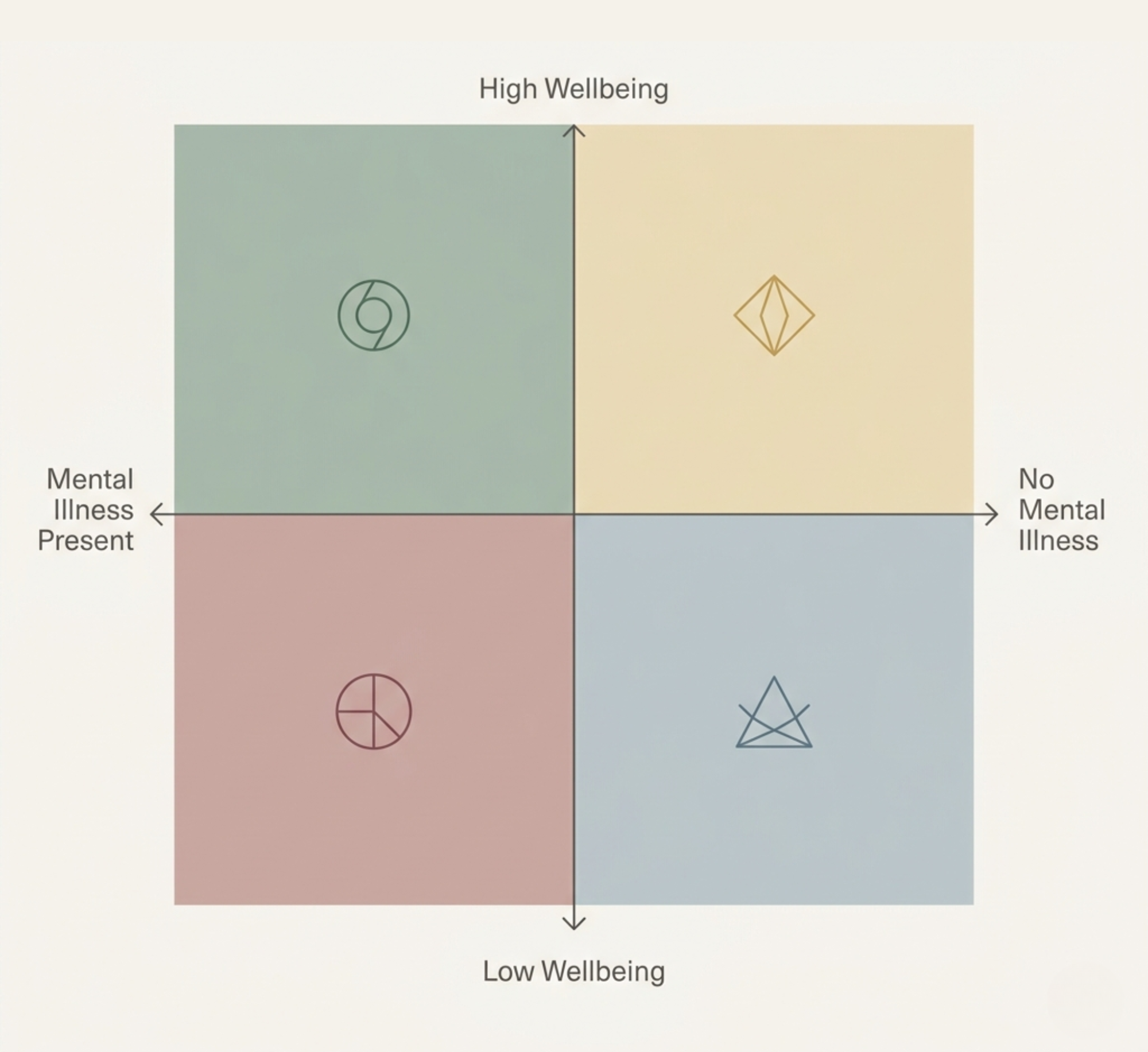
This is the architecture of coexistence. High performance can sit anywhere on this map. Many high performers occupy the third box – managing a real condition while functioning, achieving, and contributing. They are not exceptions. They are part of the design.
If you want to go deeper into what high wellbeing actually looks like, the article on flourishing walks through the wider model. The short version is that flourishing is a state where you are not just symptom-free, but actively engaged, connected, purposeful, and growing. You can flourish in this sense while still managing a condition. You can also fail to flourish without ever meeting criteria for one. The dual continuum gives us the language to see both.
Ready to dive deeper?
Paid members get tailored strategies, tactics, case studies, advanced techniques, and more!
Three Patterns of Coexistence
When you stop forcing the binary, you start seeing patterns. Coexistence is not one thing. It shows up in at least three distinct ways. Each has its own dynamics, its own risks, and its own implications for support.
Pattern 1: Performing Through
The first pattern is the most common and the most fragile. The performer is using their craft as temporary refuge from internal struggle. Sport, work, art, or service becomes the place where they do not have to feel what they feel everywhere else.
This works for a while. Sometimes for years. The structure of high-performance life – training schedules, deadlines, meetings, performances – fills the day. There is little space for the inner state to surface. The performer is fine, as long as they are working.
The problem is what happens when the performing pauses. Off-seasons, post-deadline crashes, retirement, injury, holidays – any break in the flow of demand reveals what the demand was masking. This is the pattern that produces the well-documented post-Olympic depression, the executive who falls apart after the deal closes, the academic who collapses the week the thesis is submitted. The performance was real. The wellbeing was not.
This pattern is particularly common in cultures that frame work as identity. If your sense of self is fully fused with what you produce, then any pause in production becomes a confrontation with whatever was hiding underneath. People in this pattern are not lazy or weak when they crash. They are running an unsustainable system that finally hits its limit.
Pattern 2: Performing Despite
The second pattern is more sustainable, and increasingly visible in public life. The performer has a diagnosed condition. They are receiving evidence-based support. They have built a structure of care around themselves – professional support, social support, sleep protocols, medication where appropriate, and active management of triggers. They perform at the highest levels not by pretending the condition does not exist, but by working with it as a known feature of their life.
This is what Phelps eventually did. It is what Naomi Osaka did when she stepped back from the French Open to protect her wellbeing. It is what Simone Biles did at the Tokyo Olympics. In each case, the public reaction split. Some saw weakness. Others saw the most sophisticated form of self-management we have a word for.
These are not stories of people overcoming their conditions. They are stories of people working with them, in the same way an athlete works with a recurring injury. You manage it. You rest when you need to rest. You build training around it. You do not pretend it is not there. The performance does not require the absence of the issue. It requires the integration of it.
What makes this pattern sustainable, where Pattern 1 is fragile, is that the inner reality has been named. Once you name something, you can plan around it. You can build structure for it. You can ask for help that is actually proportionate to what you need. The naming is what unlocks the design.
Pattern 3: Performing Because
The third pattern is the most counter-intuitive, and the one we discuss least. Sometimes the engagement with the craft becomes part of the recovery. The act of practising, training, creating, or leading becomes a structure of meaning that helps the person rebuild.
This is well-documented in trauma recovery and in the wider literature on post-traumatic growth. People who have lived through severe events often find that highly demanding pursuits – endurance sport, creative work, service to others, mastery of a skill – are not just compatible with healing but part of how healing happens. The structure provides what unstructured time cannot: a clear reason to get up, a measurable arc of progress, a community of people who care about the same thing.
This is not a romantic claim. It does not mean suffering is good for performance, or that struggle is somehow productive. It means that, for some people, a clear and demanding pursuit is one of the things that makes recovery possible. The performance and the recovery are the same project, viewed from two angles. Many of the people we read about in memoirs of recovery describe exactly this pattern, even when they do not have words for it.
Why the Binary Hurts Everyone
The false binary is not a harmless cultural quirk. It produces specific, measurable damage to specific people, in three directions at once.
The Cost to the Performer
The first cost is paid by the person who is struggling and performing at the same time. The binary tells them their two realities cannot both be real. So they hide one. Almost always, they hide the struggle.
What follows is well-mapped. Help-seeking is delayed by months or years – sometimes by decades. Conditions that would have responded to early support become entrenched. The performer learns to mask, to compensate, to push through, and to attribute their suffering to character flaws rather than treatable conditions. Performance often holds for a while, propped up by adrenaline and willpower. Then, often suddenly, it does not.
This is the trajectory we keep seeing in obituaries and shocking resignations. The performer was struggling for years, but they were fine, really. Until they were not. The binary did not protect them. It removed their access to help. There are also deep-seated common misconceptions about mental health that compound this isolation, particularly in performance cultures. And there is a specific, well-documented version of this trajectory in men's mental health, where the binary is enforced especially harshly.
The Cost to the Culture
The second cost is paid by teams, organisations, and families. They lose people they could have kept. They lose performers who quietly leave because the cost of staying became too high. They lose leaders who burn out and never return. They lose talent in waves, often without understanding what they are losing.
When organisations finally examine these losses, the same factors appear. Cultures of silence. Punishment for help-seeking. Praise for self-neglect framed as commitment. A leadership that models invulnerability and signals, without saying it, that struggle disqualifies you. The cost is paid in attrition, in reduced retention of senior talent, and in the slow erosion of institutional knowledge that walks out the door because the door was the only option.
There is a longer pattern here, mapped in quiet quitting and quiet burnout – the slow disengagement that happens when people decide that protecting themselves matters more than performing for an organisation that will not protect them back. By the time leadership notices, the loss is already complete.
The Cost to How We Support People
The third cost is structural. As long as we believe the binary, we design support systems that reinforce it. We build wellness programmes that focus on visible markers of struggle, missing the high performers who are masking. We build performance programmes that focus only on output, missing the inner life entirely. We build mental health systems that treat work and wellbeing as separate domains, ensuring that no one ever quite gets the integrated help they need.
Some of this is also a WEIRD bias in how we frame mental health – treating performance and wellbeing as separate domains is a particularly Western, individualist habit. Cross-cultural perspectives have always had richer language for the integration of inner and outer life, of body and mind, of person and community. We are slowly remembering this. The integration model is not a new invention. It is a return to something older, supported by new evidence.
What if staying the same is holding you back?
High performers don’t wait for change – they build it with proven tactics, real-world case studies, and advanced strategies others already use.
Ready to join them and gain that edge?
What Coexistence Actually Looks Like
So what does it look like when someone stops pretending and starts integrating? It does not look heroic. Most of the time, it looks ordinary.
The Integration Mindset
The integration mindset starts with a single shift. Mental health is not a separate domain you manage in secret. It is part of the performance system, like sleep, recovery, nutrition, and skill practice. The same way an elite athlete tracks training load, an integrated performer tracks their psychological state. The same way a senior leader plans for cognitive load, an integrated leader plans for emotional bandwidth.
Once you make this shift, several things change. You stop hiding what you are managing. You stop being shocked when difficulty appears. You start treating professional support the way you treat physiotherapy or financial planning – as something competent adults do, not something broken people are forced into. The shame collapses. What replaces it is a quieter kind of competence.
Positive psychology and the science of thriving under pressure goes deeper into how this integrated picture is built – not as a separate practice but as a way of living that strengthens both wellbeing and performance. The key idea is that the same internal skills support both axes of the dual continuum. Strengthening one tends to strengthen the other. Weakening one tends to weaken the other. They are not in competition.
Mental Health Support as a Performance Asset
The most important reframing in this whole conversation is also the simplest. Mental health support is not a performance liability. It is a performance asset. The evidence is overwhelming. Performers who receive appropriate, evidence-based support have lower attrition, longer careers, more consistent output, and faster recovery from setbacks than performers who do not.
This makes complete sense once you stop thinking of support as a sign of failure and start thinking of it as a form of training. The same person who would never train without a coach, never lift without a programme, never compete without a plan, has historically been told to manage their inner life on their own. This is incoherent. We solved it for the body decades ago. We are solving it for the mind now, slowly.
This is also where well-developed psychological skills training plays its real role – not as a workaround for psychological problems, but as a structured training of the inner skills that high performance and good mental health both rely on. The same skills that help an athlete manage pre-competition anxiety help a leader manage decision fatigue. The same skills that help a student manage academic pressure help a person manage the early signs of a mood disorder. The integration is not a metaphor. It is a feature of how the mind actually works.
What This Means for You
Three groups of readers carry different versions of this question. Each version has a clear next step.
If You Are Performing While Struggling
If you are reading this and recognising yourself, the most important sentence in this article is this one: needing help does not disqualify you from the standards you hold yourself to. It is a feature of being a person who lives in the conditions you live in.
The trajectory that hurts the most is the one where you decide to wait until things calm down before reaching out. Things are not going to calm down. The structure of high-performance life rarely does. Reaching out is not what happens after you fix yourself. It is part of how the fixing happens.
Three concrete steps, in order:
- Notice the pattern, not just the moment. A bad week is not the same as a six-month trend. Track your mood, sleep, energy, and engagement for a few weeks – even informally. Patterns are far more honest than memory.
- Talk to one person you trust. Not the whole world. Not social media. One person. A friend, a partner, a coach, a mentor, a GP. The act of saying it out loud often changes what is possible.
- Get a professional assessment if the pattern is sustained. Trained mental health professionals exist precisely for this. Their job is not to judge you. It is to give you a clearer picture and a proportionate next step.
If you have not yet, this article on seeking help for better mental health is a careful, non-judgemental walk-through of how that process actually works, and what to expect from it.
If You Lead High Performers
If you lead a team, a unit, a lab, a company, or a roster of athletes, your beliefs about coexistence are felt before they are spoken. People watch what you reward and what you punish far more carefully than what you say. If you treat help-seeking as weakness, your people will hide. If you treat it as ordinary, they will use it.
A few specific practices change cultures faster than any policy:
- Name your own use of support, where appropriate. Leaders who quietly admit they have a coach, work with a mental performance consultant, or follow a structured recovery practice normalise it for everyone watching.
- Do not reward visible self-neglect. Praising the person who works through illness, sleeps four hours, and skips holidays trains the rest of your team to do the same.
- Build help-seeking into the system, not the exception. Annual check-ins. Easy access to support. Clear routes that do not require crisis to activate.
- Respond well to early disclosures. The first time a team member tells you they are struggling, your response sets the price for the next ten disclosures from anyone watching.
The leaders who get this right rarely talk about it as a wellbeing initiative. They talk about it as a performance system. They are not wrong.
If You Support High Performers Professionally
If you work as a coach, performance consultant, mental performance specialist, or any form of mental health professional working with elite populations, the integration model changes case formulation. The person sitting opposite you is rarely just performing or just struggling. They are doing both. The work is to help them stop treating these as competing demands and start treating them as one integrated life.
The most effective support sits at the intersection. It takes performance demands seriously without using them to dismiss inner experience. It takes inner experience seriously without using it to lower the standards the person actually wants to hold. It builds the kind of psychological readiness – emotion regulation, recovery practices, identity work, meaning-making – that supports both axes of the dual continuum at once.
The performers who have the deepest, most durable careers are usually the ones who built this infrastructure early, often with support. The ones who burn out spectacularly are usually the ones who tried to manage everything alone, with shame, in the dark.
Moving Forward
The question this article opened with has a short answer and a long one.
The short answer: yes, mental health issues and high performance coexist, all the time, in millions of lives. The denial of this truth has cost us people we should not have lost.
The long answer is harder. It asks us to drop the false comfort of the binary. It asks performers to update their image of themselves, leaders to update their image of who they are leading, and the rest of us to update what we expect of the people we admire. It asks for an integration mindset that treats mental health not as a separate, shameful category, but as part of the same life as the work, the training, the family, and the goals.
This is not soft. It is the most rigorous, evidence-based, performance-respecting way of understanding human capability we have. The performers who have already made this shift are quietly winning while everyone else is still arguing about whether to start.
Stay Ahead!
If you found this useful, the Psychquania newsletter sends out one carefully written edition every two weeks, focused on exactly this kind of integration – mental health and high performance treated as one project, not two. Subscribing is the simplest way to keep this conversation going.


Discussion