Performance Anxiety: Why Your Body Panics Before It Matters
Performance anxiety peaks before you begin, not during. Understand the mechanism, why "calm down" fails, and a trainable protocol used across elite domains.
Dr. Dev Roychowdhury is a scholar, consultant, and interdisciplinary thought leader with an extensive background in academia, industry, and the military.
A violinist stands in a corridor outside a concert hall. Her hands are cold. Her heart is running at almost twice its resting rate. She has played this piece several hundred times.
A surgical registrar scrubs in for a procedure she has performed without incident on many previous occasions. Her mouth has gone dry. There is a thin tremor in her fingers that was not there an hour ago.
A soldier sits in the back of a vehicle before a night movement. Nothing has been said for twenty minutes. His breathing has shortened. His stomach has turned over twice.
Nothing has happened yet.
That is the part almost nobody explains. In each case the body has mounted a full physiological response to an event that has not begun. No note has been played. No incision has been made. No door has opened. And yet the machinery is already running at capacity.
Most advice treats this as a fault to be corrected. Calm down. Relax. Stop overthinking it. That advice fails, reliably, and it fails for a reason that has nothing to do with willpower.
Your body is not malfunctioning. Seen through the lens of performance psychology, it is doing something far more interesting, and far more useful, than the standard account allows.
It is making a prediction.
Understanding that single fact changes what you can do about performance anxiety. It moves the problem from something you endure to something you can work with. In this article, I explain the mechanism in detail, correct the most widely repeated myth in the field, identify what actually degrades performance under pressure, and address what six demanding professional domains have learned about handling it. I then set out a trainable protocol.
I have written this for anyone who performs while being assessed, which is a far larger group than the word performance usually suggests.
💡
Key Insight: Your body does not react to pressure. It anticipates it. The response you feel before a high-stakes moment is a forecast about resources and demands, generated in advance so that you arrive ready. The forecast is often wrong. That is the problem worth solving.
The Question Nobody Asks: Why Before?
There is a peculiar detail buried in the experience of performance anxiety that most discussions walk straight past.
The worst of it usually arrives before you begin.
The Timing Paradox
Ask people who perform under evaluation when they feel worst, and a consistent pattern emerges. The night before. The morning of. The forty minutes in the waiting area. The walk from the car park. Then, once they actually start, something shifts. The intensity often drops. Attention narrows onto the task. Many people report that the anticipation was substantially worse than the event.
A simple threat-response account cannot explain this. If anxiety were a reaction to danger, it would peak when danger was present. Instead it peaks when danger is imagined and falls when danger is real.
The implication is significant. Whatever your body is doing, it is not responding to what is in front of you. It is responding to a model of what is coming.
Panic, Precisely
The word panic in the title of this article is doing specific work, and it is worth defining before going further.
Performance anxiety is not a panic attack. A panic attack is a discrete episode of intense fear that peaks within minutes and is typically accompanied by a fear of losing control of your mind, dying, or going mad. Performance anxiety is generally slower, more diffuse, tied to a specific evaluative context, and it resolves when the context does.
Performance anxiety is also not an anxiety disorder, though the two can coexist and can be difficult to separate without proper assessment. The distinguishing feature of performance anxiety is that it is bounded. It attaches to a particular kind of situation. Outside that situation, functioning is typically unaffected.
What the word panic captures accurately is the disproportion. The physiological response is often calibrated as though something genuinely dangerous were about to happen, when the actual worst case is a poor result, a lost contract, an unkind review, or a difficult conversation afterwards. The body is preparing for a threat to survival. The situation is a threat to standing. Those are different things, and the gap between them is where most of the distress lives.
📖
Definition: Performance anxiety is the cognitive, physical, behavioural, and attentional response that occurs when an individual anticipates being evaluated on something they care about, in a situation where the outcome feels consequential and uncertain.
Why Early Timing Changes What You Can Do
If the response were purely reactive, your options would be limited to what you could manage in the moment. You would be permanently on the back foot, always responding to something already underway.
Because the response is anticipatory, the picture is entirely different. Anticipation runs on inputs. It draws on your assessment of the demand, your assessment of your resources, your memory of similar situations, and your physical state. Every one of those inputs can be worked on in advance.
This is the practical basis for everything that follows. It is also why the useful unit of intervention is not the moment of performance but the runway leading up to it. Much of what determines how you perform on the day has already been decided by the time you arrive.
For a broader treatment of how elite competitors manage this, see performing under pressure, which examines mental skills at the Olympic level.
What Performance Anxiety Actually Is
Precision matters here, because most of the bad advice in this area stems from imprecise definitions.
A Working Definition
Performance anxiety requires three conditions to be present at once.
Evaluation. Someone is judging, or you believe they are. This may be an audience, a panel, a coach, a supervisor, a scoreboard, or your own internalised standard. Remove the sense of being assessed and the phenomenon largely disappears. This is why people can execute flawlessly in private and fall apart in public with identical physical demands.
Consequence. The outcome matters to you. It touches something you have invested in – your competence, your standing, your identity, your livelihood, your sense of yourself as someone who can do this. Performance anxiety does not attach to things you are indifferent to.
Uncertainty. The outcome is not guaranteed. Anxiety lives in the gap between what is demanded and what you are sure you can deliver. Where that gap closes to zero, anxiety subsides. Where it opens too wide, it becomes something closer to resignation.
Take away any one of these three and the response weakens considerably. This is diagnostically useful. When someone tells me they have become anxious about a task that never troubled them before, the answer is almost always that one of the three variables has shifted – a new audience, higher stakes, or a loss of certainty following an error or an injury.
The Four Channels
Performance anxiety expresses itself through four distinct channels. Treating them as a single phenomenon is one of the most common reasons interventions fail.
Cognitive. Worry, rumination, catastrophic prediction, self-doubt, mental rehearsal of failure, difficulty concentrating on anything else. This is the channel most people mean when they say they are anxious.
Somatic. Elevated heart rate, shallow breathing, gastrointestinal disturbance, muscular tension, tremor, dry mouth, sweating, disrupted sleep, reduced appetite. This is the channel most people find most frightening, because it is undeniable and appears to be outside their control.
Behavioural. Avoidance, procrastination, over-preparation, excessive checking, seeking reassurance, arriving unnecessarily early or unnecessarily late, withdrawing socially before an event. This is the channel most people do not recognise as anxiety at all.
Attentional. Narrowing of focus, distractibility, hypervigilance towards signs of threat, difficulty disengaging from irrelevant cues. This is the channel that actually determines whether performance holds or collapses, and it receives by far the least attention.
These channels do not move together. Somebody can have a racing heart and a completely clear mind. Somebody else can be physically calm and mentally in freefall. The intervention that helps one channel may do nothing at all for another. Breathing exercises target the somatic channel. They will not resolve a cognitive problem, which is one reason so many people conclude that breathing does not work for them.
What It Is Not
It is not fear. Fear has an object and a location. Anxiety is diffuse, future-oriented, and often lacks a specific referent. You are not afraid of the stage. You are anxious about a set of possible outcomes that have not occurred.
It is not the same as stress.Stress describes the broader response to demand exceeding perceived resource. Performance anxiety is a specific form of it, shaped by evaluation.
It is not evidence of inadequate preparation. This belief causes real damage. Highly prepared people experience performance anxiety at least as intensely as underprepared people, and sometimes more, because they have more invested. Additional preparation does not reliably reduce it and can increase it by raising the stakes.
It is not a character defect. It is not weakness, and it is not a sign that you are unsuited to what you are doing. In my experience across military, academic, and commercial settings, the most capable people in the room are frequently the most affected. They simply conceal it better.
Intensity Versus Direction
The most useful finding in this entire field concerns not how much anxiety somebody experiences but how they read it.
Two performers can record identical scores on a standard anxiety measure and have completely different outcomes. One interprets the elevated heart rate, the alertness, and the narrowed focus as evidence of readiness. The other interprets the identical sensations as evidence of impending failure. This distinction, between the intensity of the symptoms and their directional interpretation, predicts performance more reliably than intensity alone.
This has been repeatedly confirmed in the sport literature and has an obvious practical consequence. If you spend your effort trying to reduce intensity, you are working on the variable that matters less. If you work on interpretation, you are working on the variable that matters more, and it happens to be far more tractable.
💡
Key Insight: Elite performers do not experience less anxiety than everyone else. They experience it differently. The sensations are largely the same. The meaning assigned to them is not.
The Machinery: Why the Body Moves First
To work with the response, you need to understand what generates it. This section is the mechanical core of the article. It is more technical than the rest, and it is the part that makes everything afterwards make sense.
Prediction, Not Reaction
The Body Budgets Before It Spends
The intuitive model of physiology is reactive. Something happens, the body responds, and things return to baseline. This model is largely wrong, and its wrongness is precisely why performance anxiety seems irrational.
Biological systems do not primarily react. They anticipate. Your body continuously forecasts what it is about to need – oxygen, glucose, blood flow to particular muscle groups, cardiac output, attentional resource – and mobilises those resources ahead of demand. Regulating through anticipation rather than correction is far more efficient than waiting for a deficit to appear and then scrambling to fix it. A system that waited for the deficit would always be late.
This forward-looking regulation is why you produce digestive enzymes before food arrives, why your heart rate rises as you stand up rather than after you have fallen over, and why your body begins mobilising the night before something difficult.
Your physiology has run a forecast. It has concluded that tomorrow will require substantially more than an ordinary day. It has begun preparing accordingly.
Why the Alarm Fires in the Car Park
Once you accept that the system is predictive, some otherwise baffling features of performance anxiety become obvious.
The forecast is triggered by cues, not by events. A diary entry. A particular corridor. The smell of a venue. The sight of a scoreboard. The email confirming the date. Any reliable predictor of demand can initiate the preparatory response, because from the body's point of view a reliable predictor is more useful than the event itself. Waiting for the event would be too late.
This is also why performance anxiety generalises. If your body has learnt that a certain category of situation demands maximum resource, it will begin mobilising for anything that resembles that category. The precision of the prediction degrades over time, which is why people often report that their anxiety has spread to situations that never used to trouble them.
And it is why the response can be entirely disproportionate. The forecasting system is calibrated conservatively. Under-preparing for a genuine threat has historically been far costlier than over-preparing for a false alarm. Your body would rather waste resources a hundred times than be caught short once.
Two Systems, Two Speeds
The preparatory response runs on two pathways with very different timescales. Understanding both explains why performance anxiety has such a distinctive temporal shape.
The Fast Line
The sympathetic-adrenal-medullary pathway operates in seconds. Signals travel from the brain through the sympathetic nervous system to the adrenal medulla, which releases adrenaline and noradrenaline into the bloodstream. Heart rate rises. Cardiac output increases. Blood is redirected towards skeletal muscle and away from the digestive system. Airways dilate. Pupils widen. Glucose is released into circulation.
This is the response you notice immediately when the door opens or your name is called. It is fast, it is powerful, and it fades relatively quickly once the trigger passes.
The Slow Line
The hypothalamic-pituitary-adrenal axis operates on a much longer timescale, from minutes to hours. The hypothalamus signals the pituitary, which signals the adrenal cortex, which releases cortisol. Cortisol mobilises energy over sustained periods, modulates immune function, and influences memory, attention, and mood.
This is the pathway that explains the night before. It is why you wake at four in the morning with your mind already running. It is why you cannot eat. It is why the day before a major event can feel physically exhausting despite an absence of physical exertion. Sustained anticipatory activation is metabolically expensive, and you pay for it whether or not the event ever happens.
The two systems together produce the characteristic profile: a long, grinding elevation across the preceding hours or days, punctuated by sharp spikes at specific cues, followed by an often striking drop once the performance actually begins and the forecast is replaced by real information.
Where You Feel It, and Why
The specific sensations are not random, and knowing their origin removes a good deal of their menace.
Gastrointestinal disturbance occurs because blood is being diverted away from the digestive tract towards muscle. The gut is richly innervated and highly responsive to autonomic signalling. This is straightforward resource reallocation, not a sign that something is wrong.
Cold or clammy hands occur because peripheral blood vessels constrict, shunting blood centrally. Tremor arises from increased muscle spindle activity and circulating catecholamines. Both are direct consequences of preparation for physical exertion.
Vocal changes – a higher pitch, reduced breath support, tightness – result from tension in the muscles of the larynx and pharynx combined with shallow, rapid breathing. This is why the voice is often the first thing to give someone away.
Shallow, rapid breathing increases oxygen availability but reduces carbon dioxide, which can produce lightheadedness, tingling in the extremities, and a sensation of unreality. These symptoms are frequently misread as evidence of an impending collapse, which generates further anxiety about the anxiety.
None of these sensations indicates that anything has gone wrong. Each one indicates that a preparatory system is doing its job, based on a forecast that may or may not be accurate.
Challenge and Threat: Same Arousal, Different Bodies
Here the picture becomes considerably more interesting, and considerably more useful.
The Demand-Resource Equation
Elevated arousal is not one thing. Two people facing the same situation, with similar heart rates, can be in physiologically distinct states with opposite consequences for performance.
The determining factor is the relationship between perceived demands and perceived resources. When you appraise your resources as sufficient for the demands, you enter what researchers term a challenge state. When you appraise the demands as exceeding your resources, you enter a threat state.
These states have distinguishable cardiovascular signatures. In a challenge state, sympathetic activation increases cardiac output while blood vessels dilate, lowering resistance and allowing efficient delivery of oxygen and fuel to the brain and muscles. In a threat state, cardiac output rises far less and vascular resistance increases, producing a less efficient distribution of energy.
The subjective experience of the two can be surprisingly similar. The performance consequences are not. Threat states are associated with less effective decision-making, degraded cognitive function, greater likelihood of conscious interference with automatic skills, and poorer self-regulation.
The Refinement That Matters
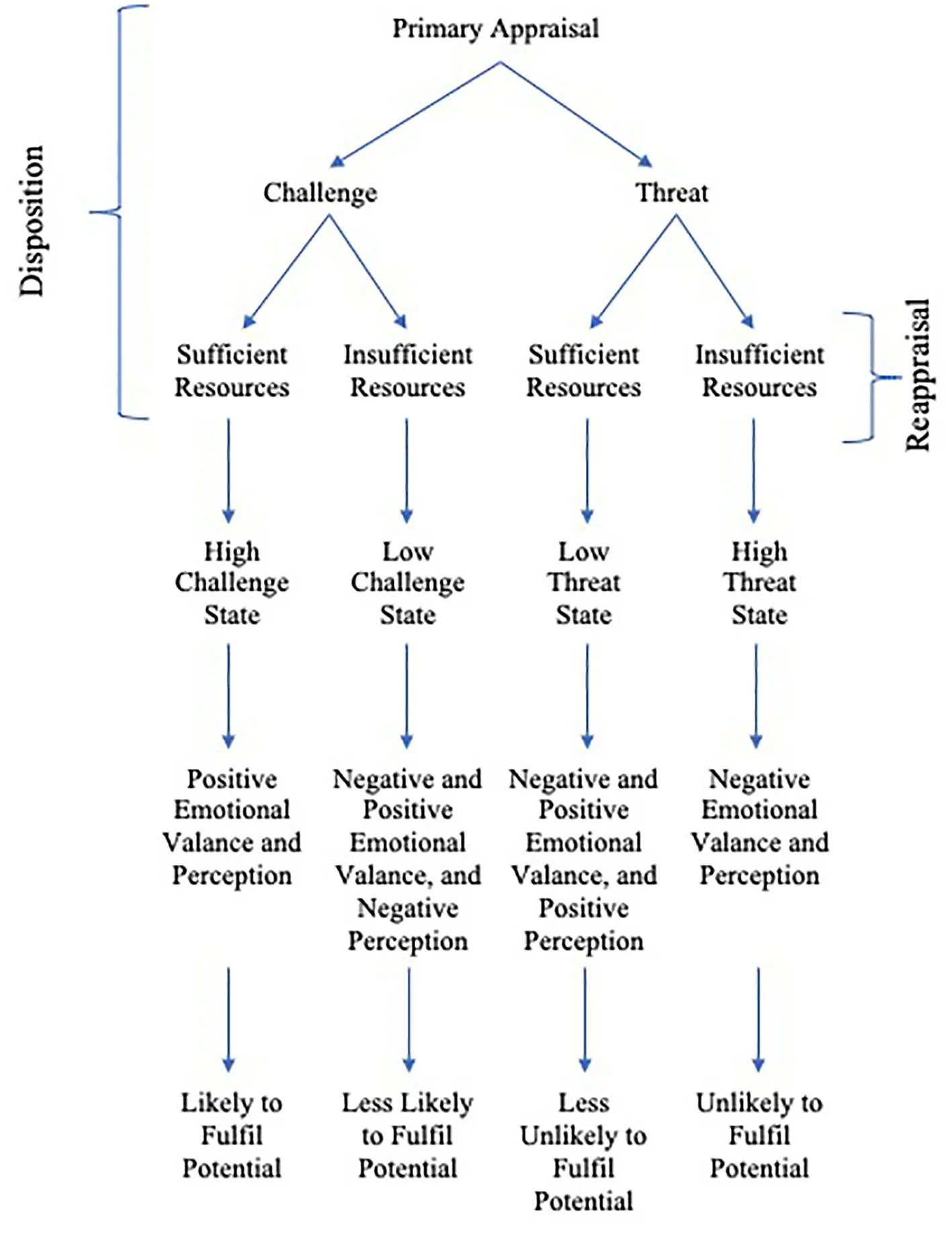
The original theoretical model treated challenge and threat as opposite ends of a single dimension. A revised formulation, developed by Meijen and colleagues – the TCTSA-R after a decade of accumulated evidence, proposes something more useful: a two-by-two structure producing four states rather than two.
Because a performer can make a primary appraisal of either challenge or threat, and can separately perceive their resources as high or low, four combinations exist – high challenge, low challenge, low threat, and high threat. The practically important case is low threat. Here a performer appraises a situation as threatening yet still perceives substantial resources, and can perform well regardless.
Revised theory of challenge and threat states (TCTSA-R)
This matters enormously for how you approach your own experience. You do not need to eliminate the sense of threat in order to perform. You need sufficient resource to meet it. That reframes the entire problem from emotional management to resource building, which is a far more tractable undertaking.
The revised model also expanded what counts as a resource. Social support is now included alongside self-efficacy, perceived control, and approach-oriented goals. The people around you are not peripheral to your physiology. They are part of it.
📊
Research Says: Some of the clearest evidence on this comes from military survival training, one of the most severe controlled stressors that can be studied ethically. Morgan and colleagues found that the ratio of DHEA-S to cortisol during acute stress was significantly higher in personnel who reported fewer dissociative symptoms and who demonstrated superior objective performance. The total quantity of stress hormone was not the determining variable. The balance between the mobilising and the protective components of the response was. The shape of your stress response matters more than its size.
The Anabolic Signature
That finding deserves elaboration, because it overturns a common assumption.
We tend to speak about stress as though it were a single substance that arrives in larger or smaller quantities, with less being better. The survival school data indicate something different. Under extreme stress, everyone's cortisol rises. What separated those who performed well from those who did not was the concurrent presence of other compounds that buffer the effects of prolonged cortisol elevation.
In other words, the people who held together were not the people who produced less stress response. They were the people whose stress response had a better internal composition.
This has a direct implication for how you should think about your own preparation. Attempting to have less of a response is the wrong goal, and it is not achievable in any case. Building the physiological and psychological conditions under which your response takes a more favourable shape is achievable, and it is what the rest of this article addresses.
💌
Stay Ahead! Want research-based insights on performance, resilience, and wellbeing – delivered in plain language, straight to your inbox? Become a member and join thousands of high performers who read it every month.
The Inverted-U Problem: The Most Misused Idea in Performance
If you have ever attended a workshop on performance and pressure, you have seen the curve. Arousal along the horizontal axis, performance along the vertical, and a smooth inverted U rising to a peak in the middle before falling away. Too little arousal and you are flat. Too much and you collapse. Find the sweet spot.
It appears in management texts, coaching manuals, corporate training decks, and a substantial proportion of the material written about performance anxiety.
It does not hold up.
What Yerkes and Dodson Actually Did
The curve is attributed to a study published in 1908 by Robert Yerkes and John Dodson in the Journal of Comparative Neurology and Psychology. It is worth knowing what that study involved.
The subjects were Japanese dancing mice. The task was learning to discriminate between a white chamber and a black chamber. The motivational manipulation was electric shock of varying intensity, delivered when the mouse entered the wrong chamber. The outcome measure was the number of trials required to form the discrimination habit.
Yerkes and Dodson found that for the harder discriminations, intermediate shock intensities produced faster learning than either very weak or very strong shocks. That was the finding. The original paper is freely available and worth reading, if only for how modest its claims are compared with what has been built on top of them.
Note what the study was not about. It was not about arousal. It was not about stress. It was not about anxiety. It was not about performing an already-mastered skill. It was not about humans. It measured how quickly mice learned a novel visual discrimination when punished at different intensities.
How a Mouse Study Became a Management Poster
The transformation happened gradually and without anybody being responsible for it. The 1908 findings were largely ignored for decades. Interest revived in the 1950s alongside the emergence of arousal theory, and over time the specific finding about punishment intensity and discrimination learning in mice was progressively generalised into a universal law relating arousal to performance in humans.
This process has been examined directly. Corbett's analysis in the Journal of Managerial Psychology traced how a speculative animal experiment became a widely cited law of human behaviour, examined the supporting empirical evidence, and found it wanting. The paper argues that the law has no adequate basis in empirical fact yet continues to shape workplace practices that seek to maintain or increase employee stress as a route to performance.
The simplicity of the graph did much of the work. A clean curve is memorable, teachable, and reproducible on a slide. Nobody checks the citation.
⚠️
Important: The inverted-U is not a description of how anxiety affects performance. Treating it as one leads directly to the two most damaging errors in this area: believing there is an optimal arousal level you should be hunting for, and believing that more pressure will improve output up to some threshold.
What Actually Replaced It
Serious work on anxiety and performance moved on some time ago. Three developments are worth knowing.
Individual Zones of Optimal Functioning
The first is the recognition that optimal states are individual rather than universal. Research on Individual Zones of Optimal Functioning demonstrated that performers have characteristic emotional profiles associated with their best work, and that these profiles vary substantially between individuals.
Some people perform best when highly activated. Others perform best when notably subdued. The same absolute level of anxiety may be optimal for one athlete and disastrous for another in the identical event. Crucially, the profile is not limited to anxiety. It includes emotions that would ordinarily be classed as negative, some of which are functional for particular individuals. Certain performers do their best work with a degree of irritation present.
This dismantles the sweet spot entirely. There is no general optimum. There is your optimum, and finding it requires observation rather than theory.
The Catastrophe Model
The second development addresses the shape of the decline.
The inverted-U implies a symmetrical, gradual falling away. Push past your peak and performance eases downward. Ease back and it recovers. Anybody who has watched a performance genuinely collapse knows this is not what happens.
Catastrophe models propose that when physiological arousal is high and cognitive anxiety is also high, performance does not decline gradually. It drops sharply, almost discontinuously. And the recovery is not symmetrical. Reducing arousal slightly does not restore performance to its previous level. You must reduce it considerably further than the point at which the collapse occurred before performance returns.
This matches observed reality far better. It also explains something practically important. Once a performance has genuinely fallen apart, small adjustments will not retrieve it. The system has moved to a different state, and getting back requires a larger intervention than most people attempt in the moment.
Multidimensional Models
The third development is the recognition that cognitive anxiety and physical activation are separate dimensions with different relationships to performance. Physical activation may have a broadly curvilinear relationship. Cognitive anxiety, the worry component, tends to be more consistently unhelpful. Collapsing them into a single arousal variable, as the inverted-U does, obscures the distinction that matters most.
The Practical Consequence
Stop looking for an arousal number.
The useful question is not how activated you are. It is whether your activation is taking a favourable shape, whether your attention is where it needs to be, and whether your resources feel adequate to the demand. Those are the variables that predict outcomes, and they are the ones that I address in the remainder of this article.
What Actually Breaks: Attention, Not Arousal
Here is the pivot on which everything practical depends.
For decades, the implicit model was that anxiety impairs performance by making the body less capable. Shaky hands miss the shot. A racing heart disrupts fine control. There is something to this at the extremes, but it explains very little of what actually happens when capable people underperform under pressure.
The dominant mechanism is attentional.
Processing Efficiency and Performance Effectiveness
The foundational distinction here comes from work on attentional control theory and its predecessor, processing efficiency theory. Both rest on a separation that most people have never encountered but that immediately explains a great deal.
Performance effectiveness is the quality of what you produce. Did you hit the target? Was the diagnosis correct? Did the presentation land?
Processing efficiency is the relationship between that output and the resources consumed to produce it. How much effort, attention, and working memory did it cost you?
The central claim is that anxiety damages efficiency before, and more severely than, it damages effectiveness. Under anxiety, you can often still produce a good result. You simply pay far more for it.
This is why so many people are unaware they have a problem. Their outputs still look acceptable. What has changed is invisible from outside – the effort required has escalated, the cognitive reserve has thinned, and there is nothing left over for anything unexpected.
The theory holds that anxiety specifically impairs the balance between two attentional systems. The goal-directed system, which is top-down and driven by your intentions, becomes less efficient. The stimulus-driven system, which is bottom-up and captured by whatever is salient, becomes more influential. Attention is increasingly pulled towards threat-related cues rather than directed towards task-relevant ones.
For skilled work, this is exactly backwards. A skilled performer needs attention allocated deliberately to specific cues. Anxiety hands control of attention to whatever seems most threatening, which is almost never what you need to be looking at.
Why You Can Succeed and Still Be Degraded
The efficiency-effectiveness distinction has an uncomfortable corollary that deserves stating plainly.
If you have been performing well under pressure while feeling terrible, you have not solved the problem. You have been paying a tax that does not appear in the results.
The tax shows up in three places. It shows up in fatigue that seems disproportionate to what you did. It shows up in the absence of reserve when something unexpected occurs, because your capacity was already fully committed. And it shows up over years, in an accumulating cost that eventually presents as burnout or a sudden reluctance to continue.
I have seen this pattern in senior people across every setting I have worked in. The individual is performing at a high standard. Their results are not in question. And they are running at 95% capacity to produce what used to cost them sixty. Nobody intervenes, because from outside there is nothing to intervene in.
The Two Roads to Breakdown
When performance does visibly collapse, it happens by one of two routes. They are frequently confused, and the interventions for each are opposite.
Distraction
The first route is straightforward. Attention leaves the task.
Working memory has limited capacity. Worry occupies that capacity. Every cycle spent on the consequences of failure, on the audience, on what a particular person is thinking, or on the internal commentary about how badly this is going is a cycle unavailable for the work itself.
Distraction dominates in tasks that require sustained conscious processing – complex decisions, mental arithmetic, planning, holding multiple variables in mind, novel problems. It is the primary mechanism in academic examinations, in clinical reasoning under time pressure, and in any performance where you must actively think.
It is also the primary mechanism for people who are still learning. A skill that has not yet become automatic requires working memory, and worry competes directly for that same resource.
Reinvestment
The second route is subtler and considerably more interesting.
Here, attention returns to the task. That is precisely the problem.
When a complex motor skill is learned to a high level, it becomes proceduralised. It runs without step-by-step conscious control. The expert golfer does not think about wrist angle. The experienced surgeon does not narrate the movement of their hands. The skill has been compiled into an integrated unit that executes as a whole.
Under pressure, performers often attempt to reassert conscious control over these automated processes. The technical accounts of this are the reinvestment hypothesis and the explicit monitoring hypothesis. The effect is that an integrated skill is broken back into its component parts and run consciously, step by step, using a system that is far slower and far less capable than the one that had been handling it.
The result is a performance that looks tight, effortful, and mechanically wrong. The player who has suddenly forgotten how to make a routine pass has not forgotten anything. They have started supervising a process that runs better unsupervised.
Why Experts and Novices Break Differently
This distinction has an important practical consequence that is regularly ignored.
Reinvestment is largely a problem for skilled performers. It requires an automated skill to interfere with. Novices, whose skills have not yet been proceduralised, do not suffer from it in the same way and can genuinely benefit from step-by-step attention to technique.
Distraction is a problem for everyone but weighs most heavily on those still learning and on those performing cognitively demanding tasks.
The advice that follows from each is opposite. A novice under pressure often benefits from being directed towards technique. An expert under pressure is actively harmed by it. Telling an experienced performer to concentrate on their mechanics is one of the most reliable ways to make things worse.
This is why generic advice about focusing fails so often. It is not that the advice is wrong. It is that it is right for one group and wrong for the other, and it is usually delivered without regard to which.
📌 Remember:
Anxiety degrades the efficiency of performance before it degrades the quality
Performing well while feeling terrible is not success; it is an unrecorded cost
Distraction pulls attention away from the task; reinvestment pushes it back in the wrong way
Skilled performers are harmed by attention to technique under pressure; learners are often helped by it
Perceptual Narrowing and the Loss of the Wide Look
There is a further attentional consequence worth understanding, because it explains a particular category of error.
Under elevated threat, the range of cues a person attends to contracts. Peripheral information is filtered out. In a genuinely dangerous situation this is adaptive, since it concentrates resource on the source of threat.
In a performance situation it is frequently maladaptive, because the information you need is often peripheral. The unmarked teammate. The change in the patient's colour at the edge of vision. The instrument you were not monitoring. The member of the panel whose expression has shifted.
Research on visual attention in skilled performance has repeatedly found that expertise is associated with characteristic gaze patterns, and that these patterns degrade under anxiety. Experts fixate earlier, longer, and on more informative locations. Under pressure, fixations become shorter, more numerous, and more scattered. The eye behaves as though searching for threat rather than gathering information.
This is one reason that experienced performers under pressure sometimes make errors that would be inconceivable for them in training. They are not less skilled. They are looking at the wrong things.
What I Learned About Attention Under Load
My own understanding of this shifted through military service, and it shifted through an observation I did not expect.
The people who struggled most under load were not the least physically capable or the least technically proficient. In many cases they were highly competent. What distinguished those who held together was something narrower and more specific: the ability to keep attention where it needed to be when everything in the environment was competing for it, and to notice when it had drifted.
That is a trainable capacity, and it is trained by exposure rather than instruction. You cannot tell someone how to hold attention under load. They have to do it repeatedly under conditions that approximate the real thing, and they have to be given honest feedback about where their attention actually went.
I later found the same pattern in academic settings, where the load is intellectual rather than physical, and again in commercial ones. The variable that predicts who copes is rarely raw capability. It is attentional control under conditions that make attentional control difficult.
Which is why the goal of any serious approach to performance anxiety is not to feel calmer. It is to remain able to direct your attention while not feeling calm at all.
💡
Key Insight: You do not need to be relaxed to perform. You need to be able to put your attention where it belongs and keep it there. These are different skills, and only one of them is available to you under pressure.
How Elite Domains Actually Handle This
Every field that depends on people performing under pressure has developed its own solutions. They developed independently, in isolation from one another, often without any knowledge of the psychological literature. What makes them worth studying is that they converged.
I have selected six domains here, not because the others are irrelevant but because these six each contribute something the others do not. Reviewing every high-pressure profession would produce a longer article and a thinner one.
Military and Special Operations: Rehearsal, Not Reassurance
Why Realism Beats Comfort
The military solution to anticipatory anxiety is conceptually simple and operationally demanding. You do not attempt to reduce the response. You expose people to conditions that produce it, repeatedly, under supervision, until the response becomes familiar and the accompanying performance holds.
The principle underlying stress exposure training is that the body's forecast is built from experience. If your only experience of a category of situation is that it was overwhelming, your forecast will predict overwhelm. If you have accumulated dozens of experiences in which conditions were severe and you functioned anyway, the forecast updates.
This is why serious training environments are deliberately uncomfortable, deliberately unpredictable, and deliberately unfair. Sleep is restricted. Information is incomplete. Plans change without notice. Someone is always watching. The purpose is not to break people. It is to ensure that the first time somebody encounters degraded conditions is not the time it matters.
What is notably absent is reassurance. Nobody is told it will be fine. The conditions are what they are, and the individual discovers experientially that they can operate within them.
Overlearning and Reserve Capacity
The second military principle concerns the depth of skill acquisition.
Training continues well past the point of competence. This appears wasteful until you understand what it purchases. Under load, capacity contracts. A skill that requires 80% of your available attention on a good day will be unavailable on a bad one. A skill trained to the point where it requires 20% will still function when capacity has halved.
Overlearning does not make you better on your best day. It protects your floor on your worst. And because the reserve is available for everything else – for reading the situation, for adapting, for noticing what has changed – it is the difference between executing a plan and being able to modify it.
This translates directly outside the military. If you are anxious about a presentation, knowing the material is not enough. Knowing it so thoroughly that delivering it costs you almost nothing leaves capacity for the difficult question, the failed projector, and the person who walks out halfway through.
Aviation: Startle, Surprise, and the Discipline of Procedure
The First Thirty Seconds
Aviation has studied one specific slice of this problem more rigorously than any other field: what happens in the first moments after something unexpected occurs.
The startle reflex is an involuntary, whole-body response to sudden intense stimuli. Surprise is the cognitive counterpart, occurring when events violate expectation. Both temporarily impair information processing, and in aviation both have been implicated in fatal loss-of-control events.
The aviation insight that transfers most usefully is this: the disruption is expected, it is short, and it can be planned for. Pilots are trained to anticipate that their first response will be degraded, and to have a deliberate procedure for the interval before their capacity returns.
Most people in most fields have no such plan. They assume their first response will be their normal response, and are then dismayed when it is not.
Procedure as Cognitive Protection
Aviation's second contribution is the checklist, and the reasoning behind it is more subtle than it appears.
A checklist is not an admission of poor memory. It is an externalised working memory for a brain that has temporarily lost some of its own. Under startle, surprise, or sustained threat, the capacity to retrieve and sequence information reliably is reduced. A written procedure removes that requirement entirely.
The deeper point is that procedure protects against reinvestment. If your response is prescribed, you are not required to generate it. You are following a sequence rather than supervising your own cognition, and following is far less demanding than generating.
Surgery and Acute Medicine: Hands, Silence, and Checklists
What Threat Does to Fine Motor Control
Surgery adds a dimension the other domains do not have in the same form. The work requires fine motor precision, sustained over long periods, in conditions where errors have immediate physical consequences and where the individual is frequently being observed by more junior colleagues.
The relevant effects are well documented. Circulating catecholamines increase physiological tremor. Sustained muscular tension reduces smoothness of movement. Attentional narrowing reduces awareness of the wider field. And the specific hazard of reinvestment is acute in a domain where the technical skill is highly proceduralised and the temptation to consciously supervise it under pressure is strong.
Naming as a Regulation Device
Medicine's most transferable contribution is what happens when a crisis occurs in an operating theatre.
There is a second element worth extracting. Effective crisis management in medical teams involves speaking aloud – naming what is happening, stating what is being done, and calling for what is needed. This has an obvious coordination function. It also has a regulatory one. Articulating a situation forces it into a structured form, which is considerably harder to do when catastrophising and considerably easier to correct when wrong.
The individual application is direct. When your internal state is escalating, describing it accurately in words does something that trying to suppress it does not.
Performing Arts: The Most Honest Domain
Music Performance Anxiety
If sport has studied performance under pressure most systematically, the performing arts have been most honest about it.
Music performance anxiety is a substantial and openly discussed occupational issue. Estimates of prevalence vary considerably depending on definition and threshold, but reviews consistently find it affects a large proportion of professional and student musicians, and that it manifests across cognitive, physiological, and behavioural channels. A systematic review of coping strategies found that acceptance-based approaches, cognitive approaches, mindfulness, and physical practices all produce meaningful reductions, while noting the methodological limitations common to this literature.
The domain has also confronted questions that others avoid. The use of beta-blockers among orchestral musicians has been openly discussed for decades. That is a medical matter, and one for an individual and their doctor rather than for this article. What is notable is that the discussion happens at all. In most professional settings the equivalent conversation is conducted in silence.
What Performers Know That Others Often Do Not
The cultural difference is the useful part.
In many performing arts environments, the assumption is that anxiety before performance is normal, permanent, and compatible with a long career. Experienced performers describe the response as something that arrives, is accommodated, and is worked alongside. They do not generally expect it to disappear, and they do not treat its presence as evidence of a problem.
This differs sharply from the assumption prevailing in most corporate and clinical settings, where the response is treated as a defect requiring correction and concealment. The performing arts position is closer to what the evidence supports, and it produces considerably less secondary distress.
Elite Sport: Routines, Not Rituals
Sport's principal contribution is the pre-performance routine, and it is widely misunderstood as superstition.
A well-constructed routine performs several mechanical functions simultaneously. It occupies attention with a specific, controllable sequence, which prevents attention drifting to outcomes. It provides consistency that acts as a reliable predictor for the body, reducing the uncertainty component of the forecast. It creates a rehearsed transition from ordinary state to performance state. And it triggers, through repetition, the physiological and attentional pattern associated with good previous performances.
The specific content matters far less than the consistency. What makes a routine effective is that it is the same, that it is under your control, and that it has been performed enough times to have acquired associations.
The distinction from ritual is that a routine has an identifiable function and is robust to disruption by design. Superstition is brittle. If the routine cannot survive a delayed start, a changed running order, or a missing item, it has become a liability rather than a resource. Building this robustness deliberately is covered in the protocol section below.
A recent meta-study synthesising qualitative research on athletes performing under pressure identified self-efficacy, demand appraisal, mental toughness, and task-focused allocation of attention as the factors athletes, coaches, and practitioners consider most important. Note that three of the four are appraisal or attention variables rather than arousal variables.
Academia and Research: The Slow-Burn Variant
The Viva, the Job Talk, and the Reviewer's Letter
Academic performance anxiety differs structurally from the others, and it is chronically under-recognised.
There is no start gun. The evaluations are extended rather than momentary – a viva lasting hours, a review process lasting months, a probation period lasting years. The judgement is delivered by anonymous peers in written form, often bluntly, and frequently long after the work was submitted. And the entire enterprise is built on a norm of critique, which means the evaluative dimension is never fully absent.
The result is a low-grade, sustained version of the same physiology, running for extended periods rather than spiking around discrete events. This is considerably more damaging metabolically than acute episodes, because the recovery windows that make acute activation survivable are largely absent.
Why It Resists Standard Advice
Most performance anxiety advice assumes a discrete event with a known time. Build a routine, work backwards from the start time, execute.
None of that applies when the evaluation has no fixed moment. You cannot run a pre-performance routine for a manuscript review that may arrive at any point over four months.
Having spent years in academic environments, supervising graduate students through examinations, and watching capable researchers absorb sustained evaluative pressure, I would identify the central error as treating this as a series of individual events rather than as a continuous condition requiring different management. The interventions that work here are structural rather than momentary: bounded working periods, deliberate separation of identity from output, scheduled recovery that is defended rather than aspirational, and the construction of a working environment where evaluation is expected rather than dreaded.
The academic version also carries a specific distortion. Because the field selects for people who are unusually invested in being right, being evaluated touches identity more directly than it does elsewhere. That intensifies the consequence variable in the three-part definition, which raises the whole response.
What the Six Domains Agree On
Reviewing these independently developed solutions, I find five principles recur. They are the convergent core of this article.
One. Nobody attempts to eliminate the response. Not one of these domains has a serious tradition of trying to make the physiological response go away. They work around it, alongside it, or through it.
Two. Exposure under realistic conditions is the primary mechanism. Simulation, rehearsal, and graded exposure appear everywhere. Instruction and reassurance appear nowhere as primary interventions.
Three. Attention is managed explicitly. Routines, checklists, callouts, cue words, and focus protocols all serve to direct attention deliberately rather than allowing it to be captured.
Four. Procedure substitutes for cognition under load. Every domain externalises something, on the correct assumption that cognitive capacity will be reduced when it is most needed.
Five. The first response is assumed to be degraded. Aviation is most explicit about this, but all six build in the expectation that the opening moments will not be your best and plan accordingly.
📌
Remember: If six demanding fields, developing solutions independently over decades, all converged on exposure, attention management, and externalised procedure – and none converged on relaxation – that tells you where to put your effort.
🎖️
Ready to dive deeper? Paid members get tailored strategies, tactics, case studies, advanced techniques, and more!
Given all of the above, it is worth being explicit about why the standard advice does not work. Each failure mode has a specific mechanism.
Suppression Rebounds
Deliberately attempting to suppress a thought or a sensation tends to increase its prominence. The monitoring process required to check whether you have successfully suppressed something keeps that thing active.
Applied to performance anxiety, the sequence is familiar. You notice your heart rate. You try not to notice it. Checking whether you have stopped noticing it requires noticing it. Meanwhile the effort consumes exactly the working memory capacity you needed for the task.
Suppression is not merely ineffective. It is actively costly, and the cost is drawn from the same account the performance needs.
The Elimination Trap
Setting "feel nothing" as the objective guarantees failure, because the objective is not achievable. The preparatory response is not under voluntary control.
What follows is worse than the original problem. Having failed to eliminate the response, you now have anxiety about the anxiety. The original response is joined by a second layer concerning your inability to manage the first. This is a substantial escalation, and it is entirely generated by an impossible goal.
Reassurance as a Maintaining Factor
Being told it will be fine provides brief relief and long-term harm.
The relief is genuine but short-lived, which creates a demand for more reassurance. More importantly, reassurance prevents the learning that would actually resolve the problem. The forecast updates through experience of managing difficulty, not through being told the difficulty will not arise. Every time somebody is reassured rather than allowed to discover their own capability, an opportunity to update the forecast is lost.
This is worth knowing if you coach, teach, supervise, or parent. The instinct to reassure is kind and largely counterproductive.
Safety Behaviours
Safety behaviours are the small actions taken to reduce discomfort in the moment that prevent the disconfirming evidence from arriving.
Reading from a script so you cannot lose your place. Avoiding eye contact with the panel. Arriving so early that you have hours to spare. Over-preparing to a degree that has stopped adding value. Bringing a colleague who does not need to be there. Having a drink beforehand.
Each of these reduces anxiety slightly. Each also ensures that when the performance goes acceptably, you attribute the outcome to the safety behaviour rather than to your own capability. The belief that you could not have coped without it survives intact, and so the anxiety survives with it.
Safety behaviours are why people can accumulate years of successful performances without becoming any less anxious. The evidence never gets in.
The High Performer's Specific Trap
There is a version of this that affects capable people particularly.
If you are good at what you do, your outputs will remain acceptable long after the internal cost has become unsustainable. Nobody intervenes, because there is nothing visible to intervene in. You conclude that since you are managing, there is no problem, and that anybody who cannot manage is simply less capable.
Meanwhile the efficiency cost compounds. The recovery time lengthens. The reserve thins. And the eventual presentation is not a gradual decline but an abrupt one, frequently misattributed to whatever happened to be occurring at the time.
I have watched this in senior executives, in surgeons, in academics, and in serving personnel. It is the single most common pattern I encounter in people who are performing well and are nonetheless in difficulty. Competence conceals cost, and concealed costs are the ones that eventually arrive all at once. The relationship between sustainable performance and psychological health is examined further in whether mental health issues and high performance can coexist.
From Control to Compatibility
If elimination is the wrong goal, what is the right one?
Three Questions That Replace the Wrong One
Instead of asking how to stop feeling this, ask three different questions. Each is answerable and each points to an action.
Is my attention where it needs to be? This is the variable that determines outcomes. It is also, unlike your heart rate, at least partly under deliberate control.
Do my resources feel adequate to the demand? This is the appraisal that shapes whether your activation takes a favourable or unfavourable form. It can be worked on directly, both by building genuine resources and by ensuring you are accurately aware of the ones you have.
Am I reading my body accurately? This determines whether the sensations are interpreted as readiness or as impending failure, which is the directional variable that predicts performance more reliably than intensity.
None of these requires you to feel differently. All of them change what happens next.
Reappraisal: What the Evidence Actually Supports
Reframing arousal has become a popular recommendation, and it deserves an honest assessment rather than an enthusiastic one.
The approach involves reinterpreting the physical signs of activation as functional preparation rather than as impending failure. Rather than "my heart is pounding, I am about to fall apart", the reframe is "my heart is pounding, my body is delivering fuel to where it is needed".
The detail is more instructive than the headline. Interventions that combined reappraisal instruction with additional content produced a substantially larger effect (d = 0.45) than reappraisal instruction alone (d = 0.22). Mindset instruction on its own produced an effect that did not reach statistical significance. Effects tended to be larger for public performance tasks than for written cognitive ones.
Three conclusions follow, and they matter.
Reappraisal works, but modestly. Anybody promising transformation from a mental reframe is overselling it.
Instruction on its own is the weakest version. Simply being told that stress is enhancing does very little. It needs to be embedded in something more substantial.
Reappraisal works best precisely where performance anxiety is most acute – in public, evaluative situations.
📊
Research Says: Across forty-four randomised effect sizes, reappraising arousal produced a small but reliable improvement in performance under stress. Instruction alone was the weakest form. Reappraisal combined with other preparation was roughly twice as effective. Use it as one component of a system, not as the system.
Accuracy Over Positivity
This brings us to the principle that underpins the entire protocol.
The goal is not to think positively about your state. It is to think accurately about it.
Positive reframing that contradicts your own experience does not survive contact with a difficult moment. If you tell yourself you feel great when you plainly do not, the discrepancy registers and the whole construction collapses, usually at the least convenient time.
Accurate description survives, because it is true. "My hands are cold because blood has moved to my legs. My heart is at one-forty because my body is preparing for output. I have done this eleven times before and it has never once gone as badly as the forecast suggested". Every part of that is checkable. None of it requires you to feel good.
Accuracy also has a second benefit. It converts a vague, escalating sense of dread into a set of specific, bounded, explicable phenomena. The dread was never really about the heart rate. It was about not knowing what the heart rate meant.
When This Is Not Performance Anxiety
Performance anxiety, as I have described it in this article, is a normal response to evaluative pressure. Most of what people experience before high-stakes events falls within that description. Some does not.
Signals That Point Beyond the Performance Context
The following patterns suggest something that warrants proper assessment rather than a performance protocol.
The symptoms are not bounded by the context. If similar physical and cognitive symptoms occur in ordinary situations with no evaluative element, the performance framing is probably the wrong one.
Function is affected outside the performance domain. Difficulty with sleep, appetite, concentration, or mood that persists well away from any upcoming event.
Avoidance is expanding. You are declining opportunities, restricting your activities, or withdrawing from situations you previously managed.
The intensity is escalating despite experience. The ordinary trajectory is that repeated exposure gradually reduces the response. If yours is increasing across repetitions, something else is operating.
Discrete episodes of intense fear. Sudden surges peaking within minutes, accompanied by a fear of losing control or of a medical emergency, are a different phenomenon and are described in the material on panic disorder.
The evaluative fear is social rather than performance-specific. If the difficulty concerns being observed and judged generally, rather than being assessed on a specific competence, the relevant material is on social anxiety disorder.
Any thoughts of self-harm. This requires immediate support from a qualified professional, not a performance framework.
Physiological Masquerades
Several physical states produce symptoms indistinguishable from performance anxiety and are frequently misattributed.
Sustained sleep restriction reliably produces elevated resting heart rate, impaired attention, emotional volatility, and increased threat sensitivity. So does accumulated training load without adequate recovery. So do a number of medical conditions affecting thyroid function, cardiac rhythm, and blood glucose regulation, and so do some medications and stimulants, including caffeine at higher doses.
The relationship with burnout is particularly worth attending to, because the presentations overlap and the appropriate responses differ substantially. Performance anxiety is anticipatory activation. Burnout is depletion. Applying an activation protocol to a depletion problem makes it worse.
If your symptoms have appeared without a corresponding change in evaluative pressure, or if they have persisted while pressure has reduced, a conversation with your doctor should come before any psychological approach.
⚠️
Important: Nothing in this article is a substitute for individual assessment by a qualified health professional. If your experience matches any of the patterns above, or if you are simply unsure, seeking proper support is the appropriate next step and not a failure of any kind. You can find broader context in the mental health section of this site.
Common Questions
Why do I get anxious the night before but feel fine once I start?
Because the response is anticipatory rather than reactive. Beforehand, your body is operating on a forecast, and forecasts are conservative by design – they over-prepare because under-preparing has historically been more costly. Once you begin, the forecast is replaced by actual information, and the actual information is almost always less alarming than the prediction. The drop you feel at the start is your system correcting an overestimate.
Is performance anxiety the same as an anxiety disorder?
No, though they can coexist. Performance anxiety is bounded by evaluative context and resolves when that context does. An anxiety disorder is not context-bound in the same way and typically affects functioning across ordinary situations. If your symptoms persist away from performance settings, or if avoidance is expanding into everyday life, that warrants proper assessment.
Why doesn't deep breathing work for me?
Usually one of three reasons. First, you may be targeting the wrong channel – breathing addresses the somatic component and does very little for the cognitive one, so if your problem is primarily worry, breathing may disappoint. Second, technique matters: the effects depend on a slow rate with a longer exhalation than inhalation, and a few fast deep breaths achieve close to nothing. Third, expectation: breathing shifts your physiological state modestly, and if you are expecting it to eliminate the response you will read a real effect as a failure.
Can you eliminate performance anxiety completely?
No, and the attempt is counterproductive. The response is generated by systems not under voluntary control, and its complete absence would indicate that the situation no longer matters to you. What changes with skill and exposure is the shape of the response, its duration, how quickly it settles once you begin, and how much it costs you. Experienced performers do not report an absence of anxiety. They report a different relationship with it.
Does performance anxiety mean I am underprepared?
No. Highly prepared people frequently experience it more intensely, because preparation increases investment and investment raises the consequence variable. If additional preparation has stopped improving your competence and is now mainly serving to reduce your discomfort, it has become a safety behaviour rather than preparation.
Why do I choke in competition but not in training?
Because training usually lacks the evaluative component that generates the response. The physical demands may be identical, but nobody is judging and nothing is consequential. This is precisely why realistic rehearsal matters: practice that omits the evaluative dimension does not prepare you for it. The closer your practice conditions come to the real ones, including the presence of consequence and observation, the more of your training will transfer.
Do experienced performers still get it?
Consistently. Surveys of professional musicians find substantial proportions reporting anxiety significant enough to affect their working and personal lives, with anticipation beginning days or weeks in advance. Research on athletes finds the great majority reporting episodes of performance breakdown under pressure. Experience changes how the response is handled. It does not remove it.
How long does it take to improve?
Meaningful change typically requires repeated exposure across several performance cycles rather than days or weeks. The forecast updates through accumulated experience, and accumulation takes time. Most people notice a change in how quickly the response settles after they begin before they notice any change in its initial intensity.
The Protocol: A Trainable System
In the article so far, I have explained the mechanism, corrected the dominant myth, identified the actual failure mode, and outlined what six demanding domains have converged on. What follows is the working system.
The section below contains the complete five-phase protocol organised by time-to-event – from the long runway days out through to the recovery move in the seconds after an error – along with the Performance Anxiety Signature Map for identifying your own profile across the four channels, specific adaptations for professional contexts, and a troubleshooting guide covering the five most common ways this fails in practice.
🔒 Elevate Your Game
I hope you’ve found this article valuable so far.
The remaining sections contain the most actionable insights – refined through decades of work in performance psychology and mental health.
Your membership supports the continued creation of in-depth, research-backed content, the development of practical tools and resources, and the ability to maintain a focused, ad-free learning environment centered on meaningful growth and performance.
Membership is designed for those who want more than surface-level advice – offering deeper guidance, advanced insights, curated resources, and a more tailored level of support as you continue your journey.
Dr. Dev Roychowdhury is a scholar, consultant, and interdisciplinary thought leader with an extensive background in academia, industry, and the military.
Dr. Dev Roychowdhury is a scholar, consultant, and interdisciplinary thought leader with an extensive background in academia, industry, and the military.
Dr. Dev Roychowdhury is a scholar, consultant, and interdisciplinary thought leader with an extensive background in academia, industry, and the military.
Dr. Dev Roychowdhury is a scholar, consultant, and interdisciplinary thought leader with an extensive background in academia, industry, and the military.
Dr. Dev Roychowdhury is a scholar, consultant, and interdisciplinary thought leader with an extensive background in academia, industry, and the military.
Dr. Dev Roychowdhury is a scholar, consultant, and interdisciplinary thought leader with an extensive background in academia, industry, and the military.
Dr. Dev Roychowdhury is a scholar, consultant, and interdisciplinary thought leader with an extensive background in academia, industry, and the military.
Dr. Dev Roychowdhury is a scholar, consultant, and interdisciplinary thought leader with an extensive background in academia, industry, and the military.
Dr. Dev Roychowdhury is a scholar, consultant, and interdisciplinary thought leader with an extensive background in academia, industry, and the military.
Dr. Dev Roychowdhury is a scholar, consultant, and interdisciplinary thought leader with an extensive background in academia, industry, and the military.
Dr. Dev Roychowdhury is a scholar, consultant, and interdisciplinary thought leader with an extensive background in academia, industry, and the military.