Golf is four hours of thinking and three minutes of swinging. An evidence-based guide to the psychology of golf, from the pre-shot routine to the yips.
Dr. Dev Roychowdhury is a scholar, consultant, and interdisciplinary thought leader with an extensive background in academia, industry, and the military.
A round of golf takes about 4.5 hours. The club is actually in motion for less than 3 minutes of that time.
Everything else is psychology.
The walking. The waiting. The deciding. The remembering of the last shot and the imagining of the next one. The quiet negotiation with yourself on the tee about whether to take the driver. The 4-minute conversation in your own head after a three-putt.
Golf is not a sport with a mental side. It is a mental sport with a physical expression. The scorecard has always known this. Most golfers have not been told.
If you have ever struck the ball beautifully on the range and then lost it completely on the first tee, you already have direct evidence. Your swing did not change in the 11 minutes between the two. Something else did.
In this guide I will explain what that something is. It draws on performance psychology research, and it is written for the person holding the club.
Why Golf Is a Psychological Sport Before It Is a Physical One
Most sports have a mental side. Golf is built differently. Its structure creates psychological demands that other sports simply do not impose, and understanding that structure explains almost everything that follows.
The Arithmetic of a Round
Take a golfer who shoots 90. That is 90 strokes. A full swing takes roughly 1 second from the start of the takeaway to impact. A putting stroke takes less.
90 strokes is therefore about 90 seconds of movement. Call it 3 minutes if you include practice swings.
The round itself takes 4.5 hours. That is 270 minutes.
So roughly 1% of a round of golf is physical execution. The other 99% is something else.
What happens in that time? You walk. You look for a ball. You calculate a yardage. You choose a club, then change your mind. You replay the shot you hit into the water on the 6th. You worry about the tee shot on the 12th, which you have not reached yet. You talk. You stay silent. You wait.
None of this is neutral. Every minute of it either prepares you for the next shot or degrades your ability to hit it.
💡
Key Insight: Golf gives you 4 hours to think and 3 minutes to act. Any sport with that ratio is a thinking sport, whatever else it is.
Compare this with football or basketball. In those games, the action is continuous and externally driven. There is barely time to form a thought, let alone develop one into anxiety. The opponent decides what happens next, and your job is to respond.
Golf gives you time. Time is what makes it hard.
Self-Paced, Closed, and Cumulative
Three structural facts about golf shape its entire psychology. Each has a technical name, and each is worth understanding plainly.
Golf is self-paced. Nobody starts your swing but you. In tennis, the serve arrives and you react. In cricket, the ball is bowled and you must play. In golf, the ball sits there. It will sit there all day. You decide when to begin.
This sounds like an advantage. It is the source of most of golf's difficulty. When nobody forces you to act, you must generate the readiness yourself. And when you are not ready, nothing stops you from swinging anyway.
Golf is a closed skill. A closed skill is one performed in a predictable, stable environment. The ball does not move. Nobody tackles you. The target does not shift.
Closed skills become highly automatic with practice. Automatic movement is fast, smooth, and efficient. It is also fragile in a specific way: it breaks down when you try to run it consciously. We will return to this, because it is the single most important mechanism in golf psychology.
Golf is cumulative. This is the cruellest of the three. In most sports, a mistake can be erased. Concede a goal and you can score one. Drop a catch and you can take the next one. The scoreboard moves in both directions.
Golf only adds. A quadruple bogey on the 4th hole is still on your card on the 18th green. You cannot un-hit a shot. You can only take more of them.
📌
Remember: No opponent forces you to act, no clock tells you when, and nothing you do later removes what you did earlier. Golf hands you the pressure, the timing, and the permanence, and then leaves you alone with all three.
Why Golf Became the Laboratory of Sport Psychology
If you read the research literature on pre-shot routines, gaze behaviour, choking under pressure, or motor skill breakdown, you will notice something. An extraordinary share of it was conducted on golfers.
There are practical reasons for this. Golf putting is close to an ideal experiment. The task is repeatable, the outcome is binary and easy to score, the environment can be controlled, and the participant stands still, which makes eye-tracking equipment usable. Researchers can run hundreds of trials in an afternoon.
There are conceptual reasons too. Because golf is self-paced and closed, it isolates the psychological variable cleanly. If a golfer misses a 3-foot putt under pressure, you can be reasonably confident that no opponent, no weather change, and no tactical surprise caused it. Something happened between the ears.
This has two consequences for you as a reader.
The first is good news. The evidence base on golf's mental demands is unusually deep. When this guide tells you that pre-shot routines work, that claim rests on a substantial body of controlled research, much of it conducted on golfers specifically.
The second is a caution. Because golf is the laboratory, findings from golf get generalised to all of sport, sometimes without warrant. And the golf findings themselves come mostly from a narrow population. I will address this later.
The broader field this sits within is sport and exercise psychology, and the principles connect directly to what we know about peak performance across every high-stakes domain, from surgery to military operations to the concert platform.
What This Guide Claims, and What It Does Not
Clarity here protects you from disappointment later.
What is true. Mental skills are trainable. The effects are real, measurable, and replicated. A golfer who builds a proper routine, learns to direct attention, and manages the interval between shots will score better than the same golfer without those skills. This is not motivational belief. It is a research finding.
What is also true. The effects are moderate, not miraculous. Meta-analysis of pre-shot routine research finds benefits that are consistent and meaningful but not enormous. Mental training might be worth a few shots a round to a committed golfer. That is a great deal in golf, and it is not the same as transformation.
What is not true. Mental skills do not substitute for technique. If your swing path is wrong, no amount of attentional control will straighten the ball. Psychology makes your existing skill more available under pressure. It cannot manufacture skill you do not have.
What is also not true. Nobody can make a bad swing repeatable. If you strike the ball inconsistently in a calm, empty practice bay with no consequence attached, your problem is motor, not mental. Fix that first.
⚠️
Important: The honest promise of golf psychology is that you will play closer to your best, more often. Anyone promising more than that is selling something.
The Six Psychological Demands That Define Golf
Golfers often describe the mental game as one thing, usually called "confidence" or "focus". It is not one thing. It is at least six distinct demands, each with its own mechanism and its own remedy.
Name them accurately and you can address them. Leave them lumped together and you will keep applying the wrong solution.
Demand One: Pressure You Generate Yourself
In most sports, pressure has an external source. A defender closes you down. A bowler runs in. The clock shows 90 seconds left.
Golf has almost none of this. The ball is still. The course is not trying to beat you. Your playing partners are, at most, mildly interested.
So where does the pressure come from?
It comes from you. It comes from the meaning you attach to the shot. A 3-foot putt on the practice green carries no pressure. The identical putt to win the monthly medal carries a great deal. The physical task has not changed by 1 millimetre. The significance has.
This matters practically, and here is why. Because the pressure is constructed internally, it can be reconstructed internally. You are not fighting a bowler. You are working with your own appraisal of a situation, and appraisals are trainable in ways that fast bowlers are not.
It also means golf's pressure is bottomless. An opponent can only apply so much. You can apply as much as you want, and many golfers do.
Demand Two: Attentional Endurance Across 4 Hours
Here is a mistake almost every amateur makes: trying to concentrate for the whole round.
It cannot be done. Sustained, effortful attention is metabolically expensive and depletes within roughly 20 to 40 minutes. Any golfer who tries to hold focus from the first tee to the 18th green will be running on fumes by the 12th, which happens to be where most amateur rounds fall apart.
Golf does not require sustained attention. It requires roughly 70 short bursts of precisely timed attention, separated by long recovery intervals.
That is a completely different skill. It is switching, not holding.
The golfer who can switch on hard for 40 seconds and then genuinely switch off for 2 minutes has vastly more attentional resource available on the closing holes than the golfer who never switches off at all. This is why the traditional advice to "concentrate harder" is not just unhelpful but actively counterproductive. Detailed work on attention control makes the same point across sports, but golf is where it matters most, because golf has the longest gaps.
Demand Three: Decisions Under Irreducible Uncertainty
Every golf shot is a new problem. No two shots in a round are identical, and no shot you hit today will exactly repeat a shot you hit last week.
Consider what a single approach shot requires you to assess. The distance to the flag. The distance to the front of the green and to trouble beyond it. The lie: is the ball sitting up, sitting down, above your feet, in the rough, on a downslope? The wind, which you cannot measure and which differs at ball level and at the height the shot will reach. The firmness of the green. The pin position. Your own current form. The score situation.
Then you choose a club, a shot shape, a landing point, and a margin of safety.
You do this 70 to 90 times a round, and you do it in about 30 seconds each time.
Most sports do not ask this. Skilled performers in open sports rely heavily on pattern recognition, where the situation resembles thousands of previous situations and the response comes automatically. Golf offers less of this, because the situations are genuinely novel and the consequences of each choice are large.
The result is that golf imposes a decision-making load that is often mistaken for an execution problem. A golfer who hits a poor shot frequently did not swing badly. They committed to a decision they had not actually made.
Demand Four: Emotional Carry-Over Between Shots
Here is a number worth sitting with. In golf, the average interval between finishing one shot and beginning the next is somewhere between 40 seconds and 3 minutes.
That is long enough for a full emotional response to develop, mature, and take hold.
In football, you concede and the game restarts in 30 seconds. There is no room to build a story. In golf, you hit a ball out of bounds and then walk 200 metres back to the tee, alone with your own commentary, with nothing to do but construct meaning out of what just happened.
By the time you reach the next shot, you are not the same performer who hit the last one. Your arousal is higher, your attention is narrower, and your risk appetite has usually flipped in one direction or the other.
This is why golf's errors cluster rather than scatter. The double bogey is rarely a single mistake. It is one poor shot plus 4 minutes of unmanaged emotional processing plus a second poor shot that the first one caused.
💡
Key Insight: Most amateur golfers lose more strokes to the shot after the bad shot than to the bad shot itself.
Demand Five: Identity Exposure Through the Handicap
Amateur golf does something unusual. It assigns every player a public, portable number that states their competence.
Your handicap travels with you. It appears on a screen when you enter a competition. Strangers know it before they meet you. It changes when you play badly. You cannot hide it.
There is no equivalent in most amateur sport. A club footballer has no number attached to them. A recreational swimmer is not assigned a public rating.
The handicap is a genuinely useful invention. It makes competition between unequal players possible, which is golf's great social achievement. But psychologically it does something else too. It converts performance into a statement about the self.
When a score becomes a statement about who you are, every shot carries more weight than it should. The golfer playing to protect a handicap is in a defensive psychological posture before they have hit a ball. And defence, as we will see, is precisely the state in which attention narrows and skill degrades.
Demand Six: Automaticity That Punishes Conscious Control
This is the deepest of the six, and it produces golf's most famous failures.
A well-practised golf swing is an automated motor programme. Automated means it runs without step-by-step conscious supervision, the way you walk downstairs or tie a shoelace. The whole sequence executes as a unit, fast and smoothly, because the brain has consolidated the individual components into one chunk.
Automation is what skill acquisition produces. It is the goal of practice.
It also creates a vulnerability. When you consciously attend to the individual components of an automated movement, you break the chunk back into parts and run them serially. Serial execution is slower, less accurate, and far more variable than the automated version.
So the better your swing becomes, the more you have to lose by thinking about it.
This is the central paradox of golf. Practice makes the swing automatic. Pressure makes you want to control it. And control destroys what practice built.
How the Six Demands Compound
The demands do not act independently. They form a chain, and the chain is the reason golf feels the way it feels.
It runs like this.
Uncertainty about the shot raises anxiety. Anxiety narrows and redirects attention, pulling your eyes and thoughts towards the hazard rather than the target. Narrowed, threat-focused attention triggers an attempt to take conscious control of the swing, because control is what anxious systems reach for. Conscious control degrades the automated movement and produces a poor shot. The poor shot creates emotional carry-over during the walk. Carry-over contaminates the next decision. Contaminated decisions produce more uncertainty.
And around it goes.
The good news hidden in this chain is that it is a chain. You do not have to fix all six. You have to break it at one point, and in the following sections I will show you several places where it breaks cleanly.
What Pressure Actually Does to a Golf Swing
This is the mechanism section. If you read only one part of this guide, read this one, because everything practical later depends on understanding what is physically happening when a swing deserts you.
Pressure, Anxiety, and Arousal Are Three Different Things
These words are used interchangeably in golf conversation. They mean different things, and conflating them is why "just relax" gets offered as advice.
Pressure is a property of the situation. It is the presence of consequence. A putt to win carries pressure whether or not you feel anything.
Arousal is a property of the body. It is physiological activation: heart rate, breathing rate, muscle tension, adrenaline. Arousal is neutral. It has no emotional content of its own.
Anxiety is a property of your interpretation. It is what happens when you appraise a situation as containing a threat you may not be able to handle. Anxiety has two components: the cognitive part (worry, intrusive thought, doubt) and the somatic part (the physical symptoms you notice).
The distinction matters enormously. Arousal is not the enemy. Arousal is preparation. Your body raises heart rate and sharpens vision because it is getting you ready to perform. Trying to eliminate it removes the preparation along with the discomfort.
What harms performance is not the activation. It is the interpretation of the activation as evidence that something is wrong.
📌
Remember: You are not nervous because something is going badly. You are activated because something matters. Those are different sentences, and your body cannot tell them apart until you decide which one is true.
Attentional Control Theory: Where Anxiety Sends the Eyes and the Mind
Attentional control theory, developed by Michael Eysenck and colleagues, gives the clearest account of what anxiety does to attention.
The theory proposes that we have two attentional systems. One is goal-directed: it points attention where you have decided it should go. The other is stimulus-driven: it grabs attention automatically when something salient or threatening appears.
Anxiety shifts the balance between them. Under anxiety, the stimulus-driven system gains influence at the expense of the goal-directed system. You become more distractible, and specifically more distractible by things that look like threats.
In golf this has a precise and observable consequence.
Stand on a tee with water down the right. Calm, you look at the fairway. Anxious, your eyes go to the water. Not because you decided to look at it, but because the threat-detection system did its job and pulled them there.
Eye-tracking research in aiming sports shows this reliably. Anxious performers spend more time fixating on hazards and obstacles and less on their intended target. And in golf, where you swing at what you are looking at, that is not a minor issue.
The same mechanism explains intrusive thoughts. Under anxiety, worry consumes working memory, the limited mental workspace you use for holding and manipulating information. With less working memory available, the goal-directed system has less to work with, and control slips further towards the automatic threat detector.
This is why telling an anxious golfer to "focus" fails. They are focusing. Their attention is locked on the pond with tremendous intensity.
Reinvestment and Explicit Monitoring: The Mechanism Behind the Bad Swing
Attentional control theory explains where your attention goes. The next mechanism explains what happens when it goes inward, towards the swing itself.
The theory has two names in the literature, which describe the same process from different angles.
Explicit monitoring describes what attention does: under pressure, performers begin to consciously monitor the step-by-step execution of a movement that normally runs automatically.
Reinvestment describes what the performer does: they reinvest conscious, rule-based knowledge back into a skill that had moved beyond needing it.
The practical result is identical. The automated chunk is broken apart and run consciously, and conscious execution is worse.
Think about what this feels like on the course. You stand over a drive on a tight hole and suddenly you are aware of your grip pressure. Then your takeaway. Then whether your hips are clearing. You are running a swing that has 10,000 repetitions behind it as though you learned it on Tuesday.
The swing that results is stiffer, slower, and less coordinated. Golfers describe it as "steering" or "guiding" the ball, and those words are accurate: that is exactly what conscious motor control feels like.
Why Skilled Golfers Choke Differently From Beginners
Here is the most useful counter-intuitive finding in this entire field.
Researchers ran a series of experiments in which they manipulated where performers directed attention during a skilled motor task, including golf putting. They compared novices with experienced performers.
When novices were asked to attend to the components of their movement, their performance improved. When experienced performers were asked to do the same thing, their performance got worse.
The reason follows directly from what automation is. The novice has not yet chunked the skill. For them, the components are all there is, and attending to them is simply practising. The expert has chunked it. For them, attending to components means disassembling something that works.
The implication for golf coaching is significant. The swing thought that helped you at 24 handicap may be actively harming you at 8. The instruction that transformed a beginner's ball-striking may be the thing that ruins a good player's tournament.
💡
Key Insight: Thinking about your swing helps beginners and harms experts. The better you get, the less you can afford to think about what you are doing while you do it.
Reinvestment as a Disposition, Not Just a State
Not everyone reinvests equally. Research on the tendency to consciously control movement suggests it varies between people as a stable characteristic, not just as a momentary response.
Some golfers are high reinvestors. They are analytically inclined, self-conscious about movement, and drawn to technical explanation. They are often the most diligent practisers and the most enthusiastic readers of instruction.
Others are low reinvestors. They think less about mechanics, are harder to unsettle technically, and often describe their own swing vaguely because they have never needed to describe it.
Two golfers of identical skill, under identical pressure, can therefore have completely different experiences. One tightens and steers. The other swings at it.
If you recognise yourself in the first description, that is useful information rather than a flaw. High reinvestors benefit disproportionately from external attentional cues, from implicit learning methods, and from a routine that removes the decision point entirely. I cover all three later.
Distraction and Self-Focus: Two Roads to the Same Bad Shot
The choking literature contains two competing explanations, and a great deal of confusion comes from treating them as one.
Distraction theories say that pressure loads working memory with task-irrelevant material, mostly worry about outcomes and consequences. Attention is drawn away from the task. Not enough resource remains for the shot.
Self-focus theories say that pressure draws attention towards the task, specifically towards the execution of the movement. Attention goes inward and interferes with automation.
These are opposites. One says you have too little attention on the task, the other says you have too much of the wrong kind.
They are also both true, for different people in different situations. Researchers reviewing the choking literature concluded that both mechanisms operate and that the challenge is identifying which is in play.
This matters because the remedies conflict.
If your problem is distraction, you need something to occupy working memory with task-relevant material: a specific target, a defined routine, a clear intention. Giving you more to attend to helps.
If your problem is self-focus, you need to reduce conscious involvement in the movement: an external focus, a single simple cue, or a shorter interval between deciding and swinging. Giving you more to attend to makes it worse.
Here is how to tell which one you have. After a pressure shot goes wrong, ask yourself what you were aware of in the final 2 seconds. If you were aware of the consequence, the audience, the score, or what people would think, that is distraction. If you were aware of your hands, your hips, your takeaway, or your tempo, that is self-focus.
Most golfers have a dominant pattern. Knowing yours changes which half of this guide you should work on first.
The Quiet Eye: What the Eyes Do in the Last Second
One of the most robust findings in the study of aiming skills concerns something you cannot feel and have probably never thought about.
The quiet eye is the final sustained fixation on a target before a movement begins. In putting, it is the period during which the gaze settles on the ball or a specific point on it, held steady, immediately before the stroke starts.
Skilled performers have longer quiet eye periods than less skilled performers. This has been found across darts, basketball free throws, shooting, and golf putting. Within the same performer, successful attempts tend to have longer quiet eye periods than unsuccessful ones.
Why should this matter? The leading explanation is that the quiet eye period is when the brain programmes the movement. A steady, sufficiently long fixation allows the motor system to gather the spatial information it needs and set the parameters of the stroke before it starts. Rush it, and the stroke is launched with incomplete instructions.
Anxiety shortens the quiet eye. This is exactly what attentional control theory predicts: the stimulus-driven system fragments gaze, the eyes flick between the ball, the hole, and the surroundings, and the steady fixation never establishes.
What the Elite Putting Evidence Shows
In a study published in Frontiers in Psychology, researchers worked with 22 elite golfers, mean handicap 2.7 – genuinely good players, not students recruited from a psychology course. Putting statistics were recorded over 10 competitive rounds before any intervention. Players were then randomly assigned to quiet eye training or a control group, and both groups received video feedback of their own gaze behaviour.
Under a laboratory pressure test, the quiet eye trained group maintained their gaze control and their putting. The control group did not.
More importantly, the effect transferred to actual competition. Quiet eye trained golfers took an average of 1.9 fewer putts per round compared with their own pre-training baseline. The control group showed no change.
Nearly two putts a round, from a brief intervention, in real tournaments, with elite players. That is a substantial result in a domain where improvements are usually measured in fractions.
Subsequent work has broadly supported the picture. A study published in Scientific Reports found that junior national-team golfers given quiet eye training showed longer quiet eye durations, lower self-reported pressure, lower state anxiety, and better putting under pressure than a technically trained comparison group.
📊
Research Says: Elite golfers given quiet eye training holed more putts under pressure and took nearly two fewer putts per round in real competition, while a control group showed no change. The intervention took a single session.
Two honest caveats. The samples in this literature are small, which is normal for elite-athlete research and still a limitation. And quiet eye training works best when it is built into a pre-shot routine rather than practised as a standalone drill, which is how the successful studies delivered it.
Challenge and Threat: Identical Nerves, Opposite Outcomes
Two golfers stand on the same tee with the same shot and the same amount of adrenaline. One plays well. The other does not. What separates them is not how much they feel but what the feeling means to them.
The challenge and threat framework explains this through a simple ratio: your perception of the demands of the situation against your perception of the resources you have to meet them.
When perceived resources meet or exceed perceived demands, you enter a challenge state. Physiologically, this involves efficient cardiovascular activation: the heart pumps more blood and the blood vessels open. Subjectively, it feels like readiness, energy, and a kind of eagerness.
When perceived demands exceed perceived resources, you enter a threat state. The heart still speeds up, but the vessels constrict. Subjectively it feels like dread, tightness, and a wish to be elsewhere.
Both states involve elevated arousal. They are not calm versus nervous. They are two different interpretations of being switched on.
The ratio has four inputs you can actually influence.
Perceived demands rise with uncertainty, with how much you think is at stake, and with how much danger you perceive. A golfer who has decided that this putt determines whether they are any good has inflated the demand side enormously.
Perceived resources come from three sources: your belief that you can execute the skill, your sense that the outcome is within your control, and whether you are pursuing something you want rather than avoiding something you fear.
That last one is the most actionable item in this entire section. Approach goals produce challenge states. Avoidance goals produce threat states. "Start this at the left edge and roll it" is an approach goal. "Do not leave it short again" is an avoidance goal. The physical task is identical. The physiology is not.
Your Optimal Zone Is Not the Same as Anyone Else's
There is a persistent belief in golf that calm is always better. It is false, and it has cost a lot of golfers a lot of shots.
The individual zones of optimal functioning model, developed by Yuri Hanin, makes the point precisely. Each performer has a personal band of emotional intensity within which they perform best. The band differs between people, and it can be surprisingly high.
Some golfers genuinely need to be stirred up. They play their best golf slightly annoyed, or with something to prove, or in a competitive edge that a Sunday fourball never provides. Ask them to relax and you take away the fuel.
Others need to be genuinely calm, and any competitive edge tips them into steering.
The model also holds that certain emotions usually considered negative can be functional for particular individuals. Some players putt better with a touch of anger. Some drive better with a little fear of the right-hand side.
The practical implication is that generic advice about arousal is worthless. You have to find your own zone, and the method is unglamorous: record how you felt before your best and worst rounds over a season, and look for the pattern. Most golfers are surprised by what they find.
🎯
Try This: For your next 10 rounds, write one word for your emotional state on the first tee and your score at the end. 10 data points will tell you more about your optimal zone than 10 years of assuming that calm is best.
🎖️
Ready to dive deeper? Paid members get tailored strategies, tactics, case studies, advanced techniques, and more!
Golfers experience these four patterns constantly and rarely have language for them. Naming them precisely is the first step to addressing them, because each has a different cause and a different remedy.
Choking: A Precise Definition
The word is used loosely, which makes it useless. Let us tighten it.
Choking is an acute, pressure-induced drop in performance below your own established standard, in a situation where you were motivated to perform well.
Every part of that definition does work.
Acute distinguishes it from a gradual decline. Choking happens in the moment, not over a season.
Pressure-induced means the drop is caused by the consequence attached to the situation, not by fatigue, illness, conditions, or bad luck.
Below your own established standard is critical. If you shoot 94 and your handicap says you should shoot 92, you did not choke. You played a bit below average, which happens constantly in a high-variance sport. Choking means a sharp departure from what you have repeatedly demonstrated you can do.
Motivated to perform well rules out the cases where somebody simply stopped caring.
By this definition, most rounds that golfers describe as choking were not. They were ordinary bad rounds, which golf produces in abundance. This matters, because labelling normal variance as choking installs a belief about yourself that then causes the real thing.
Genuine choking has a signature. It happens on shots you can normally execute without thought. It involves a felt loss of fluency. And it appears specifically when the consequence is salient. If you can make 8-foot putts all afternoon on the practice green and cannot make one to win a match, that is choking. If you miss them everywhere, that is a putting stroke.
The broader mechanics of performing under pressure apply across domains, and golf is simply where they are most visible.
The Spiral: How One Bad Hole Becomes Four
Ask any golfer about their worst round and they will describe a sequence, not an incident.
The spiral has a reliable structure.
A poor shot occurs. It may be genuinely poor, or merely unlucky, but it is experienced as failure. Arousal rises sharply, and because the shot has already happened, there is nothing to do with the activation. It sits there.
Attention narrows. Under elevated arousal, the perceptual field contracts. You stop noticing the wind, the pin position, the slope. You begin to see fewer options.
The narrowed field produces worse decisions. Specifically, it produces two characteristic errors: reckless aggression (attempting the hero recovery through a 2-foot gap) or excessive caution (chipping out sideways from a lie that offered a reasonable shot). Both come from a contracted view.
Conscious control engages. Having hit one poor shot, you now want to make sure. Wanting to make sure is the psychological signature of reinvestment, and the next swing is steered.
A second poor shot follows, and now the story has evidence. "I'm losing it." The evidential base for that story has just doubled.
Then the walk to the next tee, which in golf is long enough to consolidate all of it.
The spiral can be broken at four points, and they are not equally easy. Breaking it at the arousal stage is possible but hard, because the spike is fast. Breaking it at the decision stage is easier: you can simply refuse to make a decision while activated. Breaking it at the conscious control stage requires a routine solid enough to survive. And breaking it at the story stage is the most durable of all, because a golfer who has not concluded anything about themselves has nothing to prove on the next hole.
The Yips: A Continuum, Not a Character Flaw
Few phenomena in sport are as misunderstood, or as casually mocked, as the yips. The mockery is worth abandoning. This is a genuine and in some cases genuinely neurological problem, and golfers who have it are not short of nerve.
The yips are involuntary movements – jerks, twitches, tremors, or freezing – that disrupt the execution of a fine motor skill, most commonly putting and chipping. The golfer does not choose them and frequently cannot see them until shown video.
The consequences are serious. A review published in Sports Medicine reported that affected golfers added around 5 strokes per 18 holes, and that many reduced their playing or left the game entirely to avoid the experience.
Prevalence estimates across precision sports vary widely, from roughly 5 to nearly 30% depending on how the yips are defined and measured. That spread tells you something important about the state of the science: there is no agreed diagnostic standard.
Type I and Type II: Distinguishing Dystonia From Choking
Researchers have proposed a continuum model that remains the most useful framework available. It has two anchors.
Type I sits at the neurological end. Here the yips resemble a task-specific focal dystonia: a movement disorder in which specific muscles contract involuntarily during one particular practised task. The closest parallel is musician's dystonia, in which a professional pianist's fingers curl during performance but function normally otherwise.
Type I features tend to include visible co-contraction of opposing muscles, symptoms that appear in practice as well as competition, a long history of very high-volume repetition, and relative independence from anxiety level.
Type II sits at the psychological end. Here the yips are better understood as a chronic, severe form of choking driven by conscious control of an automated movement. Type II features tend to include symptoms that appear under pressure and recede in casual play, strong anxiety involvement, and an experience the golfer describes in terms of thinking too much.
Most affected golfers are not purely one or the other. In a systematic review of the yips literature, researchers identified psychological, physiological, neurological, and performance components across the studies, which is consistent with a continuum rather than two separate conditions.
The distinction matters because it determines what might help. Type II responds to the psychological approaches in this guide: implicit relearning, external focus, routine restructuring, reduced conscious control. Type I may require medical assessment, and psychological intervention alone is unlikely to resolve it.
What Makes the Yips Worse
There is a vicious circle here, and it is well documented.
A symptom appears. The golfer, reasonably, tries to prevent it happening again. Prevention means watching the stroke closely, which is conscious monitoring, which is the exact condition under which automated movement degrades. The symptom worsens. Confidence in the stroke collapses. The golfer changes equipment, grip, or technique, which removes whatever automation remained. Anticipatory anxiety builds before every short putt. Avoidance begins.
Several well-intentioned responses accelerate this.
Excessive technical instruction adds conscious rules to a skill that needs fewer. Constant video analysis increases self-focus. Being told to "just hit it" fails because the problem is not effort. Being told it is "all in your head" is both unhelpful and, for Type I golfers, untrue.
The Honest State of the Evidence
You are owed a clear statement here.
The cause of the yips remains unresolved. Research using electroencephalography, motion capture, and muscle activity measurement has found genuine differences between affected and unaffected golfers, which supports a real neuromuscular component in at least some cases. Work on personality and reinvestment tendency supports a psychological component in others. Nobody has produced a unifying account.
There is no established cure. There are approaches that help some golfers substantially, and I address these later in the guide. But anyone who offers you a guaranteed fix for the yips is overselling, and you should treat that as a signal about the source rather than about your prospects.
⚠️
Important: If your symptoms appear in practice as well as competition, involve visible involuntary movement, and do not track with how nervous you feel, seek assessment from a qualified medical professional before pursuing psychological approaches. That pattern points towards the neurological end of the continuum.
The Practice-to-Course Gap
Almost every golfer strikes the ball better on the range than on the course. This is so universal that it is worth asking why, rather than treating it as a personal failing.
Four differences account for most of it.
Consequence. On the range, a bad shot costs nothing and the next ball is already teed. On the course, every shot is irreversible and scored. Consequence changes arousal, and arousal changes attention.
Repetition. On the range you hit the same club to the same target repeatedly. By the 5th shot you have calibrated. On the course you never hit the same shot twice, and you get one attempt at each.
Decision load. On the range, there is no decision. The club is in your hand, the target is obvious. On the course, every shot requires assessment, selection, and commitment before you begin.
Lie and stance. Range mats and flat, well-maintained hitting areas give you a perfect lie every time. Courses do not.
The gap is therefore not evidence that you have a mental weakness. It is evidence that range practice and golf are different activities. I will explain later how to close it, and the answer involves changing how you practise rather than trying harder on the course.
Outcome Bias: Why Golfers Learn the Wrong Lesson
Golf has high variance. A well-struck shot can finish in a divot. A thin, half-topped recovery can scuttle onto the green and stop 3 feet from the hole.
This creates a serious learning problem. If you evaluate your shots by where the ball finished, you will frequently reward bad decisions and punish good ones.
The golfer who takes on a low-percentage shot over water and pulls it off learns that it was a good idea. It was not. It was a bad idea that worked, and over a season it will cost them.
The golfer who plays the sensible layup and then makes a poor swing with a wedge concludes the layup was wrong. It was not. The strategy was correct and the execution failed, and those are separate problems requiring separate fixes.
Golf's feedback is delayed and noisy, which makes this bias unusually damaging. In a sport with tight feedback loops you would eventually see through the randomness. In golf, with perhaps 70 shots a week and outcomes affected by lie, wind, bounce, and roll, you can persist in a wrong belief for years.
The remedy is to separate decision quality from outcome quality every time you assess a shot. Ask two questions, in this order. Was that the right shot to attempt, given my ability and the situation? Then, and only then: did I execute it?
Four combinations exist, and only two of them contain useful information about your swing.
📌
Remember: In a high-variance sport, the result is weak evidence about the decision. Judge the shot you chose separately from the shot you hit, or you will spend years learning things that are not true.
Attention: The Central Skill in Golf
If the last two sections were diagnosis, this is where treatment begins. Attention is the skill everything else rests on, because every mechanism described so far operates through it.
Four Attentional Styles, and Where Each Golf Shot Sits
Robert Nideffer's model describes attention along two dimensions, giving four combinations. It is a simple framework that happens to map onto golf with unusual precision.
The first dimension is width. Broad attention takes in a lot of information at once. Narrow attention concentrates on one thing.
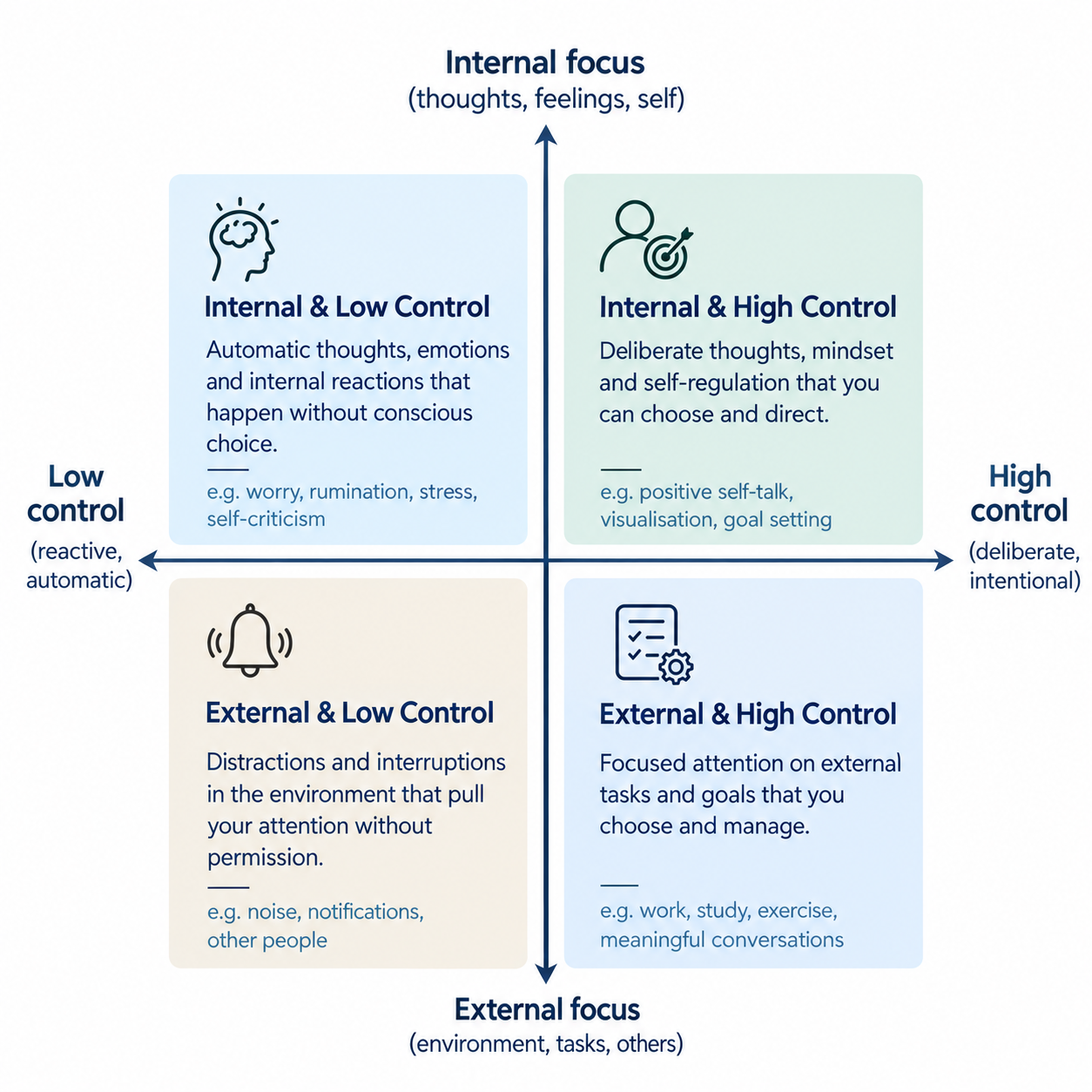
The second is direction. External attention is on the world outside you. Internal attention is on your own thoughts, feelings, and body.
The four combinations:
Broad-external. Taking in the whole situation. Wind, slope, hazards, pin, lie, the state of the match.
Broad-internal. Analysing and planning. Weighing options, recalling similar shots, calculating.
Narrow-internal. Rehearsing one thing. A single feel, a tempo, an intention.
Narrow-external. Locked onto one point in the world. The target, the ball, the spot you intend the ball to start over.
Here is what makes golf distinctive. A single golf shot requires you to move through all four, in order, in about 30 seconds.
You arrive at the ball and go broad-external: what is the situation? You shift to broad-internal: what are my options and which do I choose? You commit and move to narrow-internal: one feel, one intention, one cue. Then you step in and go narrow-external: the ball, the line, nothing else.
Almost every attentional error in golf is a failure to complete that sequence in the right order.
The most common by far is failing to leave broad-internal. The golfer is still analysing when they step in. They are computing yardage and second-guessing club choice while standing over the ball, which means the swing begins while attention is still in planning mode. The result is the classic uncommitted shot.
The second most common is returning to broad-internal from narrow-external. You have settled, and then a thought arrives: is this enough club? Now you are analysing again, with the club already back.
The fix in both cases is structural rather than effortful, and it is called a pre-shot routine.
External Focus and the Constrained Action Hypothesis
There is a large body of motor learning research comparing two kinds of attentional focus during movement.
Internal focus directs attention to the body producing the movement. "Keep your left arm straight." "Rotate your hips through impact." "Feel your weight shift."
External focus directs attention to the intended effect of the movement, or to something outside the body. "Swing the clubhead through the ball." "Send it over that bunker." "Brush the grass."
Across a very large number of studies, in many tasks and at many skill levels, external focus produces better performance and better learning than internal focus.
The explanation offered is the constrained action hypothesis. When you consciously attend to your own body movements, you interfere with automatic motor control processes that would otherwise organise the movement efficiently. Attending externally allows those processes to run unconstrained.
This is the same mechanism as reinvestment, described from the motor learning side rather than the pressure side. Internal focus is reinvestment by another name.
The implication for golf is direct and slightly uncomfortable, because it cuts against a great deal of golf instruction. Most swing tips are internal. "Stay behind the ball." "Keep your head still." "Lead with the hips." Every one of those points attention at a body part.
This does not mean instruction is useless. It means there is a time and place. Internal focus is appropriate during technical work, at slow speed, with no consequence, when you are deliberately building a movement pattern. It is inappropriate when you are trying to hit a golf ball at a target under any kind of pressure.
The transition from internal to external is one of the most valuable things a golfer can learn, and most never make it. They carry the practice-bay instruction onto the first tee and wonder why the swing feels mechanical.
💡
Key Insight: Practise with internal focus if you must. Play with external focus always. Confusing the two is why many golfers hit their best shots before they had lessons.
Designing a Cue: What to Think About When "Don't Think" Fails
"Don't think, just hit it" is well-meant and unworkable. Minds do not switch off on request, and a mind with nothing assigned to it will assign itself something, usually a hazard.
You cannot empty attention. You can occupy it.
A good golf cue has four properties.
Singular. One cue, not three. Multiple cues create a checklist, and checklists are conscious processing. If you have three swing thoughts, you have no swing thought, because you cannot attend to three things in 1 second.
External. Point it at the effect or the target, not the body. "Clubhead through the ball" rather than "release the hands."
Positively framed. Say what you intend to happen, not what you intend to avoid. This matters more than it sounds. To process "don't hit it left", the mind must first represent hitting it left. You have just spent your one second of narrow attention rehearsing the shot you fear.
Pre-decided. Choose the cue before you step in. A cue invented over the ball is not a cue, it is a last-minute thought, which is precisely what a routine exists to prevent.
Some cues that meet all four criteria, offered as templates rather than prescriptions: a specific intermediate target 2 feet in front of the ball on the intended start line; the sound you want the strike to make; the finish position you intend to hold; a single word for tempo; the flight shape drawn in your mind's eye.
The right cue is personal, and it changes. A cue that works this month may stop working, usually because it has become an instruction rather than an intention. When that happens, replace it rather than trying harder with it.
🎯
Try This: Choose one cue for your next range session and use nothing else for 40 balls. Not "mostly that cue". Only that cue. Most golfers find the first 10 balls uncomfortable and the last 20 revealing.
Attentional Economy Across 18 Holes
Return to the arithmetic. Roughly 70 shots, each needing perhaps 40 seconds of genuine attention. That is about 45 minutes of concentration distributed across 4.5 hours.
45 minutes is achievable. 270 minutes is not.
So the skill is not endurance. It is switching, and specifically it is switching off, which is the half nobody practises.
Think of it as a budget. You have a limited quantity of high-quality attention available in a round. Every minute you spend concentrating when there is nothing to concentrate on is a minute unavailable on the 17th green.
Golfers who play well over 4 hours share a visible pattern. They are fully engaged from the moment they begin assessing a shot until the ball is struck. Then they disengage completely. They talk about something unrelated, look at the trees, notice the weather. They are not managing their emotional state through the walk. They are simply elsewhere.
This looks like carelessness to golfers who have been taught that concentration is a virtue. It is the opposite. It is resource management.
The Walk Between Shots
The interval between shots is trainable architecture, not dead time. It has three phases, and skipping any of them costs you.
Disengage. The first 10 to 20 seconds after the shot. Whatever reaction the shot produced happens here, in full, and then ends. This is where the post-shot routine lives.
Recover. The long middle. Attention goes somewhere neutral or pleasant. The conversation. The view. This is the part that most amateurs eliminate, replacing it with rumination about the last shot or anticipation of the next one, and it is the part that determines whether you have anything left at the end.
Re-engage. The last 30 to 60 seconds before you reach your ball. You begin gathering information. What is the wind doing? Where is the pin? What is the lie likely to be? By the time you arrive, you are already in broad-external mode.
A golfer who runs this cycle 70 times arrives on the 18th tee with attention still available. A golfer who concentrates continuously arrives depleted, and depleted attention is exactly the condition in which conscious control takes over.
Mindfulness and Acceptance: Attention Without Control
There is an alternative tradition in performance psychology worth understanding, because it fits golf's structure unusually well.
Most mental skills training is control-based. It aims to change what you think and feel: replace negative thoughts, reduce anxiety, generate confidence.
Acceptance-based approaches take a different view. They hold that trying to control internal states is often the problem rather than the solution, because suppression is effortful and frequently backfires. Instead they train you to notice thoughts and feelings without treating them as instructions, and to act on your intentions regardless of what is present.
Applied to golf, the difference looks like this.
Control-based: you feel anxious over a putt, so you work to reduce the anxiety before stroking it.
Acceptance-based: you feel anxious over a putt, you notice that you feel anxious, you do not treat that as information about the putt, and you stroke it.
The second is usually faster and cheaper. You are not spending resource fighting a feeling that was going to be there anyway.
This connects to mindfulness as a trainable capacity: the ability to notice where your attention is, and to move it, without judging what you found. That skill is directly useful in golf, because the sport gives you several opportunities a round to notice that your attention has drifted to the water on the right and to move it back.
The evidence base for acceptance and mindfulness approaches in sport is growing and is genuinely promising, though it remains smaller and less mature than the evidence for routines and attentional training. It is reasonable to treat it as a useful complement rather than a replacement.
Where Attention Training Breaks Down
Three honest limitations.
Attention cannot be trained in the abstract. Doing concentration exercises at home does not reliably transfer to the golf course. Attentional skill is largely task-specific, which means it has to be trained while doing the thing.
Gains are context-bound. Attention trained on the practice green under no consequence does not automatically survive a competitive round. If the training never included pressure, it never taught you how to attend under pressure.
Awareness is not control. Many golfers learn to notice their attention wandering and conclude they have failed. Noticing is the skill. The wandering will continue for as long as you have a mind. The measure of progress is how quickly you notice, not whether it happens.
The Pre-Shot Routine: Golf's Most Researched Mental Skill
If you take one practical thing from this guide, take this. No other mental skill in golf has comparable evidence behind it, and no other skill delivers as much for the effort involved.
What the Evidence Actually Shows
In a meta-analysis published in the International Review of Sport and Exercise Psychology, researchers pooled 112 effect sizes from studies using both before-and-after designs and controlled experimental designs, under both low-pressure and pressurised conditions.
The findings, stated plainly.
Pre-performance routines improved performance in before-and-after designs, with a small but statistically reliable effect. In controlled experimental designs the effects were moderate to large, both when there was no pressure and when pressure was applied.
Critically, the effects held under pressure. This is the finding that matters most for golf, since a skill that works only when nothing is at stake is of limited use.
And the effects were not moderated by the type of routine, the age of the performer, their gender, their skill level, or the characteristics of the intervention. Both extensive routines with many components and simple standalone elements produced benefits.
That last point deserves emphasis, because it contradicts a great deal of golf folklore. There is no evidence that one particular routine is correct. What the evidence supports is having one.
📊
Research Says: Pooling 112 effect sizes, researchers found pre-performance routines improved sport performance under both low-pressure and pressurised conditions, and the benefit did not depend on the type of routine, the player's age, gender, or skill level. Having a routine mattered. Which routine did not.
Work specific to golf reinforces this. Studies of golf pre-shot routines have consistently found that skilled golfers show more consistent routine timing than less skilled ones, and that routines are highly individualised. Researchers studying elite golfers concluded that routines should be built around the individual player's needs rather than imposed from a template.
Why Routines Work: Three Competing Explanations
Researchers have offered three mechanisms. They are not mutually exclusive, and each carries a different practical implication.
Attentional control. The routine directs attention to task-relevant information and away from task-irrelevant distraction. It fills working memory with the right material so there is no room for the wrong material.
Implication: the routine's content matters. Filling the time with meaningless ritual will not work as well as filling it with target, line, and intention.
Warm-up decrement. Skills degrade when not performed for a period. In golf, the gap between shots is long. A routine that includes rehearsal movement re-primes the motor pattern before execution.
Implication: the practice swing is not decoration. It is part of the mechanism, and it should resemble the shot you intend to hit rather than being a generic swish.
Automatic execution. The routine acts as a trigger that initiates the automated motor programme without conscious involvement. The routine becomes the thing you consciously do, and the swing becomes something that happens.
Implication: consistency and repetition matter most. The routine has to be grooved enough to run itself, or it becomes one more thing to think about.
In practice, a good routine delivers all three.
The Anatomy of a Routine: Gather, Decide, Commit, Rehearse, Execute
A routine is not a superstition. It is a decision-making architecture that moves you through the four attentional states in the right order and closes the door behind you at each stage.
Five phases.
Gather (broad-external). Collect the information. Yardage, wind, lie, slope, pin, trouble, score situation. Look at everything that is relevant and nothing that is not.
Decide (broad-internal). Choose the shot. Club, shape, start line, landing point, acceptable miss. This is where analysis lives, and it is the only place analysis is allowed.
Commit (the hinge). A defined moment at which the decision becomes final. This is the most neglected phase and the most important. Commitment is not a feeling. It is an event, and you should be able to name when it happened.
Rehearse (narrow-internal). One practice movement or one felt rehearsal of the intended shot. Not three. Not a technical drill. A representation of the shot you are about to hit.
Execute (narrow-external). Step in, settle the gaze, swing. No new information enters here.
The whole sequence takes most golfers between 20 and 40 seconds.
Behind the Ball and in Front of It
The single most useful structural idea in golf routines is a physical boundary.
Everything in phases one to four happens behind the ball. You stand back, you look, you think, you choose, you rehearse.
Everything from the moment you step in happens in front of the ball, and it contains no thinking at all.
The line between the two positions is the commitment point. Crossing it means the decision is made. If a doubt arrives after you have crossed, you do not resolve it there. You step back behind the ball and restart the routine.
This gives you a clean rule that requires no willpower. Doubt over the ball is not a signal to think harder. It is a signal to reset.
🎯
Try This: For one round, allow yourself unlimited resets but zero thinking over the ball. If a doubt arrives after you have addressed the ball, step away and start again. Most golfers reset four or five times in the first nine holes and once or twice in the second nine.
Duration, Consistency, and the Myth of the Perfect Routine
Three practical questions come up constantly.
How long should it take? Long enough to complete the five phases, short enough that you do not have time to start analysing again. For most golfers, 20 to 40 seconds from arriving at the ball to starting the swing.
The absolute duration matters less than the consistency of it. Research on golf routines has repeatedly found that skilled players are more consistent in routine timing than less skilled players, and that a player's own timing consistency predicts performance better than any particular duration.
How many practice swings? Whatever number you can repeat every time. One is plenty for most golfers. The number is not the variable. The consistency is.
Should I copy a professional's routine? No. Copy the structure, not the content. The five phases are general. The specific cues, rehearsals, and timings should be built around how you actually process information.
The myth worth dismantling is that there is a correct routine waiting to be found. The meta-analytic evidence says otherwise: routine type did not moderate the effect. Elaborate routines and simple ones both worked. What did not work was having no routine, or having one that changes every week.
Imagery and Rehearsal Inside the Routine
The rehearsal phase is where visualisation and mental rehearsal actually earn their place in golf. Three points are worth getting right.
Perspective. You can imagine a shot from inside your own body, feeling it, or from outside, watching yourself. For golf shot rehearsal, internal perspective is generally more useful, because what you are trying to prime is the felt sense of the movement rather than its appearance.
Modality. Most golfers think of imagery as visual. The kinaesthetic component matters at least as much. What should this shot feel like in your hands and through your body? Golfers who add the felt dimension report that rehearsal becomes considerably more effective.
Content. Rehearse the shot you intend, complete, from start to finish, including the ball flight and where it lands. Not the swing mechanics. Not a fragment. The whole shot, successfully.
A caution worth stating. If your imagery is poor, vague, or keeps producing images of failure, that is not a moral problem and it does not mean imagery is not for you. Imagery ability varies, it improves with practice, and starting with simpler content (the ball's flight alone, or a single feel) usually works better than attempting a full cinematic rehearsal.
The Post-Shot Routine: The Half Nobody Trains
Here is the most underused idea in amateur golf.
Almost every golfer has some version of a pre-shot routine, however loose. Almost no golfer has a post-shot routine. And because of the structure described earlier, the post-shot routine probably matters more.
Think about it from the timing. Your pre-shot routine occupies 30 seconds of the interval before a shot. The remaining 90 seconds to 2 minutes of that interval is unmanaged. That is where the spiral lives.
A post-shot routine is a defined, three-step sequence that runs in the 10 to 20 seconds after every shot, good or bad.
React. Let the reaction happen. Do not suppress it. If you are annoyed, be annoyed. Research on emotion regulation is consistent that suppression is expensive and ineffective, and golfers who try to appear serene while seething are spending resource on the performance of calm. Give the reaction a defined window: a few seconds, bounded.
Assess. One sentence of useful information, then stop. Was that a decision error, an execution error, or variance? A single sentence. Not a technical inquest. Not a theory about your swing. The full inquest happens after the round, when you can think clearly and when it will not cost you a shot.
Release. A physical action that ends the sequence. Replace the club. Take one slow breath. Pick up the tee. The action does not matter. What matters is that it is the same every time and that it means the shot is over.
Then the walk begins, and the walk is for recovery, not for continued processing.
🎯
Try This: Build a post-shot routine before you refine your pre-shot routine. 10 seconds, three steps, after every shot for a full round. Most golfers who do this for four rounds report that their scores improve before their striking does.
What Breaks a Routine Under Pressure
Routines fail under pressure in four characteristic ways. Recognising yours in real time is most of the battle.
Acceleration. Everything speeds up. You walk faster, look less, rehearse quicker, and swing sooner. This is the most common failure and it comes directly from elevated arousal. The countermeasure is a timed anchor: one deliberate slow breath at a fixed point in the routine, which is very hard to rush.
Abbreviation. Steps disappear. Usually the rehearsal goes first, then the commitment point, and eventually you are walking up and hitting. The countermeasure is a checkable structure: know your five phases well enough that you notice when one is missing.
Addition. Extra steps appear. A second practice swing. A third look at the target. A re-grip. Additions are the visible form of doubt, and they signal that commitment did not occur. The countermeasure is the reset rule: step away and restart rather than adding.
Abandonment. The routine is dropped entirely, usually late in a round after several bad holes. This is a depletion signal. If you have been concentrating for 4 hours, you have nothing left to run a routine with.
Routines are also more vulnerable at specific moments. The first tee. The shot after a bad hole. A short putt that matters. The last three holes when something is at stake. Those are the moments to check the structure deliberately, and they are also the moments to establish a baseline of psychological readiness before you arrive at them.
The Other Half of the Round: Emotional Regulation Between Shots
Most amateur strokes are lost here, in the part of golf that nobody practises because it does not look like golf.
The 40-Second Window
Define the unit correctly and the problem becomes tractable.
The unit of golf's mental game is not the shot. It is the interval: the period from the moment the ball stops moving to the moment you begin your next pre-shot routine.
In that window, three things must be complete before you reach your ball.
The emotional response to the last shot must have run its course and ended. The useful information from it must have been extracted, in one sentence. And your arousal must be back within your working range.
If any of those three is unfinished when you arrive at the next shot, the routine starts contaminated, and no amount of routine quality will fix it.
The interval is generous. 40 seconds is a long time. 2 minutes is an enormous time. The problem is not that golf gives you too little time to recover. It is that golf gives you so much that, unmanaged, you will fill it with something worse than nothing.
Reappraisal Beats Suppression
Emotion regulation research distinguishes two broad strategies, and they have very different costs.
Suppression means having the emotional response and hiding it. You feel furious and you look composed.
Reappraisal means changing how you interpret the situation, which changes the emotional response itself.
The research is consistent. Suppression is expensive. It consumes cognitive resource, it does not reduce the internal experience much, and it tends to impair subsequent performance on demanding tasks. Reappraisal is cheap and effective, but it has to happen early, before the response is fully built.
This is why the calm-looking golfer who is internally raging plays worse than the golfer who visibly reacts for 3 seconds and then genuinely lets it go.
Reappraisals that work in golf share a feature: they are true. A reappraisal you do not believe is just a slogan, and slogans do not change appraisals.
Some that are usually true.
That shot was worse than the swing. Often accurate. Bad results frequently come from decent swings with a bad bounce or an unnoticed lie.
This is one shot of 70. Arithmetic, not optimism.
I have recovered from worse than this, on this course. Check whether it is true before you use it, and if it is, it is powerful.
The feeling is the stake, not the problem. You care because it matters. That is not a malfunction.
The broader approach here is cognitive restructuring: identifying the interpretation that produced the feeling and testing whether it is accurate. On a golf course you have neither time nor cognitive space for a full examination, so the reappraisals have to be decided in advance, which means the work happens off the course.
Anger, Frustration, and Caring Correctly
There is a widespread belief that good golfers feel nothing. They do not. Watch any high-level player closely for a full round and you will see plenty.
The difference is not the presence of emotion but its duration and its direction.
Consider what frustration actually is. It is the gap between expectation and result, experienced as energy. That energy is not automatically harmful. Directed forward, into the next decision, it sharpens. Directed backwards, into the last shot, it corrodes.
There is also a useful distinction between frustration with a shot and frustration with a self. "That was a poor strike" is specific, bounded, and finished. "I am useless at this" is global, permanent, and has no exit. The first ends when the shot ends. The second follows you to the 18th.
The emotions involved in sport are not obstacles to be removed. They are part of how performance is organised, and the goal is to keep them in the range where they help you, which is the practical meaning of finding your optimal zone.
One further point, often missed. The golfer who feels nothing on a difficult shot is not necessarily in a good state. Flat affect at a moment that should matter often indicates disengagement, and disengaged golfers make careless decisions. Caring is not the enemy. Caring in a way that produces threat rather than challenge is.
The Physiological Reset: Breath, Ground, Cue
You cannot talk yourself out of an activated nervous system quickly. You can act on it directly, and the fastest lever available is breathing.
The mechanism is worth understanding rather than taking on trust. Heart rate rises during inhalation and falls during exhalation, an effect mediated by the vagus nerve. Deliberately extending the exhalation relative to the inhalation therefore increases the proportion of each breath cycle spent in the heart-rate-lowering phase. Slow breathing at roughly 6 breaths per minute also maximises the natural oscillation in heart rate, which is associated with a calmer autonomic state.
This is not relaxation as a mood. It is a mechanical intervention on the nervous system, and it works whether or not you believe in it.
The practical version for a golf course, in three parts.
Breath. One slow inhalation through the nose for about 4 seconds, one slow exhalation for about 6 to 8. One breath is often enough. If not, take two. There is rarely time for more, and there is rarely need.
Ground. Shift attention to a physical sensation outside your thoughts. The feel of your feet in your shoes. The grip in your hands. The temperature of the air. This interrupts rumination by occupying the channel it runs on.
Cue. One word or phrase that signals the reset is complete and the next shot has begun. "Next." "Here." Whatever you like. What matters is that it is the same word every time, so that repetition eventually gives it real effect.
Fuller methods of breathing and relaxation are worth learning properly, because a technique practised only when you need it will not be available when you need it. Practise it when calm, in ordinary situations, until it is automatic.
📌
Remember: A breathing technique you have only used in a crisis is not a skill. It is a hope. Practise it on the practice green, in the car, at your desk, until the body knows what the first slow exhale means.
Rumination and the Hole You Cannot Leave Behind
Rumination is repetitive thinking about a negative event that generates no new information. Reflection is thinking about an event in order to learn from it. They look similar from outside and are completely different in effect.
Golf is close to an ideal environment for rumination. It provides a negative event, followed by several minutes of low-demand walking with nothing to occupy attention, followed by another opportunity to fail. Repeat 70 times.
Three practical tests to distinguish the two.
Does the thinking produce anything new? Reflection generates information. Rumination replays.
Is it bounded? Reflection ends when the information is extracted. Rumination continues until interrupted.
Is it about the shot or about you? Reflection examines what happened. Rumination examines what it means about your worth as a golfer.
If two or more of those point to rumination, the correct response is not to think harder about it. It is to close it.
Closure works better with a physical marker than a mental instruction. "Stop thinking about the 6th" does not work, because the instruction requires holding the 6th in mind. What works is an action that means the hole is finished: writing the score, replacing the club, a specific breath at the next tee marker. The action does the work that the instruction cannot.
One more thing worth knowing. Rumination is strongly associated with fatigue and with low mood, which means it worsens late in a round and worsens further when you are tired or have had a difficult week off the course. If you find yourself ruminating far more than usual, that is often information about something other than golf.
Self-Talk That Survives a Bad Lie
Self-talk research distinguishes two functions, and golfers mostly use the wrong one.
Instructional self-talk directs attention and guides execution. "Left edge, firm." "Smooth through it."
For fine motor skills under pressure, instructional self-talk generally outperforms motivational. Golf is almost entirely fine motor skill. Yet the self-talk most amateurs use is motivational, because that is what the culture supplies.
Three further findings worth applying.
Second person often beats first person. "You've done this before" tends to work better than "I've done this before." The proposed reason is that second-person address creates a small distance from the emotional experience, which makes the statement easier to accept.
Content matters less than pre-decision. A pre-decided, mediocre phrase beats an inspired phrase invented on the spot, because the invention itself consumes the resource you needed.
Negation fails. "Don't be short" requires representing being short. Your attention has just rehearsed the miss. Every phrase should describe the intention.
The self-talk literature in sport supports a simple approach: write down three phrases before the round, one for after a good shot, one for after a bad one, and one for a shot that matters. Use only those three. Most golfers find that having decided in advance is worth more than what they decided.
Resilience Across a Tournament, Not Just a Round
Multi-round competition adds a layer that single rounds do not.
The evening after a poor first round is a real psychological event, and most amateurs handle it badly. The two common errors are opposites and both are costly.
The first is the emergency practice session. 3 hours on the range after a 92, trying to find something. This almost never works, for reasons that should now be clear: you are attempting technical reconstruction while depleted and anxious, which installs conscious control rather than removing it.
The second is complete avoidance, in which the round is never processed at all and arrives unresolved on the first tee the next morning.
The middle path is a short, structured review, done once, early in the evening, followed by genuine disengagement. 10 or 15 minutes. What were the decision errors? What were the execution errors? What was variance? What is the one thing worth doing differently tomorrow? Then close it.
Sleep matters more than most golfers assume. Sleep loss impairs exactly the functions golf depends on: sustained attention, working memory, emotional regulation, and fine motor control. A golfer who practises until dark and sleeps 5 hours has traded the thing that would have helped for the thing that will not.
Across a season, the same principle scales up. Resilience and adaptability in golf are less about enduring bad rounds than about limiting what you conclude from them. The golfer who has a poor month and concludes "that was a poor month" starts the next one intact. The golfer who concludes "I have lost it" has created a problem that will take considerably longer to resolve than the swing fault that started it.
Course Management Is a Psychological Discipline
Golfers treat strategy as a tactical matter, separate from the mental game. It is not. Course management is applied decision psychology, and most of the strokes it costs are lost to cognitive bias rather than ignorance.
Strategy, Tactics, and Execution: Three Levels, Three Different Mistakes
Performance problems come in levels, and the most common error in golf is trying to solve a problem at the wrong one. The distinction between strategic, tactical, and operational performance applies directly.
The strategic level is the season. What are you trying to achieve this year? Where does your time go? What is worth working on, given the state of your game and your available hours? This level is decided at a desk, not on a course.
The tactical level is the round. What is your plan for this course, in these conditions, in this competition? Which holes are birdie chances and which are damage-limitation holes? What is your score target, if any?
The operational level is the shot. Given this lie, this wind, this pin, what am I going to do right now?
Almost every golfer conflates these. They arrive at a course with no tactical plan and then try to construct one shot by shot at the operational level, under time pressure, while activated. The result is inconsistent decision-making that feels like indecision but is really a missing layer.
The diagnostic is useful. If you keep making the same poor choice, that is a tactical problem and no amount of better execution will fix it. If you make good choices and execute badly, that is operational. If you have been working hard for 2 years with no improvement, that is strategic, and the answer is usually that your practice is aimed at the wrong thing.
💡
Key Insight: You cannot solve a strategic problem with operational effort. Hitting more balls will not fix a practice plan that was never designed.
The Asymmetry of Golf Scoring
Here is a piece of arithmetic that should change how you play, and usually does not because it feels wrong.
On a par four, the best realistic outcome from an aggressive play is usually a birdie. That gains you one stroke. The worst realistic outcome is a lost ball, a penalty, or a chip-out followed by a poor recovery. That costs you two, three, or four.
The distribution is not symmetrical. Your upside is capped at roughly one stroke. Your downside is not capped at all.
This means that aggressive play must succeed far more often than it fails just to break even. In practice, for most amateur golfers, the low-percentage shot needs to come off something like three times in four to be worth attempting, and it usually comes off one time in three.
Every golfer knows this intellectually. Almost none of them play as though they believe it, because the experience of the successful hero shot is vivid, memorable, and emotionally rewarding, while the cost of the failures is distributed quietly across a season.
This is availability bias doing its work. The shot you remember is the one that came off.
The practical correction is not "play safe". It is to notice that your instinct systematically underweights the downside, and to lean against it deliberately rather than trusting how a decision feels.
Loss Aversion on the Green: The Par and Birdie Asymmetry
The single most striking piece of evidence about golfers' decision-making does not come from sport psychology at all. It comes from behavioural economics.
In a study published in the American Economic Review, researchers analysed more than 2.5 million putts hit by professional golfers, using laser-measured distances.
The question they asked is elegant. In golf, only your total strokes matter. A stroke saved on the 4th is worth exactly as much as a stroke saved on the 18th, and a birdie putt is worth exactly as much as a par putt. Every putt should therefore be treated identically.
But each hole has a salient reference point: par. Missing a par putt feels like a loss. Missing a birdie putt feels like a foregone gain. And loss aversion, one of the most robust findings in behavioural science, says that losses loom larger than equivalent gains.
If golfers are loss averse, they should try harder on par putts than on birdie putts of the same length.
That is exactly what the data showed. Professionals were measurably more likely to hole a par putt than a comparable birdie putt from the same distance. The effect was small in percentage terms and enormous in aggregate: across a season it is worth a meaningful number of strokes and a substantial amount of prize money.
These were the best golfers in the world, with maximal experience, intense competition, and very high stakes. Precisely the conditions under which economists had argued biases would be extinguished. They were not.
📊
Research Says: Analysing 2.5 million professional putts, researchers found that golfers hole par putts more often than birdie putts from equivalent distances. Par functions as a reference point, and missing it feels like a loss, so players try harder. The bias persisted among the very best players in the world.
What should you do with this? Two things.
First, recognise that "par" is a number invented by a course architect and has no meaning in your score. Your card records strokes, not relationships to par. A golfer who thinks in strokes rather than in birdies and bogeys is working with a cleaner reference point.
Second, notice the asymmetry in your own play. Most amateurs leave birdie putts short and then hole the return. That is not a stroke problem. That is a reference point problem, and the fix is to give every putt the same intention regardless of what it is for.
Choosing Versus Accepting: The Psychology of Commitment
There is a difference between having decided and being committed, and golfers who do not distinguish them lose shots constantly.
Choosing is selecting an option. It is a cognitive act and it happens in the decide phase of the routine.
Committing is accepting the chosen option and closing the others. It is not primarily cognitive. It is a willingness to accept whatever happens, having made the best decision you could with the information available.
A golfer can choose a seven iron and still be uncommitted, because part of them is still holding the eight. That part will show up in the swing, usually as deceleration or steering.
The uncommitted good decision produces a worse shot than the committed mediocre one. This is why "wrong club, well struck" is usually a better outcome than "right club, tentatively struck".
Two tests for whether commitment has actually occurred.
The acceptance test. Can you say, honestly, before you swing: "If this does not work, I will still think that was the right shot to play"? If the answer is no, you have not committed, and you should step back and choose again.
The doubt test. Is there a competing option still live in your mind? If so, you are holding two intentions. Resolve it behind the ball or step away.
Commitment is easier when the decision is made properly. Most failures of commitment are actually failures of the decide phase: the golfer did not gather enough information, or rushed, or never explicitly chose. Doubt over the ball is very often a correct signal that the decision was never finished.
Pre-Round Planning and the Shots You Will Not Hit Today
Decisions made calmly in advance are better than decisions made under pressure in the moment. This is not a statement about golf. It is a general finding about human decision-making, and it applies unusually well here because golf gives you the opportunity to plan and most golfers waste it.
Three planning moves, each taking a few minutes.
The hole plan. Before the round, go through the card. Mark the holes where you will be aggressive and the holes where your only aim is to avoid a big number. On most courses, two or three holes account for a disproportionate share of an amateur's damage. Knowing which ones they are, before you stand on the tee, removes the decision from the moment when you are least equipped to make it.
The shot exclusion list. Write down one or two shots you will not attempt today. Not shots you are bad at in general – shots that are not working this week, or that this course punishes severely. "No driver on any hole with water right." "No flop shots." The point of writing it is that it becomes a pre-commitment rather than a judgement call made from the trees.
The miss plan. For each hole, know which side you can miss on. This changes club selection and aim in ways that are invisible on a scorecard and enormous over a season.
The psychological value of all three is the same. They convert operational decisions into tactical ones, which means they get made by the version of you that is calm and thinking clearly rather than the version standing over a ball with a match on the line.
Playing Your Own Game: Social Comparison and the Partner Effect
Golf is played alone and never in private. Three or four people watch every shot you hit, and this has measurable effects.
Pace matching. Golfers unconsciously match the tempo of their playing partners, in walking speed and in swing rhythm. Play with a fast player and your own routine tends to accelerate. This is one of the most common and least recognised causes of a round falling apart.
Risk contagion. If a partner takes on an aggressive line and pulls it off, the next player is measurably more likely to attempt something similar. The decision was made by somebody else's success.
Club matching. Seeing a partner hit a nine iron to a green makes it psychologically harder to take your eight, even when your eight is correct. This is straightforward social comparison, and it costs amateur golfers a great many shots that finish short.
Evaluation apprehension. Being watched by people whose opinion you care about raises arousal. The effect is strongest on the first tee, which is why the first tee is the hardest shot in amateur golf despite being, physically, an ordinary drive.
The countermeasures are unglamorous. Know your own routine timing well enough to notice when it has shifted. Choose your club before you see what anyone else has chosen. And accept in advance that the first tee will feel different, so that the feeling is not itself evidence of a problem.
Match Play, Stroke Play, and Team Formats
The scoring format changes the psychological problem entirely, which is why some golfers are transformed by one and undone by another.
Stroke play is cumulative and unforgiving. Every shot counts, nothing is erased, and one catastrophic hole can end a round. It rewards consistency, damage limitation, and emotional stability across 4 hours. The dominant psychological risk is the spiral.
Match play resets every hole. A nine on the 4th costs you exactly one hole, the same as a bogey would. This makes match play far more forgiving of disaster and far more demanding in a different way: it introduces a direct opponent, which converts an internally generated pressure environment into an externally generated one. Risk calculation changes completely, because the value of an aggressive play depends entirely on what your opponent has already done.
Team formats add something golf otherwise lacks: responsibility to other people. In foursomes, where partners play alternate shots with the same ball, your mistake is directly inherited by someone else. This produces a distinctive form of pressure that many players report as harder than anything in individual golf, and it is the reason team competitions generate the sport's most visible nerves at the highest level.
The psychology here overlaps with what we know about team dynamics more generally: interdependence changes motivation, raises evaluation apprehension, and shifts the reference point from your own standard to your contribution to the group.
The practical lesson is that a golfer should not expect the same mental approach to serve all three. The stroke-play discipline of avoiding disaster is actively wrong in match play, where a bold recovery costs one hole at most.
💌
Support this work! This article draws from years of research and experience. Your membership helps me create more valuable content like this for you, while unlocking premium articles, insights, resources, newsletter, and strategies on performance, resilience, and wellbeing – all backed by research and delivered in plain language to help you improve your life!
Confidence, Motivation, and the Long Arc of Improvement
The previous sections dealt with a round. This one deals with years, because golf is a sport people play for decades and most of what determines whether they improve happens outside any individual round.
Where Golf Confidence Actually Comes From
Confidence is the most discussed and least understood concept in golf. Treating it as a mood to be summoned is why it feels so unreliable.
Albert Bandura's work on self-efficacy gives a more useful account. Self-efficacy is your belief that you can execute a specific task in a specific situation. It is not general self-belief. A golfer can have very high efficacy for driving and very low efficacy for bunker play, and the two barely interact.
Efficacy comes from four sources, and they are not equal in power.
Mastery experience is by far the strongest. Having done the thing successfully, especially under conditions resembling the ones you now face. Nothing else comes close.
Vicarious experience is seeing someone similar to you succeed. Similarity matters: watching a professional does less for you than watching someone of your standard.
Verbal persuasion is being told you can do it. Weak, and weaker still if the source is not credible or the message is not consistent with your own evidence.
Physiological and emotional states are how you interpret what your body is doing. This is where the challenge and threat material enters: the same racing heart can read as readiness or as evidence of impending failure.
Two conclusions follow directly.
First, confidence built on recent results is inherently unstable, because results are noisy. A golfer whose confidence tracks their last three rounds is on a permanent rollercoaster through no fault of their own.
Second, the most efficient way to build durable confidence is to manufacture mastery experience deliberately. That means practice designed so that you accumulate successful repetitions under conditions that resemble competition, which is precisely what the practice protocols are for.
Task and Ego Orientation on the First Tee
Achievement goal theory distinguishes two ways of defining success, and the difference shapes everything from practice habits to how you respond to a bad round.
Task orientation defines success as improvement relative to your own past. Did I do that better than I used to?
Ego orientation defines success as performance relative to others. Did I beat them?
Most people hold both to some degree. The balance matters.
Task-oriented golfers tend to persist longer through difficulty, choose appropriately challenging tasks, attribute failure to effort and strategy rather than ability, and sustain intrinsic interest over years.
Ego-oriented golfers tend to perform well when they are winning and deteriorate when they are not, avoid tasks where they might look bad, and are more vulnerable to the threat state described earlier because their self-worth is directly on the line with every score.
Golf makes ego orientation unusually easy to fall into. The handicap system supplies a permanent comparative number. Competitions publish results. Playing partners provide a live comparison on every hole.
The practical point is not that ambition is bad. It is that a golfer who can hold a task-oriented frame during the round – am I executing my process, am I making good decisions – and save the comparative judgement for afterwards will perform better than one who is evaluating their standing on every green. The detail of achievement goal theory is worth reading in full if this pattern sounds familiar.
Autonomy, Competence, and Relatedness in Golf
Why do some golfers practise for 30 years and others quit within two? Self-determination theory gives the most useful answer available.
The theory holds that sustained motivation depends on three psychological needs being met.
Autonomy is the sense that you are doing this because you choose to. Golfers lose autonomy when the game becomes an obligation: a business necessity, a family expectation, a commitment to a team they did not want to join.
Competence is the sense that you are getting better. This is where golf is treacherous, because improvement is slow and noisy, and a golfer with no reliable way to detect progress will conclude there is none.
Relatedness is connection to others through the activity. This is golf's great strength. Much of what keeps people in the game for life is not the golf.
Practical implications follow.
If your motivation is falling, diagnose which need is unmet rather than trying to want it more. If it is autonomy, the answer may be to play less competitively for a while. If it is competence, you need better measurement, not more effort, because you are probably improving without being able to see it. If it is relatedness, the answer is a different group rather than a different swing.
Coaches and clubs should note that the three needs are also the levers for retention. Junior programmes that maximise instruction and minimise choice tend to produce good young swings and short golf careers.
The Handicap as Instrument and as Trap
The handicap is one of the great inventions in sport. It allows a 14-handicapper and a 2-handicapper to have a genuine contest, which almost no other sport permits. That is worth defending.
It also does psychological work that nobody designed.
As an instrument, it provides calibrated feedback in a sport where progress is otherwise very hard to detect. It converts noisy results into a trend. It makes competition accessible. These are real benefits.
As a trap, it converts performance into identity. "I am a 9" is a statement about the self, not about a recent scoring average. Golfers protect it, fear losing it, and experience its movement as personal rather than statistical.
Three specific distortions worth watching for.
Protective play. A golfer defending a handicap plays to avoid a bad score rather than to shoot a good one. That is an avoidance goal, and avoidance goals produce threat states.
Entitlement to a standard. A golfer who "is a 9" experiences an 85 as a failure, when 85 is a perfectly normal score for that handicap. The handicap describes your better rounds, not your average one, which many golfers never realise.
Identity lock. A golfer who has been a 12 for 5 years can find it genuinely difficult to play like a 10, because doing so contradicts a settled self-description.
Holding it usefully means remembering what it actually is: a number derived from a subset of your recent scores, updated by an algorithm, designed for a purpose that has nothing to do with your worth.
Goals That Survive a Bad Month
Goal setting is well studied and widely misapplied in golf. The standard framework distinguishes three types, in descending order of how much control you have over them.
Outcome goals concern results relative to others. Win the club championship. Finish top 10.
Performance goals concern your own measurable standard, independent of others. Break 80. Average 32 putts.
Process goals concern what you do. Complete the full routine on every shot. Commit before stepping in. Run the post-shot routine after every hole.
You have almost no control over outcome goals, considerable control over performance goals, and near-total control over process goals.
The practical structure that works is a hierarchy. Hold one outcome goal for direction, two or three performance goals as markers, and a small number of process goals that you actually track. Then, during the round, attend only to the process goals. Outcome goals belong to the strategic level and are checked at season's end, not on the 12th tee.
A golfer whose in-round attention is on process has something to succeed at on every shot, regardless of score. A golfer whose attention is on the outcome has nothing to succeed at until the round ends, and can only fail along the way.
The detailed mechanics of goal setting matter, particularly around specificity and difficulty. But the single most important move is simply the separation: know which type each of your goals is, and know which type belongs in your head while you are playing.
Mindset, Plateau, and the Honest Improvement Curve
Golf improvement does not look like a line. It looks like a staircase with very long steps and occasional drops.
You work for 3 months and nothing happens. Then something clicks and you improve noticeably in a fortnight. Then nothing again for 4 months. Then a period where you get slightly worse, which frequently follows a technical change and is a normal part of relearning rather than a sign of failure.
Most golfers expect linearity. When they encounter a plateau, they conclude that what they are doing is not working and change it. Changing during a plateau is usually the worst available move, because the plateau is often the consolidation phase in which a change is being integrated.
This is where the research on growth mindset becomes practically relevant, though it is worth stating that the effect sizes in the broader mindset literature are more modest than popular accounts suggest. The useful core of the idea survives that scrutiny: golfers who interpret difficulty as part of the process persist through plateaus, and persistence through plateaus is the main determinant of long-run improvement in a sport where the plateaus are this long.
The countermeasure to plateau panic is measurement that is not the score. Score is too noisy to detect improvement over anything less than about 20 rounds. Track something more stable – fairways, greens in regulation, putts, up-and-down percentage, or simply your process-goal adherence – and you will see movement that the scorecard hides.
📌
Remember: A plateau is usually the sound of something being consolidated. Changing your swing during one is like opening the oven every 2 minutes to see whether it has risen.
Flow in Golf: What It Is, and Why Chasing It Backfires
Golfers talk about being "in the zone" more than almost any other athletes, probably because golf's long duration makes the contrast between zone and non-zone rounds so vivid.
Flow, as described by Mihaly Csikszentmihalyi, is a state of complete absorption in an activity. Its characteristics include intense concentration, merging of action and awareness, loss of self-consciousness, altered sense of time, and the activity feeling intrinsically rewarding.
The conditions that produce it are reasonably well established. Clear goals. Immediate feedback. And, most importantly, a balance between the challenge of the task and your skill level, at a point where both are relatively high.
Golf can produce flow readily, because it supplies clear goals and immediate feedback on every shot. The challenge-skill balance is the harder part, and it explains why flow is rare in two specific situations: a course far too difficult for you, where challenge overwhelms skill and produces anxiety; and a round with nothing at stake, where challenge is too low and produces boredom.
The critical practical point is that flow cannot be pursued directly. Loss of self-consciousness is a defining feature of it, and monitoring whether you have achieved it is self-consciousness. The golfer asking "am I in the zone yet?" has answered their own question.
What you can do is create the conditions. Clear intention on every shot. A routine that produces immediate engagement. A challenge level matched to your ability. Attention externally focused. Then flow either arrives or it does not, and the round is well played either way.
This is perhaps the clearest example of a general principle running through this whole guide: the best states in golf are by-products, not targets.
How Golfers Actually Get Better: The Psychology of Practice
Most amateur practice is enjoyable, well-intentioned, and close to useless. The reason is a genuine paradox in motor learning that almost nobody is taught.
Why Block Practice Feels Good and Teaches Little
Go to any driving range and watch. A golfer takes out a seven iron and hits 40 balls with it to the same target.
Something predictable happens. The first few are scrappy. By the 10th, the strike is better. By the 20th, the golfer is hitting it well and feeling good.
This is blocked practice: the same task repeated consecutively. And it works exactly as it appears to, within the session.
Here is the problem. Motor learning research draws a hard distinction between performance – how well you do during practice – and learning – how much has been retained and can be produced later in a different context.
They are not the same thing, and the conditions that maximise one often reduce the other.
Blocked practice maximises within-session performance and produces poor retention and poor transfer. You are not really learning to hit a seven iron. You are calibrating to a repeated task, which is a much narrower skill that disappears when the task stops repeating.
On the course, you will never hit two consecutive seven irons. You will hit one, then walk, then hit a putt, then hit a drive, then, 20 minutes later, one more seven iron from a different lie to a different target.
The golfer who has practised in blocks has trained for a game that does not exist.
💡
Key Insight: Practice that feels productive and practice that produces learning are frequently opposites. If your range session feels great by the end, it is worth asking what it taught you.
Contextual Interference and Variable Practice
The alternative is random or variable practice: changing the task between repetitions.
In golf terms: change the club every shot. Change the target every shot. Change the intended shape. Never hit the same shot twice in a row.
This feels much worse. Performance during the session drops noticeably. Golfers describe it as frustrating and often conclude it is not working.
Retention and transfer are markedly better.
The phenomenon is called contextual interference. The proposed mechanism is that when the task changes between attempts, you cannot simply reuse the motor plan from the last attempt. You have to reconstruct it each time. That reconstruction is effortful, and the effort is what produces durable learning.
There is a second mechanism worth knowing. Variable practice teaches you the parameters of a movement rather than one fixed version of it. A golfer who has hit shots at many distances with many clubs in varied conditions has learned a flexible, generalisable skill. A golfer who has hit 400 identical seven irons has learned one specific instance of it.
The practical rule for a range session: after any technical work, no two consecutive shots should be the same. Change something every ball – club, target, shape, trajectory, or all four. Go through a full imaginary hole. Then a different one.
Accept that it will feel worse. That is the mechanism working, not failing.
Deliberate Practice in a Sport With Delayed, Noisy Feedback
Deliberate practice, as defined in the expertise literature, has specific requirements. It is effortful, targeted at a weakness rather than a strength, involves immediate and informative feedback, includes repetition with refinement, and is generally not enjoyable while it is happening.
Golf makes three of these genuinely difficult.
Feedback is delayed. You see where the ball goes, but that is outcome feedback, not process feedback. It tells you the result and not the cause. Outcome in golf is noisy enough that it is often misleading about the process.
Feedback is confounded. A pushed shot can come from an open face, an in-to-out path, a poor setup, an unnoticed slope, or a ball position 2 centimetres back. The result alone does not distinguish between them.
Targeting a weakness is uncomfortable. Golfers overwhelmingly practise the shot they hit best. This is human, and it is why the bunker game of the average club golfer never improves.
Three ways to create genuine deliberate practice conditions in golf.
Manufacture the feedback. Use a device, a mirror, video, an alignment stick, impact tape, or a partner who is watching for one specific thing. The point is to get information about the process, not only the result.
Practise the thing you avoid. Keep an honest list of the shots you dread and allocate time to them deliberately. If you dread bunker shots, 30 minutes a week in a bunker for 2 months will change your golf more than 300 drivers.
Define a target for each session. Not "hit some balls". One specific thing you are working on, with a way to know whether it happened.
Implicit Learning, Analogy Learning, and Errorless Practice
This is where the practice section connects back to the pressure mechanism, and it is one of the more elegant findings in the field.
If choking is caused by reinvesting explicit rules into an automated skill, then a skill learned with fewer explicit rules should be more robust under pressure. There would simply be less to reinvest.
This is the logic behind implicit motor learning, associated principally with Rich Masters. The approach is to build motor skill while minimising the accumulation of conscious, verbalisable rules.
Several methods have been developed.
Analogy learning replaces a set of technical instructions with a single metaphor that carries the movement pattern without decomposing it. Instead of a five-part description of a putting stroke, the golfer is told to swing the putter like a pendulum. The analogy conveys the movement holistically, and there are no component rules to reinvest under pressure.
Errorless practice structures early learning so that errors are rare, typically by starting with very easy versions of the task and progressing gradually. A putting example would be starting at 1 foot and moving back an inch at a time. Because errors are rare, the learner does not generate hypotheses about what went wrong, which means they do not accumulate explicit rules.
Dual-task practice occupies working memory with a secondary task during practice, which prevents explicit rule formation. Counting backwards while chipping is the classic version.
Studies comparing implicitly and explicitly trained performers have generally found that both groups reach similar skill levels in calm conditions, but the implicitly trained group holds up better under pressure.
The practical implication for golf is significant, particularly for high reinvestors. If you are the kind of golfer who has read a great deal of instruction and can describe your swing in detail, you may be carrying a large stock of explicit rules that becomes available for reinvestment at exactly the wrong moment. Deliberately building new skills implicitly – through analogies, feels, and gradual progressions rather than technical descriptions – is a genuine option.
Pressure Training: Manufacturing Consequence
You cannot learn to perform under pressure by practising without it. This sounds obvious and is almost universally ignored.
The reason golfers do not practise under pressure is that pressure is unpleasant and practice is meant to be a refuge from it. But a skill trained only in comfortable conditions is a skill that has never been tested in the conditions where you need it.
Genuine practice pressure requires at least some of four components.
Stakes. Something must be at risk. Money, however small. A forfeit. A commitment to a longer session if you fail. The amount is irrelevant; the presence of a consequence is not.
Audience. Someone watching whose opinion you care about. Even one person changes the physiology measurably.
Scoring. A defined, recorded outcome that you can succeed or fail at. "Some putting practice" has no pressure. "9 out of 10 from 6 feet or start again" does.
Irreversibility. No second attempts. One ball. On the course you get one ball, and a practice format that allows a mulligan has removed the defining feature of golf.
The design principle is graded exposure: start with mild pressure and increase it as you cope. Jumping straight to maximum pressure produces failure and avoidance rather than learning.
I will address specific games built on these principles later.
🎯
Try This: Next putting session, end with one challenge: hole five consecutive putts from 4 feet, and if you miss, start again. Nothing else. Most golfers discover that their 4th and 5th putts feel completely different from their first, which is the entire point.
Measurement: What to Track and What to Ignore
Most golfers track their score and nothing else. Score is the least informative number available, for two reasons: it is extremely noisy, and it tells you nothing about cause.
A better measurement set has three layers.
Outcome measures tell you where you stand. Score, handicap. Check these monthly or less. They move too slowly and too noisily to be useful for anything more frequent.
Performance measures tell you where strokes are going. Fairways hit, greens in regulation, putts per round, up-and-down percentage, penalty shots, three-putts. These are much more stable than score and they point to the area that needs work. Track these every round.
Process measures tell you whether you did what you intended. Routine completion rate. Number of shots where you were fully committed. Number of shots played from an unmanaged emotional state. These are the only measures you have direct control over, and they are the only ones worth attending to during a round.
Most golfers track layer one and ignore layers two and three. Reverse the emphasis and you will learn considerably more from the same number of rounds.
There is one more measure worth keeping, and it is the most revealing of all: the count of holes where you added a stroke through a decision rather than a swing. Most amateurs are shocked by that number the first time they record it honestly.
The Transfer Test
Here is a single question to ask at the end of any practice session.
Did I do anything in that session that resembles what I will actually be asked to do on the course?
On the course, you hit one ball, from a lie you did not choose, with a club you selected under uncertainty, after a decision, with a consequence, having last hit that club 20 minutes ago.
If your practice session contained none of those elements, it was not golf practice. It may have been valuable technical work, which has its place, but it will not transfer directly.
A reasonable split for a golfer with limited time: roughly a third on technical work with blocked repetition and internal focus, a third on variable practice with changing clubs and targets, and a third on competitive practice with scoring and consequence.
Most amateurs spend all of it on the first third. That is why the range and the course feel like different sports.
Golf, Wellbeing, and What the Research Overlooks
Everything so far has treated golf as a performance problem. It is also a health behaviour, a social structure, and for many people a lifelong relationship. This section addresses those, and it also states plainly where the evidence base is thinner than it looks.
Golf as a Health Behaviour Across the Lifespan
The 2018 International Consensus Statement on Golf and Health, published in the British Journal of Sports Medicine and drawing on a systematic review of 342 eligible studies, set out the evidence in one place.
The headline findings are straightforward. Golf provides moderate-intensity physical activity. A round played on foot involves substantial walking, typically well beyond the daily step counts most adults achieve. It is associated with improvements in cardiovascular and metabolic health markers, and with reduced risk of chronic disease. The consensus panel also reported likely benefits for mental wellbeing.
Two features make golf unusual as a health behaviour.
It is sustainable across the lifespan. Most vigorous sports have a natural end point. Golf does not. People take it up in their sixties and play into their nineties. Very few activities deliver several hours of moderate activity, outdoors, in company, to people in their eighth decade.
It is social by design. The 4-hour format, in a group, with conversation, is structurally protective. Social connection is among the strongest predictors of long-term health outcomes, and golf delivers it as a side effect rather than as a prescription.
The relationship between physical activity and mental health is well established, and golf hits several of the mechanisms at once: movement, daylight, green space, and company.
None of this is a reason to be relaxed about the strokes. It is a reason to be clear about what the game is actually delivering while you worry about them.
Mental Health in Professional Golf
Tour golf has a distinctive risk profile, and it is worth stating because the popular image of the sport conceals it.
The conditions are unusual. There is no guaranteed income for most professionals; you are paid only if you perform. Travel is constant and largely solitary. There is no team, no dressing room, and no colleague who shares the day with you. Seasons are long. Playing status is renewed annually, which means a bad year does not merely cost money but can remove your access to the job entirely. And the margin between a comfortable career and no career at all is often a fraction of a stroke per round.
Add to this a sport in which failure is public, recorded, and searchable.
A number of high-profile players across the professional game have spoken about anxiety, depression, and burnout in recent years, and the increased willingness to do so is a genuine shift. The point is not that golfers are unusually fragile. It is that the occupational structure contains several of the recognised risk factors for burnout and psychological distress, and that assuming otherwise because the sport looks pleasant is a mistake.
When the Mental Game Becomes a Mental Health Issue
This distinction matters, and this guide should be clear about it.
Performance difficulties are specific to the task. You struggle over short putts, or on the first tee, or when you are leading. Away from golf, you function normally. Your sleep, mood, appetite, relationships, and work are unaffected. These are what mental skills training addresses, and the material in this guide is appropriate.
Psychological distress is not specific to the task. It affects sleep, mood, energy, appetite, concentration, and enjoyment across your life. Golf may be where you notice it, because golf is demanding and exposes it, but golf is not where it lives. This requires qualified support, and mental skills training is not a substitute.
The two can coexist, and frequently do. A golfer can have a putting problem and a period of low mood at the same time, and treating the putting will not help the mood.
The evidence on whether mental health issues and high performance can coexist is clear: they can, routinely and at the highest level. Struggling does not disqualify you from performing well, and performing well does not mean you are not struggling.
⚠️
Important: If your difficulties extend beyond the golf course – to sleep, mood, energy, or enjoyment of things you normally like – that is worth taking to a qualified health professional. A mental performance consultant works on performance. It is a different job.
The WEIRD Problem in Golf Psychology Research
You are owed an honest statement about the evidence underpinning this guide.
Psychology as a discipline draws overwhelmingly on samples that are Western, Educated, Industrialised, Rich, and Democratic. This is the WEIRD problem, and it is not a minor methodological quibble. Findings drawn from these populations are routinely presented as findings about human beings in general, and in several domains they have turned out not to generalise.
Golf psychology has the problem in a concentrated form. Its research participants are typically drawn from universities in the United Kingdom, the United States, Australia, and northern Europe. They are disproportionately male. When elite golfers are studied, the samples are small, which is unavoidable but still limiting. Amateur samples skew towards low handicaps, because low handicappers are the ones who volunteer for golf studies.
Which conclusions in this guide are safest? The mechanisms – attentional control, reinvestment, quiet eye, the effect of pressure on automated movement – rest on basic cognitive and motor processes with broad support across tasks and populations. They are likely to be robust.
Which are more provisional? The specific intervention protocols, the effect sizes, and the guidance on what works best for whom. Those come from narrower samples and should be treated as well-supported starting points rather than universal prescriptions.
This is not a reason to discount the research. It is a reason to test it on yourself rather than assuming it applies.
Action Without Attachment to the Result
Golf's central practical problem – full commitment to a shot combined with genuine acceptance of its outcome – is not a new problem. It has been examined seriously in non-Western philosophical traditions for a very long time, and those treatments are considerably more precise than the golf-book version of "let it go".
The clearest formulation is the principle of nishkama karma, described in the Bhagavad Gita and central to much of Indian psychology. The usual English gloss is "action without desire for the fruit", which is often misread as detachment or indifference.
It is neither. The principle holds that you have full claim on your action and no claim on its result. The instruction is to act completely – with full attention, full skill, and full intent – while releasing ownership of what follows, because what follows was never yours to control.
Notice how precisely this maps onto the commitment problem. The uncommitted golfer is trying to control the outcome, and that attempt shows up in the swing as steering. The committed golfer has given the shot everything and accepted whatever happens. The philosophical position and the biomechanical consequence point in the same direction.
There is a second element worth naming. The associated idea of samatva, usually rendered as equanimity, describes an even-mindedness towards success and failure. Read as a mood, it sounds like emotional flatness. Read as a practice, it is closer to the separation of decision quality from outcome quality: treating a good result and a bad result as equally weak evidence about the quality of what you did.
This is not a decorative parallel. Modern acceptance-based performance approaches arrived at a strikingly similar position by a different route, some centuries later. That convergence is worth taking seriously rather than treating as coincidence.
Golf, Age, and Identity
Golf is one of the few sports where people continue competing for 50 years, which creates a psychological problem no other sport poses so directly: you will watch your absolute performance decline while continuing to play.
Distance goes first, usually noticeably in the fifties and steadily thereafter. Courses that were comfortable become long. Shots that were routine become a stretch.
Two responses are common and both are costly.
The first is denial: continuing to play as though nothing has changed, taking on carries you can no longer make, and accumulating both frustration and high scores.
The second is withdrawal: concluding that if you cannot play as you did, it is not worth playing.
The third option requires a shift in how success is defined, which is where the task and ego distinction becomes genuinely useful rather than academic. A golfer who defines success comparatively – against others, against their own past, against par – will find the later decades increasingly punishing. A golfer who defines it as playing well relative to their current capability has a game that lasts.
Practically, this usually means recalibrating: moving to a shorter set of tees, adjusting the hole plan, and revising what a good score is. Golfers resist this more than almost any other change, because the tee you play from has become a statement about who you are.
Who the Research Has Left Out
Four groups are substantially under-represented in the literature this guide draws on, and honesty requires saying so.
Women golfers. Much of the foundational research used male samples or did not report gender breakdowns. The meta-analytic finding that pre-performance routine effects were not moderated by gender is reassuring, but it rests on the studies that reported gender at all.
Juniors. Almost all the choking and reinvestment research uses adults. Children's attentional control, working memory, and emotional regulation develop through adolescence, which means findings about adult golfers cannot simply be applied to 12-year-olds.
High-handicap and beginner golfers. The research skews low-handicap. The mechanisms genuinely differ by skill level – what harms an expert can help a novice. Advice derived from studies of scratch golfers may be actively wrong for someone learning the game.
Adaptive and disability golf. Very little of the mental performance literature addresses golfers with physical or sensory impairments, despite a substantial and growing adaptive golf community.
If you belong to one of these groups, the principles in this guide are still a reasonable starting point. Treat them as hypotheses to test on yourself rather than as findings established on people like you.
Common Questions About the Psychology of Golf
Why do I play worse in competition than in practice?
Because competition adds consequence, and consequence changes where your attention goes. Under pressure, attention shifts towards threats and towards conscious control of your own swing, both of which degrade an automated movement. There are also four structural differences between range and course – consequence, repetition, decision load, and lie – which mean the two are genuinely different tasks. The gap is normal. It closes by changing how you practise, not by trying harder when you play.
What is choking in golf, and is it the same as being nervous?
No. Nerves are physiological activation, and they are usually helpful. Choking is an acute, pressure-induced drop in performance below your own established standard, caused by pressure rather than by conditions, fatigue, or luck. Its signature is failing at something you can normally do without thinking, accompanied by a felt loss of fluency. Most rounds that golfers call choking are simply ordinary bad rounds, which a high-variance sport produces constantly.
How long should a pre-shot routine take?
For most golfers, 20 to 40 seconds from arriving at the ball to starting the swing. But the absolute duration matters less than consistency. Research on golf routines finds that skilled players are more consistent in their timing than less skilled players, and that a player's own consistency predicts performance better than any particular length. Find a duration that lets you complete all five phases without leaving time to start re-analysing, then repeat it.
What is the quiet eye, and can I train it?
The quiet eye is the final sustained fixation on a target immediately before a movement begins. In putting, it is the steady gaze on the ball just before the stroke. Longer quiet eye periods are associated with better performance, and anxiety shortens them. It can be trained: elite golfers given a brief quiet eye training intervention took nearly two fewer putts per round in real competition. It works best when built into a pre-shot routine rather than practised in isolation.
Are the yips psychological or physical?
Both, depending on the golfer. The best available framework describes a continuum. At one end, type I yips resemble a task-specific focal dystonia, a genuine movement disorder similar to musician's cramp. At the other, type II yips are better understood as severe, chronic choking driven by conscious control of an automated movement. Most affected golfers fall somewhere between. If symptoms appear in practice as well as competition and involve visible involuntary movement, seek medical assessment before pursuing psychological approaches.
What should I be thinking about during the swing?
One thing, external, positively framed, and decided before you stepped in. "Clubhead through the ball", or a specific target, or the intended ball flight. Not three things. Not a body part. And not what you are trying to avoid, because processing "don't hit it left" requires first representing hitting it left. If you are an experienced golfer, thinking about swing mechanics during the swing will make it worse, not better – that is one of the most consistent findings in the field.
How do I stop one bad hole from ruining my round?
Build a post-shot routine. 10 to 20 seconds, three steps, after every shot: let the reaction happen in a bounded window, extract one sentence of useful information, then perform a physical action that ends the sequence. The reason one hole becomes four is that golf gives you several unmanaged minutes between shots, and unmanaged minutes fill with rumination. A defined closing sequence prevents that more reliably than any instruction to stay positive.
How can I stay focused for 4.5 hours?
You cannot, and you should stop trying. Sustained effortful attention depletes within 20 to 40 minutes. Golf does not require sustained attention; it requires around 70 short bursts separated by recovery intervals. The skill is switching off between shots, which is what preserves resource for the closing holes. Golfers who concentrate continuously are reliably depleted by the 12th, which is where amateur rounds most often collapse.
Does golf psychology actually lower scores, and by how much?
Yes, and by a meaningful but not dramatic amount. Pre-shot routines show consistent benefits across 112 pooled effect sizes, holding under pressure. Quiet eye training produced nearly two strokes per round in elite golfers. For a committed amateur, a few strokes a round is a realistic expectation from properly applied mental skills. That is a great deal in golf. It is not the same as a new swing, and it does not substitute for one.
Should I work with a mental performance consultant, and what would that involve?
It is worth considering if there is a clear gap between your practice standard and your competitive standard, if a specific situation reliably undoes you, or if you have plateaued despite technical work. The work typically involves assessment of how you currently perform under pressure, building a routine, attentional training, and structured pressure exposure. It is skills coaching, not treatment. If your difficulties extend beyond golf into sleep, mood, or general functioning, that is a different need and requires a qualified health professional.
Is confidence something you have or something you build?
Something you build, and the strongest building material is mastery experience: having done the thing successfully under conditions resembling the ones you now face. Watching others, being encouraged, and interpreting your own arousal favourably all contribute, but none comes close. This is why confidence built on recent scores is unstable – scores are noisy – and why deliberately manufacturing successful repetitions under realistic conditions is the most efficient route to the durable kind.
Why does my range swing disappear on the first tee?
Three reasons combine. The range gives you repeated identical shots, which lets you calibrate in a way the course never permits. The range has no consequence, so arousal is low and attention stays where you put it. And the first tee has an audience, which raises arousal measurably and pulls attention towards evaluation. The swing has not gone anywhere. The conditions under which it was rehearsed have.
What Changes When You Treat Golf as a Psychological Sport
The Single Argument, Restated
Everything in this guide follows one chain.
Golf's structure – self-paced, closed, cumulative, with long intervals – generates pressure internally. Pressure produces anxiety when demands appear to exceed resources. Anxiety redirects attention: outward towards hazards, and inward towards the swing. Attention directed inward triggers conscious control of an automated movement. Conscious control degrades the movement and produces a poor shot. The poor shot, sitting in a 4-minute interval with nothing to interrupt it, produces emotional carry-over. Carry-over contaminates the next decision, which generates more uncertainty, which raises anxiety.
Every trainable intervention in this guide acts somewhere on that chain.
Reappraisal and challenge framing act at the appraisal step. Routines and external cues act at the attention step. Implicit learning acts by reducing what is available to reinvest. The post-shot routine acts on carry-over. Pre-round planning acts on decision contamination. Practice design acts on all of it, by building skill that is robust in the first place.
You do not need all of them. The chain breaks wherever you break it.
Three Moves for Your Next Round
If you do nothing else, do these.
One cue, decided in advance. Choose a single external, positively framed swing thought before you leave the car park. Use it on every full shot. Not three thoughts. One.
A post-shot routine. 10 seconds after every shot: react, one sentence of assessment, then a physical action that closes it. Replace the club. Take one breath. Whatever you choose, make it identical every time.
One pre-round exclusion. Write down one shot you will not attempt today. Put the note in your pocket. When the situation arises, you will already have decided.
Three changes, none of them technical, none requiring a lesson or a range session. Most golfers who apply all three find that their scores improve before their striking does, which tells you something about where the strokes were going.
Golf will keep giving you 4 hours and taking 3 minutes. What happens in the gap is trainable, and almost nobody trains it. That is the opportunity.
🎖️
What if staying the same is holding you back? High performers don’t wait for change – they build it with proven tactics, real-world case studies, and advanced strategies others already use.
Everything that I have mentioned so far explains how golf works on the mind and why the standard advice fails. What follows is the build. The members-only section below contains the complete eight-week mental skills programme with week-by-week sessions, a pre-shot and post-shot routine builder you fill in for your own game, 10 pressure-training games that manufacture real consequence on the practice green, a hole-by-hole round operating system, a diagnostic that tells you whether your last bad round was a swing problem, a decision problem, or an attention problem, and a staged approach for golfers dealing with the yips.
🔒 Elevate Your Game
I hope you’ve found this article valuable so far.
The remaining sections contain the most actionable insights – refined through decades of work in performance psychology and mental health.
Your membership supports the continued creation of in-depth, research-backed content, the development of practical tools and resources, and the ability to maintain a focused, ad-free learning environment centered on meaningful growth and performance.
Membership is designed for those who want more than surface-level advice – offering deeper guidance, advanced insights, curated resources, and a more tailored level of support as you continue your journey.
Dr. Dev Roychowdhury is a scholar, consultant, and interdisciplinary thought leader with an extensive background in academia, industry, and the military.
Dr. Dev Roychowdhury is a scholar, consultant, and interdisciplinary thought leader with an extensive background in academia, industry, and the military.
Dr. Dev Roychowdhury is a scholar, consultant, and interdisciplinary thought leader with an extensive background in academia, industry, and the military.
Dr. Dev Roychowdhury is a scholar, consultant, and interdisciplinary thought leader with an extensive background in academia, industry, and the military.
Dr. Dev Roychowdhury is a scholar, consultant, and interdisciplinary thought leader with an extensive background in academia, industry, and the military.
Dr. Dev Roychowdhury is a scholar, consultant, and interdisciplinary thought leader with an extensive background in academia, industry, and the military.
Dr. Dev Roychowdhury is a scholar, consultant, and interdisciplinary thought leader with an extensive background in academia, industry, and the military.
Dr. Dev Roychowdhury is a scholar, consultant, and interdisciplinary thought leader with an extensive background in academia, industry, and the military.
Dr. Dev Roychowdhury is a scholar, consultant, and interdisciplinary thought leader with an extensive background in academia, industry, and the military.
Dr. Dev Roychowdhury is a scholar, consultant, and interdisciplinary thought leader with an extensive background in academia, industry, and the military.
Dr. Dev Roychowdhury is a scholar, consultant, and interdisciplinary thought leader with an extensive background in academia, industry, and the military.